𝗘𝗻𝗴𝗶𝗻𝗲𝗲𝗿𝗶𝗻𝗴 𝗠𝗮𝗻𝗮𝗴𝗲𝗺𝗲𝗻𝘁 — 𝗧𝗿𝗮𝗻𝘀𝗳𝗼𝗿𝗺𝗶𝗻𝗴 𝗥𝗲𝗾𝘂𝗶𝗿𝗲𝗺𝗲𝗻𝘁𝘀 𝗶𝗻𝘁𝗼 𝗗𝗲𝘀𝗶𝗴𝗻𝘀.
𝗗𝗲𝗮𝗿 𝗘𝗻𝗴𝗶𝗻𝗲𝗲𝗿𝘀 & 𝗣𝗿𝗼𝗷𝗲𝗰𝘁 𝗣𝗿𝗼𝗳𝗲𝘀𝘀𝗶𝗼𝗻𝗮𝗹𝘀,
In an EPC project, Engineering is much more than producing drawings and technical documents.
Engineering must transform project requirements into a coordinated, technically sound, verified, and execution-ready solution.
It must establish the design basis, develop the engineering solution, coordinate multiple disciplines, manage interfaces, incorporate vendor information, support Procurement and Construction, control technical changes, and ultimately provide reliable information for commissioning and handover.
That is where Engineering Management becomes essential.
EPC-08 explores how engineering can be planned, coordinated, controlled, and progressively developed throughout the EPC lifecycle.
The article covers:
📐 What Engineering Management means in an EPC environment
🎯 Engineering objectives and the Engineering Management Framework
📋 Engineering Requirements & Design Basis
💡 Concept Engineering, Concept Selection and Pre-FEED
🔧 FEED and Basic Engineering
🏗️ Detailed Engineering and Engineering Maturity
🔄 Multidiscipline Coordination and Interface Engineering
📁 Engineering Deliverables and Vendor Engineering Information
🔍 Engineering Review, Verification & Validation
📊 Engineering Progress & Performance Management
📚 Engineering Information & Document Management
⚠️ Engineering Risks and Technical Queries
🔄 Engineering Changes, Design Freeze & Configuration Management
🏛️ Engineering Governance
👷 The role of the Engineering Manager
✅ Practical Engineering Management Checklist
The central message is simple: “Engineering Management is the bridge between project requirements and project execution.”
Engineering does not end when drawings are produced. It continues through Procurement, Construction, Testing & Commissioning, and final Handover—ensuring that the technical information supporting the project remains coordinated, controlled, and reliable.
📘 Read the full article in the attached pdf or at below link: [INSERT EPC-08 LINK]
I welcome your experience, observations, and lessons learned.
💬 Discussion Question:
In your EPC project experience, which engineering-management challenge creates the greatest downstream impact—unclear requirements, weak multidiscipline coordination, late vendor information, inadequate document control, or uncontrolled engineering changes—and what practical approach helped resolve it?
Learn → Share → Grow
EPC Project Management Series – Article# EPC-08
ENGINEERING MANAGEMENT
Transforming Requirements into Designs.

Engr. Muhammad Akram Sadiq CE (SCE), PMP® (PMI)
Sr. Electrical Engineer & Projects Manager
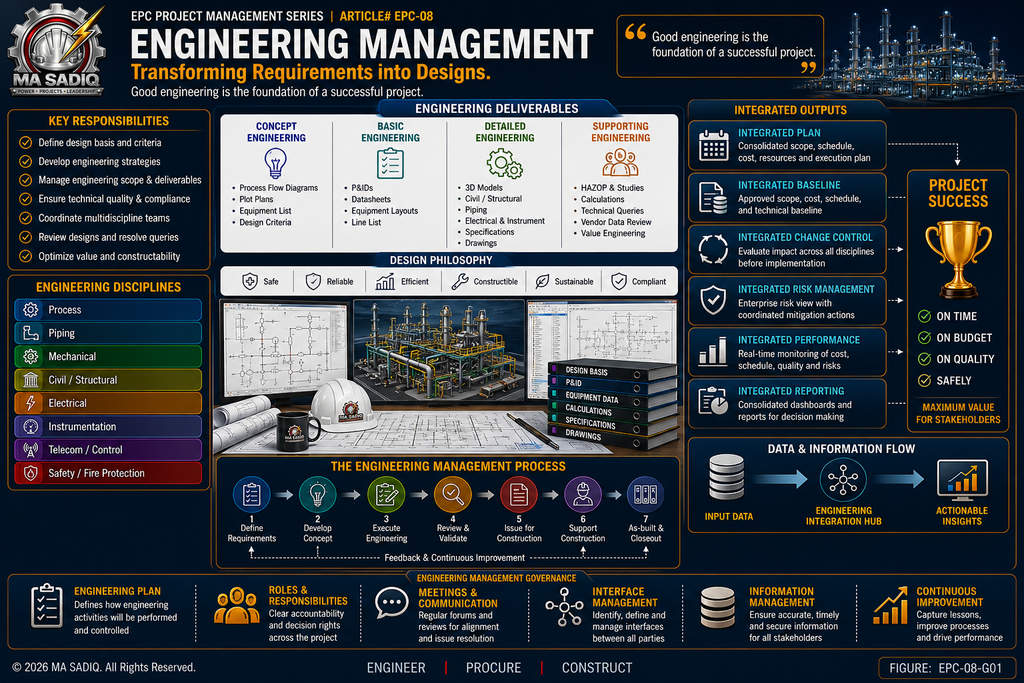
⚙️ 1. INTRODUCTION — WHY ENGINEERING MANAGEMENT MATTERS?
Every EPC project begins with requirements. An Owner has a business need. A contract establishes obligations. Technical specifications define performance expectations. Codes and standards establish minimum requirements. Operating conditions, site conditions, interfaces, statutory requirements, and project objectives add further constraints.
But requirements alone do not create a project.
They must be transformed into a coherent technical solution that can ultimately be procured, constructed, tested, commissioned, operated, and maintained.
This is where Engineering Management becomes fundamental.
Engineering provides the technical foundation of an EPC project. It translates project requirements into design criteria, engineering calculations, drawings, specifications, equipment definitions, system configurations, technical studies, and other controlled deliverables.
However, engineering is not simply the production of drawings and documents. It is a coordinated management process involving multiple disciplines, interfaces, reviews, technical decisions, vendor information, project changes, and continuous interaction with Procurement, Construction, Commissioning, Quality, HSE, Project Controls, and other project functions.
A useful way to view the engineering journey is:
Requirements → Engineering Basis → Design Development → Coordination → Verification → Engineering Release → Execution Support → Handover
If this process is poorly managed, problems created during engineering can propagate into procurement, construction, commissioning, schedule, cost, quality, and ultimately project performance.
Effective Engineering Management therefore seeks to ensure that the right technical solution is developed, properly coordinated, adequately verified, correctly documented, and released at the right time for project execution.
🏗️ 2. WHAT IS ENGINEERING MANAGEMENT?
Engineering Management is the structured planning, coordination, control, review, and delivery of engineering activities required to convert project requirements into technically sound, coordinated, compliant, and execution-ready engineering deliverables.
Engineering Management is more than design. A project may have highly capable engineers and still experience engineering-related project problems if requirements are unclear, design criteria are inconsistent, disciplines are not properly coordinated, interfaces are overlooked, deliverables are released prematurely, vendor information is not incorporated, technical queries remain unresolved, or design changes are poorly controlled.
Engineering Management provides the structure through which these activities are planned and controlled.
It connects technical work with project execution. Engineering defines equipment and technical requirements; Procurement uses those requirements to obtain equipment, materials, and services; Construction uses approved engineering information to install and build; Testing & Commissioning uses engineering information to verify systems; and Handover requires complete and controlled technical documentation.
Major dimensions include engineering planning, requirements management, design basis development, engineering development, multidiscipline coordination, deliverable management, technical reviews, verification and validation, interfaces, vendor engineering, progress management, technical queries, change management, information and document management, procurement support, construction support, and commissioning/handover support.
The exact organization and responsibilities vary by project, contract, organization, and industry. The underlying principle remains consistent: Engineering Management creates controlled technical progression from project requirements to an executable design.
🎯 3. ENGINEERING OBJECTIVES IN EPC PROJECTS
Engineering exists to establish the technical foundation from which the project can be executed successfully. Its objectives therefore extend beyond producing technically correct documents.
3.1 Meet Project Requirements
Engineering must translate contractual, functional, technical, regulatory, and Owner requirements into a coherent design. This includes understanding not only what the project requires, but also the conditions and constraints under which the requirements must be achieved.
3.2 Establish a Sound Engineering Basis
Engineering should establish a clear technical foundation for design development. Typical elements include Design Basis, Design Criteria, Basis of Design, Engineering Design Philosophy, Operating Philosophy, Control Philosophy, design and operating conditions, applicable codes and standards, design life, design margins, battery limits, and tie-in points. A weak or incomplete engineering basis can create uncertainty throughout subsequent design stages.
3.3 Develop Coordinated Engineering Deliverables
Engineering deliverables are produced by different disciplines and at different stages. A project therefore needs more than technically competent individual disciplines; it needs coordination between them. Engineering Management must ensure that discipline outputs form a coherent overall design.
3.4 Support Procurement
Engineering must provide sufficient and controlled technical information for Procurement, including equipment specifications, datasheets, material requirements, technical requisitions, technical evaluation criteria, vendor document requirements, and material quantities. Engineering must also review and incorporate relevant vendor information.
3.5 Support Construction
Construction needs engineering information that is sufficiently developed, reviewed, coordinated, approved, and released for execution. This may include construction drawings, specifications, approved technical documents, technical clarifications, site queries, RFIs, field engineering, design changes, redlines, and as-built information.
3.6 Support Commissioning and Handover
Engineering information continues to have value during testing, pre-commissioning, commissioning, start-up, performance testing, system handover, and final documentation. Complete and accurate engineering records become particularly important when the project transitions from construction into operation.
3.7 Control Technical Risk
Engineering Management should provide mechanisms for identifying and addressing incomplete requirements, design assumptions, interface conflicts, inadequate technical information, constructability concerns, operability concerns, vendor data delays, late design changes, and code or specification conflicts. The objective is not to eliminate every uncertainty, but to ensure significant technical uncertainties are identified, assessed, controlled, and resolved at an appropriate stage.
🔧 4. ENGINEERING MANAGEMENT FRAMEWORK
Engineering Management can be viewed as a structured progression from requirements to execution.
4.1 Requirements
Understand what the project must achieve. Inputs may include contract requirements, Owner requirements, functional requirements, technical specifications, codes and standards, site conditions, operating requirements, and regulatory requirements.
4.2 Engineering Basis
Establish the technical foundation. Typical elements include Design Basis, Design Criteria, Basis of Design, engineering philosophies, design and operating conditions, design life, design margins, battery limits, and interfaces.
4.3 Engineering Development
Develop the selected technical solution through the applicable engineering stages. Depending on the project, Owner, industry, and contract model, front-end stages may include Concept Engineering, Concept Selection, Pre-FEED, FEED, Basic Engineering, or combinations of these stages.
4.4 Multidiscipline Coordination
Bring individual discipline designs together through interface management, interdisciplinary checks, design coordination, model reviews, and clash detection.
4.5 Technical Assurance
Determine whether the developing design satisfies its requirements and is sufficiently mature for its intended use through appropriate design reviews, technical reviews, verification, validation, code compliance checks, constructability reviews, operability reviews, maintainability reviews, and safety studies.
4.6 Engineering Deliverables
Produce and control drawings, calculations, specifications, datasheets, reports, models, schedules, technical requisitions, material quantities, and other information required to execute the project.
4.7 Engineering Release
Engineering deliverables progress through applicable review and approval processes before release. Depending on project terminology, statuses may include IFR, IFA, IFI, or IFC.
4.8 Execution Support
Engineering continues to support Procurement, Construction, Testing & Commissioning, and Handover.
Engineering Management is not a single activity performed before construction. It is a controlled technical process that develops and supports the project throughout its lifecycle.
📐 5. ENGINEERING REQUIREMENTS & DESIGN BASIS
Engineering does not begin with drawings. It begins with understanding what the project is required to achieve.
An EPC project may contain requirements originating from the Owner, contract, applicable legislation, technical specifications, codes and standards, site conditions, operating philosophy, performance guarantees, existing facilities, and interfaces with other systems or projects.
Engineering Management must bring these requirements together and establish a controlled technical basis from which the design can develop.
5.1 From Requirements to Design
Project Requirements → Design Basis & Criteria → Engineering Philosophies → Engineering Development → Design Deliverables
If requirements are misunderstood or remain ambiguous, the resulting design may need repeated clarification and revision. Requirements should therefore be identified, reviewed, interpreted, documented, communicated to relevant disciplines, and controlled throughout engineering development.
5.2 Design Basis
The Design Basis establishes the fundamental technical assumptions, conditions, criteria, and requirements used to develop the design.
Design conditions
Operating conditions
Environmental conditions
Applicable codes and standards
Design life
Design margins
Capacity requirements
Performance requirements
Materials requirements
Utility requirements
Battery limits
Tie-in points
Existing-facility constraints
Some organizations may use terms such as Basis of Design (BOD) or Design Basis Memorandum (DBM) for particular documents or purposes. The important principle is not the document title; it is the existence of a clear and controlled technical basis for design.
5.3 Engineering and Design Philosophies
Engineering philosophies establish how particular technical aspects of the project are intended to be approached. Examples include Electrical Design Philosophy, Instrumentation & Control Philosophy, Process Design Philosophy, Equipment Design Philosophy, Piping Design Philosophy, Control Philosophy, and Operating Philosophy. These documents help maintain consistency across disciplines and engineering deliverables.
5.4 Battery Limits and Interfaces
Battery limits define boundaries between systems, facilities, packages, or project scopes. Tie-in points identify physical or functional connection points to existing or other project facilities. Poorly defined boundaries can create gaps or overlaps in responsibility. These are engineering-management questions as much as technical questions.
🧭 6. CONCEPT & FRONT-END ENGINEERING
Engineering development normally progresses through increasing levels of definition and maturity. Depending on the project, this may include Concept Engineering, Concept Selection, Pre-FEED, FEED, Basic Engineering, or combinations of these stages. These stages are not universally identical across all industries or contracts; their scope and boundaries depend on the Owner, project type, industry practice, contract strategy, and execution model.
6.1 Concept Engineering
Concept Engineering explores potential technical solutions to satisfy the project need, considering technology, capacity, configuration, equipment arrangement, process/system architecture, site considerations, major interfaces, and execution constraints.
6.2 Concept Selection
Where alternatives exist, the project may undertake structured concept selection. Factors may include technical feasibility, performance, safety, reliability, operability, maintainability, constructability, schedule, cost, site constraints, and future expansion.
6.3 Pre-FEED
Pre-FEED is commonly used to describe engineering performed before formal FEED, where applicable. It may further develop the selected concept and resolve important technical questions before FEED. Its exact scope varies considerably between projects.
6.4 FEED — Front-End Engineering Design
FEED is the engineering stage in which the selected project concept is developed to a level sufficient to establish and mature the technical basis for subsequent project execution. FEED typically develops engineering requirements, design criteria, major equipment and system definitions, preliminary layouts, technical specifications, key interfaces, engineering quantities, technical studies, and execution inputs.
FEED and Basic Engineering — An Important Distinction
FEED and Basic Engineering are closely related front-end engineering concepts, but they are not universally interchangeable. In some projects, FEED constitutes the principal basic engineering package; in others, Basic Engineering is treated as a distinct stage that further develops the engineering basis before Detailed Engineering. Accordingly, the definitions established by the applicable Owner, contract, project procedures, and execution strategy should govern.
🏗️ 7. BASIC ENGINEERING & DETAILED ENGINEERING
As the project progresses from front-end definition toward execution, engineering develops the selected solution to increasing levels of technical definition and maturity.
7.1 Basic Engineering
Where Basic Engineering is treated as a distinct stage, it develops the selected project solution into a sufficiently defined technical framework for Detailed Engineering and subsequent execution activities. Depending on the project, it may establish system definitions, major equipment requirements, engineering criteria, preliminary or developed layouts, process/system documentation, equipment information, technical specifications, design calculations, and interfaces.
7.2 Detailed Engineering
Detailed Engineering converts the approved engineering basis into the detailed technical deliverables required to execute the project. Depending on the discipline and project, these may include detailed drawings, equipment datasheets, specifications, calculations, cable schedules, instrument schedules, P&IDs, single-line diagrams, structural details, piping isometrics, wiring diagrams, construction drawings, material quantities, technical reports, and 3D models.
7.3 Engineering Maturity
Engineering development should progressively increase design maturity: Definition → Development → Coordination → Verification → Approval → Release. The objective is not simply to produce more documents, but to increase the reliability and completeness of technical information needed for execution. Engineering progress should therefore be considered together with engineering maturity.
🔄 8. DETAILED ENGINEERING & MULTIDISCIPLINE COORDINATION
EPC engineering is inherently multidisciplinary. Typical disciplines include Process, Mechanical, Piping, Civil, Structural, Electrical, Instrumentation & Control, Telecom, HVAC, Fire Protection, Architectural, Materials/Metallurgy, HSE/Safety, and Environmental.
8.1 Why Coordination Matters
Each discipline has its own technical responsibilities, but the project has one physical and functional system. For example, equipment information affects electrical supply, instrumentation and control, civil/structural loads, piping connections, layout, and construction. The engineering question is therefore not only whether each discipline’s design is technically correct, but whether the discipline designs work together.
8.2 Interdisciplinary Checks
Interdisciplinary checks, often referred to as IDC, provide a structured mechanism for reviewing interfaces between engineering disciplines. They can verify consistency of equipment information, dimensions, interfaces, electrical loads, instrumentation requirements, structural provisions, drawings, and schedules.
8.3 3D Model Review and Clash Detection
Where a 3D model is used, model reviews can identify physical clashes, access limitations, maintenance clearances, equipment accessibility, routing conflicts, structural interference, and construction-access issues. A technically valid model can therefore become an important coordination and constructability tool.
8.4 Interface Engineering
Engineering interfaces occur at boundaries between systems, disciplines, contractors, packages, or existing facilities. Effective Interface Engineering requires clear ownership, defined interface points, agreed technical requirements, controlled information exchange, and timely resolution of interface issues. This is a direct connection between EPC-08 and EPC-07 Integration Management.
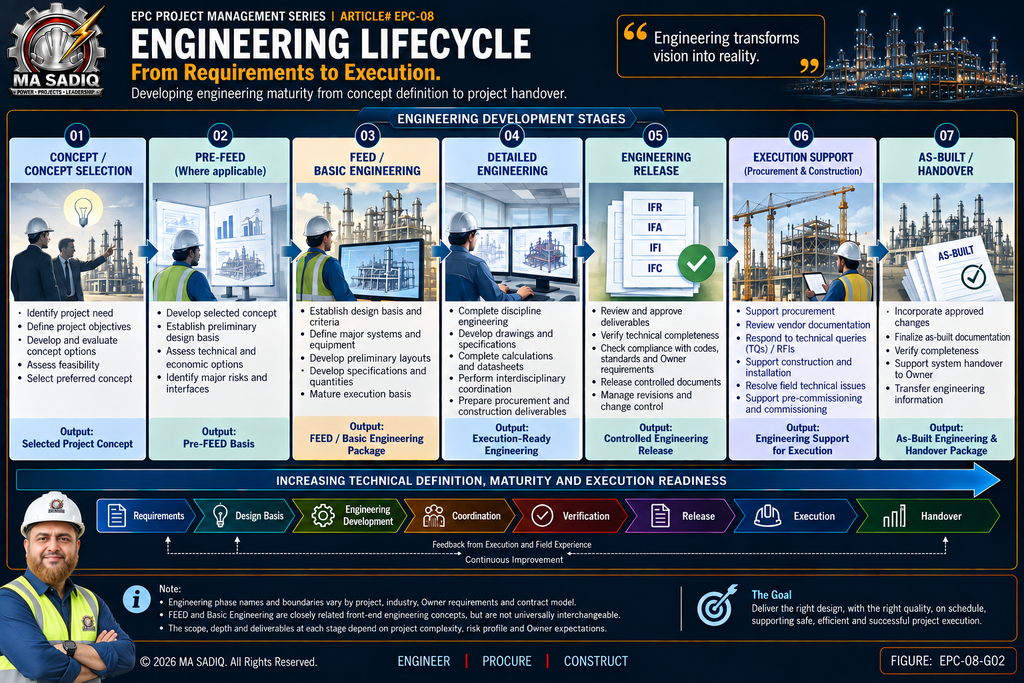
Figure EPC-08-G02 — Engineering Lifecycle & Deliverable Flow
📋 9. ENGINEERING DELIVERABLES
Engineering ultimately produces information that enables the project to make decisions and execute work.
9.1 Drawings and Models
General Arrangement drawings
Layouts
Plot plans
PFDs
P&IDs
Single-Line Diagrams
Schematics
Wiring diagrams
Piping isometrics
Structural drawings
Construction drawings
3D models
9.2 Technical Documents
Design calculations
Engineering reports
Design criteria
Technical specifications
Equipment datasheets
System descriptions
Design philosophies
Control philosophies
Cause & Effect documents
Technical studies
9.3 Procurement Engineering Deliverables
Material Requisitions
Equipment specifications
Technical datasheets
Technical requisitions
Material Take-Offs (MTO)
Bills of Quantities (BOQ)
Vendor document requirements
MTO and BOQ are not interchangeable terms, and their application varies by discipline and project. The relevant project definitions should govern their use.
9.4 Vendor Engineering Information
Vendor drawings
Vendor datasheets
Certified documents
Manufacturer data
Technical clarifications
Vendor calculations
Inspection documentation
Vendor information must be reviewed and incorporated into the project design where applicable. This creates a controlled feedback loop: Engineering → Procurement → Vendor → Engineering.
🔗 10. ENGINEERING INTERFACES WITH PROCUREMENT & CONSTRUCTION
Engineering, Procurement, and Construction are highly interconnected. Engineering establishes technical requirements; Procurement converts those requirements into purchased equipment, materials, and services; Construction converts approved engineering information into physical installation.
10.1 Engineering → Procurement
Technical specifications
Equipment datasheets
Material requirements
Technical requisitions
Technical evaluation criteria
MTOs
BOQs
Vendor document requirements
10.2 Technical Bid Evaluation
Engineering frequently participates in Technical Bid Evaluation (TBE) to assess whether proposed vendor solutions satisfy applicable technical requirements, including compliance, deviations, exceptions, alternatives, performance, standards, equipment characteristics, and interfaces. Commercial evaluation remains a separate procurement responsibility.
10.3 Vendor Data
After award, vendors produce technical information such as drawings, datasheets, general arrangements, interface information, electrical data, instrument data, and control information. A Vendor Document Requirement List (VDRL) or equivalent may define and track expected information. Vendor data can affect multiple disciplines and must therefore be integrated into Engineering Management.
10.4 Engineering → Construction
Construction requires engineering information that is sufficiently mature and released for its intended use, including IFC drawings, approved specifications, construction details, installation information, technical clarifications, and approved vendor data. IFC — Issued for Construction — is commonly used, although document-status terminology varies.
10.5 Construction → Engineering
Site queries
RFIs
Field changes
Redlines
Constructability feedback
As-built information
Engineering must evaluate these inputs and determine whether technical action, clarification, revision, or formal change control is required. Engineering therefore continues to support execution.
Engineering ↔ Procurement ↔ Vendor Engineering ↔ Construction ↔ Commissioning & Handover
🔍 11. ENGINEERING REVIEW, VERIFICATION & VALIDATION
Engineering deliverables should not move directly from design development to execution without appropriate technical review. Review should determine whether the design is technically appropriate, consistent with requirements, compliant with applicable codes and standards, coordinated, suitable for its intended purpose, and sufficiently mature for the intended stage.
11.1 Engineering Review
Design Review
Technical Review
Interdisciplinary Review
Constructability Review
Operability Review
Maintainability Review
Safety Review
A review should not become merely an administrative approval exercise. Its value comes from identifying issues while they can still be resolved efficiently.
11.2 Verification
Design Verification generally asks whether the engineering output satisfies specified requirements and established design criteria. It may involve calculations, drawing checks, independent checking, code compliance, design-criteria checks, and interdisciplinary checks.
11.3 Validation
Design Validation addresses whether the resulting design is suitable for its intended application or operational purpose. Verification and validation are related but different: verification asks whether the design was developed correctly against requirements; validation asks whether the resulting design is suitable for its intended purpose. Exact terminology and formal processes vary by organization and project.
11.4 Technical Assurance
Technical assurance provides confidence that engineering processes and outputs meet required standards of quality, compliance, and technical integrity. Depending on project requirements, it may include HAZID, HAZOP, SIL assessment, LOPA, Design Safety Review, Fire and Safety Studies, Reliability Studies, and Constructability Reviews. These activities should be applied according to project scope and risk.
📊 12. ENGINEERING PROGRESS & PERFORMANCE MANAGEMENT
Engineering progress is often misunderstood when measured only by document counts. Producing 90 of 100 documents does not necessarily mean 90% engineering maturity if many documents remain under review, require major revisions, or cannot support procurement or construction.
Engineering progress should measure meaningful engineering achievement, not merely document production.
12.1 Engineering Deliverable Register
Deliverable number
Description
Discipline
Planned issue date
Actual issue date
Revision
Review status
Approval status
Current status
Responsible discipline
Required action
12.2 Engineering Schedule
Engineering activities should be integrated into the project schedule, including engineering start, design-basis approval, major reviews, key deliverables, procurement engineering milestones, vendor document dates, IFC release, engineering completion, and as-built completion. Dependencies should also be reflected.
12.3 Progress Measurement
Engineering progress may be measured using deliverable weighting, milestones, engineering manhours, planned versus actual progress, productivity, progress curves, forecast completion, critical deliverables, and backlog. The methodology should be defined consistently.
12.4 Engineering Productivity
Engineering performance is influenced by resources, workload, complexity, technical maturity, information availability, review cycles, vendor data, and changes. A productivity decline may indicate an underlying project issue; Engineering Management should look for the cause, not only the number.
📁 13. ENGINEERING INFORMATION & DOCUMENT MANAGEMENT
Engineering produces an enormous volume of project information. Without proper information control, even technically correct engineering can become difficult to use.
13.1 Engineering Document Register
Document number
Title
Discipline
Revision
Status
Planned issue date
Actual issue date
Review status
Approval status
Distribution
Superseded revisions
13.2 Document Status and Revision
IFR — Issued for Review
IFA — Issued for Approval
IFI — Issued for Information
IFC — Issued for Construction
Other organizations may use different status codes or definitions. Everyone involved should understand what a document means, what it can be used for, and whether it is the current controlled revision.
13.3 Controlled Engineering Information
An obsolete drawing, outdated specification, or outdated control document can create physical, procurement, or commissioning problems. Document control is therefore part of technical risk control.
13.4 Single Source of Truth
Projects increasingly use a Common Data Environment (CDE) or equivalent controlled information environment to provide reliable current information with appropriate revision control, access control, approval status, distribution, and traceability.
13.5 As-Built and Handover Information
Engineering information must ultimately reflect the facility actually constructed and commissioned. Construction changes, approved field modifications, and final installation information may need to be incorporated into As-Built, As-Installed, As-Constructed, O&M, commissioning, and handover documentation. Terminology varies by project; the objective is a final technical record representing the delivered asset.
⚠️ 14. ENGINEERING RISKS & TECHNICAL QUERIES
Engineering development involves uncertainty. Requirements may be incomplete, vendor information unavailable, existing-facility data inaccurate, interfaces undefined, or assumptions later proven incorrect. Engineering Management must provide mechanisms for identifying and resolving these issues.
14.1 Typical Engineering Risks
Incomplete design inputs
Unclear requirements
Missing site information
Conflicting specifications
Late vendor information
Interface gaps
Design assumptions
Late design changes
Inadequate design maturity
Constructability problems
Procurement-driven changes
Unresolved review comments
14.2 Technical Queries
A Technical Query (TQ) is commonly used to obtain clarification or resolution of an engineering issue. Related mechanisms may include Technical Clarification, RFI, Design Query, Site Query, Engineering Comment, and Review Comment.
What is unclear?
What information is required?
Why is the information required?
What part of the project is affected?
What is the required response date?
14.3 Technical Deviations and Exceptions
A proposed solution may differ from a specified requirement. Mechanisms such as Technical Deviation, Technical Exception, or Concession may therefore be used. Such departures should be formally assessed and approved according to project procedures and contractual requirements.
14.4 NCR and Engineering
A Non-Conformance Report (NCR) may arise where work, material, or documentation does not comply with specified requirements. Engineering may be involved in determining technical acceptability, corrective action, repair requirements, disposition, and design implications.
🔄 15. ENGINEERING CHANGES & DESIGN DEVELOPMENT
Engineering is rarely completely static. As the project develops, new information becomes available, including updated Owner requirements, vendor information, site discoveries, regulatory changes, constructability findings, interface resolution, design optimization, technical corrections, procurement decisions, and construction requirements.
Some changes may be minor; others can affect scope, cost, schedule, procurement, construction, commissioning, safety, and quality. Engineering change must therefore be integrated with overall project change control.
15.1 Engineering Change
An Engineering Change is a controlled modification to an approved or developing engineering solution. Depending on the project, this may be managed through a Change Request, Engineering Change Request, Design Change Notice, Technical Change, Change Register, or Configuration Management.
15.2 Impact Assessment
Does the change affect other disciplines?
Does it affect procurement?
Has equipment already been ordered?
Does construction need to be modified?
Does the schedule change?
Is there a cost impact?
Does it affect safety?
Does it affect commissioning?
Does it affect existing interfaces?
Does it require regulatory or Owner approval?
A technical change should not be considered only from the perspective of the initiating discipline.
15.3 Design Freeze
A design freeze establishes a maturity point after which changes require stronger justification and control because downstream work may already depend on the established design. It does not necessarily mean that change becomes impossible.
15.4 Configuration Management
Configuration Management helps maintain consistency between approved requirements, engineering design, physical implementation, modifications, and final technical records.
15.5 Engineering Maturity and Controlled Change
A mature engineering organization should not measure success by the absence of all design changes. Some changes are necessary and beneficial. The objective is to ensure that engineering changes occur for understood reasons and are controlled before they create uncontrolled downstream consequences.
Engineering maturity is not the absence of change; it is the controlled management of change.
🏛️ 16. ENGINEERING GOVERNANCE
Engineering governance establishes the framework within which engineering teams operate and helps ensure that technical decisions are consistent, responsibilities are understood, and outputs remain aligned with project requirements.
Engineering responsibilities
Discipline authority
Technical approval
Design review requirements
Applicable codes and standards
Engineering procedures
Design criteria
Document control
Technical assurance
Interface management
Engineering change control
Technical query management
Engineering progress reporting
Compliance and escalation
16.1 Technical Authority
Technical authority should be established at appropriate levels for discipline decisions, design approval, technical deviations, engineering changes, risk acceptance, interface decisions, and compliance matters. Clear authority reduces ambiguity and helps prevent technically significant decisions from being made informally.
16.2 Engineering Procedures
Engineering procedures may define requirements for design development, checking, approval, interdisciplinary review, document numbering, revision control, design changes, technical queries, vendor document review, engineering progress, and engineering release. Procedures should support engineering execution rather than create unnecessary administrative burden.
16.3 Engineering Governance and Project Integration
Engineering governance should not operate as an isolated technical system. Engineering decisions can affect scope, cost, schedule, procurement, construction, quality, HSE, commissioning, and stakeholders. Technical decisions should therefore be integrated with project decisions whenever their consequences extend beyond engineering.
👷♂️ 17. ROLE OF THE ENGINEERING MANAGER
The Engineering Manager directs and coordinates the engineering function so that it delivers the required technical outcome within project requirements, schedule, quality expectations, and execution strategy. The role combines technical leadership, engineering coordination, planning, management, and communication.
17.1 Engineering Strategy
Engineering execution strategy
Discipline organization
Engineering work processes
Deliverable strategy
Engineering schedule
Resource requirements
Review and approval strategy
Interface arrangements
Vendor engineering strategy
17.2 Engineering Team Leadership
The Engineering Manager coordinates multidisciplinary resources and establishes clear responsibilities, including assigning responsibilities, coordinating discipline leads, managing priorities, resolving interfaces, supporting technical decisions, escalating critical issues, and maintaining team alignment.
The Engineering Manager does not necessarily perform every technical calculation or design personally. The responsibility is to ensure that the engineering organization produces the required technical result.
17.3 Engineering Performance
Deliverable progress
Engineering schedule
Critical deliverables
Engineering workload
Resource utilization
Technical review status
Outstanding comments
Technical queries
Vendor information
Engineering changes
Forecast completion
17.4 Interface Leadership
Project Manager
Procurement Manager
Construction Manager
Project Controls
Quality
HSE
Commissioning
Operations/Owner representatives
Vendors
Subcontractors
Engineering cannot be effectively managed from within the engineering department alone.
17.5 Technical Risk and Change
The Engineering Manager should ensure that significant technical risks and changes are identified, communicated, assessed, coordinated, controlled, and escalated when required, helping protect design integrity throughout the EPC lifecycle.
✅ 18. PRACTICAL ENGINEERING MANAGEMENT CHECKLIST
The following checklist can be used as a practical review tool.
18.1 Before Engineering Starts
☐ Project and contractual requirements identified
☐ Owner requirements understood
☐ Applicable codes and standards identified
☐ Design basis established
☐ Design criteria established
☐ Engineering philosophies defined where required
☐ Engineering disciplines identified
☐ Engineering interfaces identified
☐ Engineering execution strategy established
☐ Engineering schedule established
☐ Engineering resources identified
18.2 During Engineering Development
☐ Requirements remain controlled
☐ Design basis remains current
☐ Engineering deliverables are tracked
☐ Multidiscipline coordination is active
☐ Interdisciplinary checks are performed
☐ Engineering reviews are completed
☐ Technical queries are tracked
☐ Vendor information is incorporated appropriately
☐ Procurement interfaces are maintained
☐ Construction interfaces are maintained
☐ Engineering progress is measured
☐ Technical risks are visible
☐ Engineering changes are controlled
18.3 Before Engineering Release
☐ Required calculations completed
☐ Required reviews completed
☐ Interdisciplinary comments resolved
☐ Applicable technical requirements verified
☐ Required approvals obtained
☐ Correct revision established
☐ Document status clearly identified
☐ Procurement implications considered
☐ Construction implications considered
☐ Engineering release requirements satisfied
18.4 During Construction & Execution Support
☐ Site queries addressed
☐ RFIs/TQs tracked
☐ Field changes evaluated
☐ Approved design changes controlled
☐ Vendor information updated where required
☐ Redlines maintained
☐ Engineering impacts of construction changes assessed
☐ As-built information captured
☐ Handover documentation progressed
💡 19. KEY TAKEAWAYS
Engineering starts with requirements—not drawings.
Engineering develops progressively. Concept, Pre-FEED, FEED, Basic Engineering, and Detailed Engineering represent stages or levels of engineering development whose exact boundaries vary by project.
Engineering is multidisciplinary. Individual discipline designs must ultimately function as one coordinated project solution.
Engineering deliverables must be more than technically correct. They must be appropriately reviewed, coordinated, controlled, and released for their intended purpose.
Engineering directly influences Procurement and Construction. Technical requirements, vendor information, construction drawings, technical queries, and field changes create continuous interfaces across EPC functions.
Engineering progress must reflect meaningful technical achievement. Document production alone does not necessarily represent engineering maturity.
Engineering changes must be controlled. The objective is not to eliminate every change, but to ensure that changes are understood, assessed, approved, implemented, and traceable.
Engineering continues throughout the project lifecycle. Engineering supports Procurement, Construction, Testing & Commissioning, and final Handover.
Ultimately: Engineering Management protects the technical integrity of the project from requirements through design development and execution to final handover.
💬 DISCUSSION QUESTION
In your EPC experience, which engineering-management challenge creates the greatest downstream impact: unclear requirements, weak multidiscipline coordination, late vendor information, inadequate document control, or uncontrolled engineering changes—and what practical approach helped resolve it?
🏁 CONCLUSION
Engineering is where project requirements begin their transformation into a physical and functional solution.
From concept development and FEED through Basic and Detailed Engineering, multiple disciplines progressively develop the technical definition of the project.
But successful engineering requires more than technical competence.
Clear requirements. A sound design basis. Multidiscipline coordination. Effective technical assurance. Controlled information. Integrated interfaces. Measured progress. Controlled change.
Engineering must ultimately produce information that others can rely upon.
Procurement depends on engineering to define what must be purchased. Construction depends on engineering to define what must be built. Commissioning depends on engineering to define what must be tested and verified. Operation depends on engineering records to understand what has ultimately been delivered.
Therefore:
Engineering Management is the bridge between project requirements and project execution.
When that bridge is properly planned, coordinated, reviewed, and controlled, engineering becomes more than a document-producing function. It becomes a foundation for safe, coordinated, constructible, and executable EPC delivery.
📚 GLOSSARY — KEY ENGINEERING TERMS
The following glossary provides concise working definitions of key terms used in this article. Terminology, document-status codes, and phase boundaries can vary by project, Owner, organization, industry, and contract model.
FEED — Front-End Engineering Design; the engineering stage used to develop and mature the technical basis for subsequent project execution.
Pre-FEED — Front-end engineering work undertaken before FEED, where applicable, to develop or assess the project concept and prepare for FEED.
Basic Engineering — Engineering that establishes or further develops the technical basis, systems, major equipment, design criteria, and other information needed for subsequent detailed engineering; its relationship to FEED varies by project.
Detailed Engineering — Engineering development that converts the approved technical basis into sufficiently detailed, coordinated drawings, specifications, calculations, datasheets, models, and other deliverables for procurement, construction, commissioning, and handover.
Design Basis — The documented technical foundation defining the assumptions, requirements, criteria, conditions, and constraints governing engineering design.
BOD — Basis of Design; a documented statement of the design approach, criteria, assumptions, and technical basis used to develop the engineering solution.
DBM — Design Basis Memorandum; a project document used to formally record and communicate the design basis, where required.
IDC — Interdisciplinary Check; a structured review of engineering deliverables by relevant disciplines to identify and resolve technical interfaces and inconsistencies.
IFR / IFA / IFI / IFC — Common document-status designations such as Issued for Review, Issued for Approval, Issued for Information, and Issued for Construction. Exact meanings and approval workflows are project-specific.
MTO — Material Take-Off; a quantified listing of materials or equipment derived from engineering deliverables for planning, procurement, estimating, or construction purposes.
BOQ — Bill of Quantities; a structured schedule of quantified work or materials, commonly used for commercial, tendering, or construction purposes.
TBE — Technical Bid Evaluation; the technical assessment of supplier or contractor bids against specified requirements.
VDRL — Vendor Document Requirements List; a controlled list defining vendor documents and information required for review, approval, records, or handover.
TQ — Technical Query; a formal request for technical clarification or resolution of an engineering issue.
RFI — Request for Information; a formal request for clarification or information, often arising during procurement, construction, or execution.
NCR — Nonconformance Report; a formal record of a product, process, document, or activity that does not conform to specified requirements.
CDE — Common Data Environment; a controlled information environment used to manage, share, review, and distribute project information.
HAZID — Hazard Identification; a structured process for identifying potential hazards and associated risks.
HAZOP — Hazard and Operability Study; a structured examination of a process or system to identify deviations, their causes, consequences, and safeguards.
SIL — Safety Integrity Level; a measure used in functional-safety applications to specify the required risk-reduction performance of a safety instrumented function.
LOPA — Layer of Protection Analysis; a semi-quantitative method used to assess risk and the effectiveness of independent protection layers.
📖 REFERENCES
The following references and frameworks provide relevant professional context. Requirements, terminology, and applicability should always be confirmed against the governing project documents, Owner requirements, contract, and applicable codes and standards.
ISO 9001 — Quality management systems — Requirements.
ISO 10006 — Quality management — Guidelines for quality management in projects.
ISO 21502 — Project, programme and portfolio management — Guidance on project management.
Applicable IEC, IEEE, ISA, ASME, API, NFPA and other discipline standards — Applied as relevant to the engineering discipline, project scope, jurisdiction, and Owner requirements.
Owner specifications and project engineering requirements — Project-specific design criteria, technical specifications, engineering procedures, document-control requirements, and other governing requirements.
EPC contract and execution requirements — Contractual requirements governing engineering deliverables, reviews, approvals, interfaces, procurement support, construction support, and handover.
➡️ NEXT IN THE SERIES
EPC-09 — Procurement Management — From Engineering Requirements to Project Resources
Engineering defines technical requirements; Procurement takes those requirements into the marketplace and transforms them into equipment, materials, and services.
🌱 Learn → Share → Grow
Knowledge becomes more valuable when it is shared.
This article is part of the MASADIQ EPC Project Management Series.
👨💼 ABOUT THE AUTHOR
Engr. Muhammad Akram Sadiq is a Senior Electrical Engineer and Project Management Professional (PMP®) with over 30 years of international experience in engineering, construction, commissioning, operation & maintenance, instrumentation & control, and project management.
Throughout his career, he has contributed to major power generation, transmission substations, and industrial infrastructure projects with a strong focus on technical excellence, leadership, quality, safety, and continuous improvement.
Through his professional brand MA SADIQ, he is committed to transforming practical engineering experience into structured knowledge that empowers engineers, project professionals, and future leaders to achieve engineering excellence.
🏗️ ABOUT THE EPC PROJECT MANAGEMENT SERIES
The MASADIQ EPC Project Management Series is a structured educational publication developed to provide engineers, project managers, students, and industry professionals with practical knowledge covering the principles and practices of EPC project management.
Each article explores a specific EPC topic, progressing systematically from foundational concepts to advanced project-management practices while emphasizing practical experience, professional excellence, leadership, and continuous learning.
The series aims to bridge the gap between project-management principles and the realities of engineering, procurement, construction, commissioning, and project delivery.
⚠️ DISCLAIMER
This publication is intended solely for educational and professional development purposes.
Although every effort has been made to ensure the accuracy and usefulness of the information presented, project requirements, engineering codes, standards, contractual frameworks, market conditions, regulations, and management practices may vary and are periodically revised.
Readers should always consult the latest official editions of relevant publications, applicable legislation, client specifications, contractual requirements, organizational procedures, and project-specific requirements before applying any information to engineering or project-management activities.
The examples and recommendations presented in this article are intended to support professional learning and constructive discussion. They should not be considered a substitute for project-specific engineering, commercial, financial, legal, regulatory, or management judgment.
The views expressed are those of the author and are intended to promote professional learning and constructive discussion.
— THE END —