📘 𝗣𝗠𝗣 𝗦𝗲𝗿𝗶𝗲𝘀 | 𝗔𝗿𝘁𝗶𝗰𝗹𝗲 𝗣𝗠𝗣-𝟬𝟰
⚠️ 𝗥𝗶𝘀𝗸 𝗜𝘀 𝗡𝗼𝘁 𝘁𝗵𝗲 𝗦𝗮𝗺𝗲 𝗮𝘀 𝗨𝗻𝗰𝗲𝗿𝘁𝗮𝗶𝗻𝘁𝘆 — 𝗨𝗻𝗱𝗲𝗿𝘀𝘁𝗮𝗻𝗱𝗶𝗻𝗴 𝗣𝗿𝗼𝗷𝗲𝗰𝘁 𝗨𝗻𝗰𝗲𝗿𝘁𝗮𝗶𝗻𝘁𝘆
Dear Friends and Professionals,
🤝 𝗚𝗿𝗲𝗲𝘁𝗶𝗻𝗴𝘀! I hope you are doing well!
I am pleased to share 𝗔𝗿𝘁𝗶𝗰𝗹𝗲 𝗣𝗠𝗣-𝟬𝟰 of the PMP Series.
Imagine an EPC project where a critical equipment delivery may be delayed, a client requirement has two interpretations, several technical systems interact in unpredictable ways, and resource availability is changing rapidly.
𝗔𝗿𝗲 𝗮𝗹𝗹 𝗼𝗳 𝘁𝗵𝗲𝘀𝗲 𝘀𝗶𝘁𝘂𝗮𝘁𝗶𝗼𝗻𝘀 𝘀𝗶𝗺𝗽𝗹𝘆 “𝗿𝗶𝘀𝗸𝘀”?
Not necessarily.
𝗥𝗶𝘀𝗸 𝗶𝘀 𝗼𝗻𝗲 𝗳𝗼𝗿𝗺 𝗼𝗳 𝗽𝗿𝗼𝗷𝗲𝗰𝘁 𝘂𝗻𝗰𝗲𝗿𝘁𝗮𝗶𝗻𝘁𝘆 — 𝗯𝘂𝘁 𝘂𝗻𝗰𝗲𝗿𝘁𝗮𝗶𝗻𝘁𝘆 𝗶𝘀 𝗯𝗿𝗼𝗮𝗱𝗲𝗿 𝘁𝗵𝗮𝗻 𝗿𝗶𝘀𝗸.
This article explores how 𝗿𝗶𝘀𝗸, 𝗮𝗺𝗯𝗶𝗴𝘂𝗶𝘁𝘆, 𝗰𝗼𝗺𝗽𝗹𝗲𝘅𝗶𝘁𝘆, 𝗮𝗻𝗱 𝘃𝗼𝗹𝗮𝘁𝗶𝗹𝗲 𝗰𝗼𝗻𝗱𝗶𝘁𝗶𝗼𝗻𝘀 can appear together—and why recognizing what is actually happening matters more than putting every unknown into a risk register.
📚 𝗜𝗻 𝘁𝗵𝗶𝘀 𝗮𝗿𝘁𝗶𝗰𝗹𝗲, 𝘆𝗼𝘂’𝗹𝗹 𝗹𝗲𝗮𝗿𝗻:
✅ Why uncertainty is broader than risk.
✅ How to distinguish 𝗥𝗶𝘀𝗸, 𝗔𝗺𝗯𝗶𝗴𝘂𝗶𝘁𝘆, 𝗖𝗼𝗺𝗽𝗹𝗲𝘅𝗶𝘁𝘆, 𝗮𝗻𝗱 𝗩𝗼𝗹𝗮𝘁𝗶𝗹𝗲 𝗖𝗼𝗻𝗱𝗶𝘁𝗶𝗼𝗻𝘀.
✅ How different uncertainty patterns can coexist and evolve.
✅ Why complexity is more than a technically difficult problem.
✅ Why PMP questions require diagnosis and judgment—not keyword matching.
✅ Common PMP traps involving risk, issues, ambiguity, complexity, and volatility.
✅ The practical 𝗖𝗹𝗮𝘀𝘀𝗶𝗳𝘆 → 𝗨𝗻𝗱𝗲𝗿𝘀𝘁𝗮𝗻𝗱 → 𝗥𝗲𝘀𝗽𝗼𝗻𝗱 → 𝗥𝗲𝗮𝘀𝘀𝗲𝘀𝘀 framework.
Whether you are a student, PMP aspirant, engineer, project professional, or experienced project leader, I hope this article provides practical knowledge for PMP preparation and real-world project management.
🌐 𝗥𝗲𝗮𝗱 𝘁𝗵𝗲 𝗙𝘂𝗹𝗹 𝗔𝗿𝘁𝗶𝗰𝗹𝗲:
💡 𝗞𝗲𝘆 𝗺𝗲𝘀𝘀𝗮𝗴𝗲:
𝗗𝗼𝗻’𝘁 𝗮𝘀𝗸 𝗼𝗻𝗹𝘆, “𝗜𝘀 𝘁𝗵𝗶𝘀 𝗮 𝗿𝗶𝘀𝗸?”
𝗔𝘀𝗸, “𝗪𝗵𝗮𝘁 𝗶𝘀 𝗿𝗲𝗮𝗹𝗹𝘆 𝗴𝗼𝗶𝗻𝗴 𝗼𝗻 — 𝗮𝗻𝗱 𝘄𝗵𝗮𝘁 𝘀𝗵𝗼𝘂𝗹𝗱 𝗜 𝗱𝗼 𝗻𝗲𝘅𝘁?”
💬 𝗗𝗶𝘀𝗰𝘂𝘀𝘀𝗶𝗼𝗻 𝗤𝘂𝗲𝘀𝘁𝗶𝗼𝗻
𝗜𝗻 𝘆𝗼𝘂𝗿 𝗽𝗿𝗼𝗷𝗲𝗰𝘁𝘀, 𝗵𝗮𝘃𝗲 𝘆𝗼𝘂 𝗲𝘃𝗲𝗿 𝗲𝗻𝗰𝗼𝘂𝗻𝘁𝗲𝗿𝗲𝗱 𝗮 𝘀𝗶𝘁𝘂𝗮𝘁𝗶𝗼𝗻 𝘁𝗵𝗮𝘁 𝘄𝗮𝘀 𝗶𝗻𝗶𝘁𝗶𝗮𝗹𝗹𝘆 𝘁𝗿𝗲𝗮𝘁𝗲𝗱 𝗮𝘀 𝗮 𝗿𝗶𝘀𝗸 — 𝗯𝘂𝘁 𝗹𝗮𝘁𝗲𝗿 𝘁𝘂𝗿𝗻𝗲𝗱 𝗼𝘂𝘁 𝘁𝗼 𝗯𝗲 𝗮𝗺𝗯𝗶𝗴𝘂𝗶𝘁𝘆, 𝗰𝗼𝗺𝗽𝗹𝗲𝘅𝗶𝘁𝘆, 𝗼𝗿 𝗮 𝗰𝘂𝗿𝗿𝗲𝗻𝘁 𝗶𝘀𝘀𝘂𝗲?
Please share your thoughts and experiences in the comments.
🙏 𝗜𝗳 𝘆𝗼𝘂 𝗳𝗶𝗻𝗱 𝘁𝗵𝗶𝘀 𝗰𝗼𝗻𝘁𝗲𝗻𝘁 𝘂𝘀𝗲𝗳𝘂𝗹, 𝗽𝗹𝗲𝗮𝘀𝗲 𝗹𝗶𝗸𝗲 𝗮𝗻𝗱 𝗿𝗲𝗽𝗼𝘀𝘁.
📘 𝗟𝗲𝗮𝗿𝗻 > 𝗦𝗵𝗮𝗿𝗲 > 𝗚𝗿𝗼𝘄
EPC Project Management Series – Article# PMP-04
RISK IS NOT THE SAME AS UNCERTAINTY
Understanding the Different Faces of Project Uncertainty

Engr. Muhammad Akram Sadiq CE (SCE), PMP® (PMI)
Sr. Electrical Engineer & Projects Manager
INTRODUCTION
Article# PMP-03 asked a simple but demanding question: What value are we trying to create?
The next question is just as important: What could affect our ability to create it?
That is where many project conversations go off track. Teams often use uncertainty, risk, issue, and change as if they mean the same thing. They do not. When everything unknown is labeled as risk, the response becomes mechanical: add it to the risk register, assign an owner, and move on. That can work for some situations, but not for all of them.
Current PMI guidance supports a broader view. Risk matters, but it sits inside a larger landscape of uncertainty. Some situations are unclear rather than risky. Some are difficult because of interdependence rather than probability. Some are shaped by fast-moving external conditions. Some shift from one form to another as the project develops.
For a project manager, the practical question is not which label sounds smartest. The question is: What is really going on here, and what should I do next?
◈ UNCERTAINTY IS BROADER THAN RISK
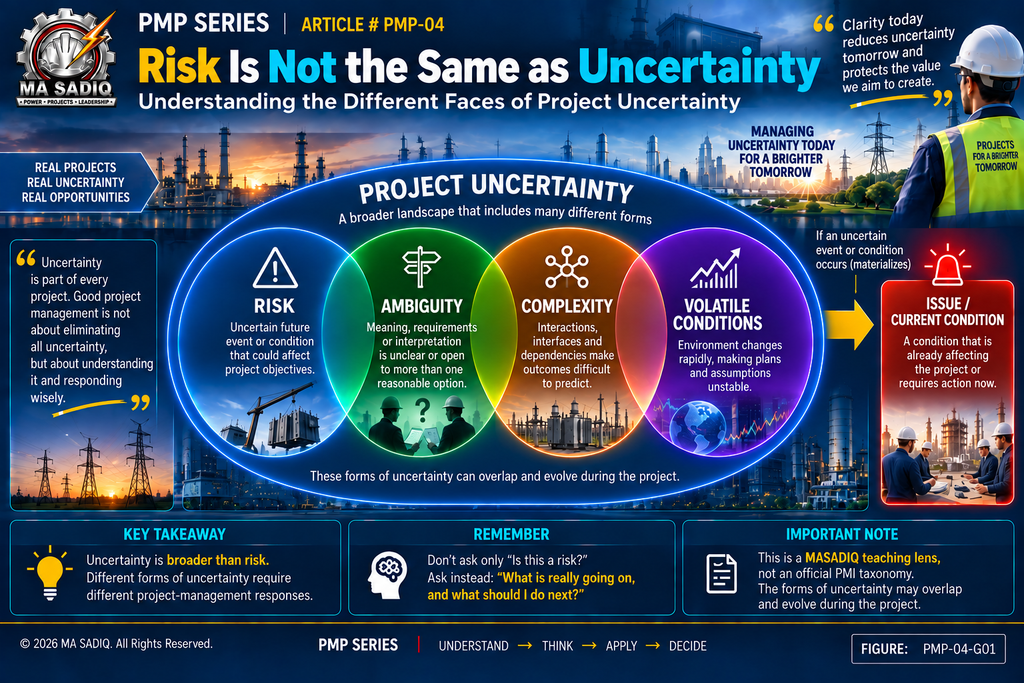
PMI defines risk as an uncertain event or condition that, if it occurs, affects one or more objectives. That is precise and useful. It tells us that risk is future-oriented and tied to impact on project objectives.
But PMI’s current treatment of uncertainty is wider than that. Uncertainty includes situations where the team does not yet fully understand the issue, the path forward, the likely outcomes, or even what problem needs solving. PMI also recognizes that ambiguous or uncertain situations do not always become risks. Some are resolved through clarification, analysis, coordination, or progressive learning before they ever need to be managed as formal risks.
That distinction matters. If a client requirement can be read in two different ways, the immediate problem may be ambiguity, not risk. If several engineering packages are individually sound but their combined behavior is difficult to predict, the central challenge may be complexity. If market conditions are shifting so quickly that last month’s assumptions no longer hold, the project may be dealing with volatility in its environment.
Risk is still part of that picture. It is just not the whole picture.
🧭 A MORE USEFUL WAY TO READ PROJECT UNCERTAINTY
For this article, MASADIQ uses four practical lenses to help diagnose uncertainty:
Risk deals with uncertain future events or conditions that could affect objectives.
Ambiguity appears when meaning is unclear, incomplete, or open to more than one reasonable interpretation.
Complexity appears when interactions, interfaces, dependencies, and system effects make outcomes difficult to predict.
Volatile conditions appear when the environment changes quickly enough that assumptions, plans, or forecasts become unstable.
These are teaching lenses, not a rigid official PMI taxonomy. Real projects do not present uncertainty in neat boxes. The same situation may contain more than one pattern at once, and a situation can evolve over time.
A requirement may begin as ambiguity, become a risk of rework, and later turn into an active issue. A supplier market may be volatile, creating multiple procurement risks. A technically integrated system may be complex even when no single component is especially difficult on its own.
The value of this lens is diagnostic. It helps the project manager match the response to the problem.
⚖ RISK, ISSUE, AMBIGUITY, COMPLEXITY, AND VOLATILITY ARE NOT INTERCHANGEABLE
The clearest distinction for PMP thinking is the one between risk and issue.
A risk is still in the future. It may occur, and if it does, it affects the project.
An issue is a current condition that is already affecting the project or requires action now.
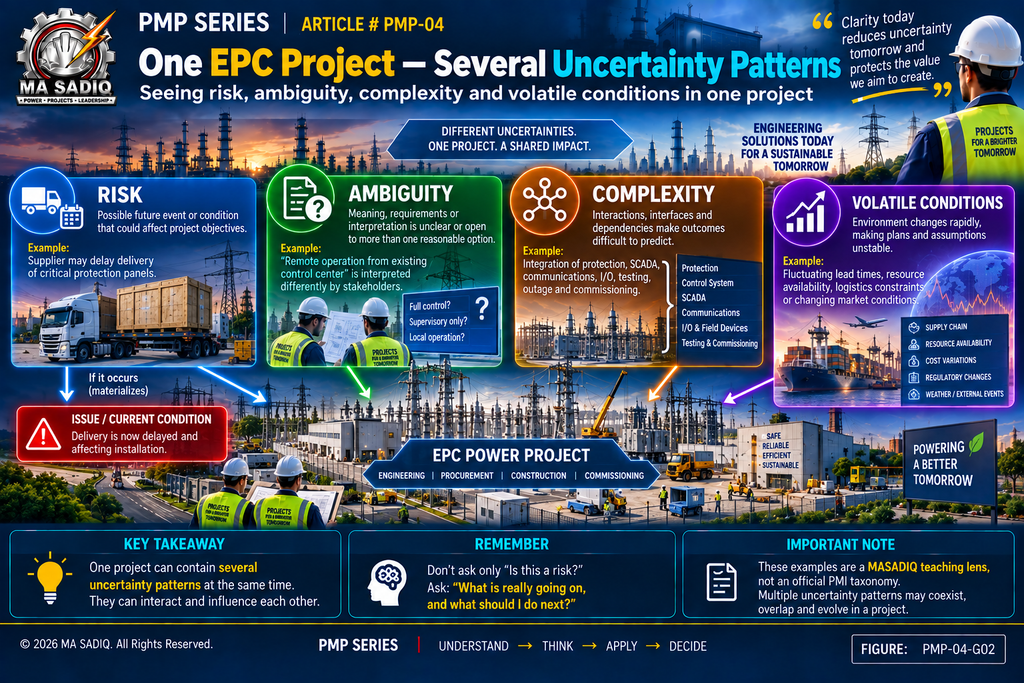
That sounds obvious until a schedule review turns into confusion. A vendor warning that relay panels may ship late is a risk. A missed contractual shipment date is an issue. Treating the second one as if it were still only a risk delays recovery action.
Ambiguity is different again. Suppose the phrase “remote operation from the existing control center” appears in the client requirement. One team reads that as command and control through the existing SCADA architecture. Another reads it as limited supervisory visibility with manual switching controls retained locally. The immediate problem is not the probability of an event. The problem is that the requirement does not yet mean the same thing to everyone.
Complexity has a different signature. Think of an EPC power project where protection settings, communications architecture, SCADA point lists, vendor I/O schedules, civil completion status, cable meggering, outage windows, and commissioning sequences all interact. Each workstream may be manageable on its own, yet the combined behavior becomes hard to predict because the system is tightly coupled.
Volatile conditions sit differently again. A stable procurement plan can unravel quickly if specialist commissioning resources become scarce, logistics lead times move sharply, or approval cycles start changing under external pressure. The issue is not only one future event. The environment itself is moving.
🏗 ONE ENGINEERING PROJECT CAN CONTAIN SEVERAL FORMS OF UNCERTAINTY AT ONCE
Consider a generic grid connection or substation expansion project involving HV equipment, protection and control panels, SCADA integration, communications interfaces, construction, and commissioning.
The project team is progressing through detailed engineering and long-lead procurement. Civil works are moving. Primary equipment drawings are under review. Protection logic is being coordinated with the client’s operations team. FAT and site energization windows are already visible on the forward plan.
Now several uncertainty patterns emerge.
A key vendor advises that global component availability may affect the delivery of protection relays. That is a risk. It is a future possibility with clear schedule and commissioning implications. The team should assess probability and impact, evaluate response options, and decide how closely it needs to be monitored.
At the same time, the client’s requirement for remote control authority is being interpreted differently by the protection engineer, the SCADA integrator, and the operations representative. That is ambiguity. The right next action is not to score it on a probability-impact matrix. The right action is to clarify intent, confirm functional expectations, align stakeholders, and document the requirement correctly.
Meanwhile, the integration path is becoming difficult to predict because protection settings, RTU configuration, telecoms readiness, interface testing, outage approvals, and commissioning sequences are all interdependent. That is complexity. The response is not simply “add more detail.” The team may need stronger interface management, staged integration planning, systems-level reviews, and tighter coordination across disciplines.
At the same time, specialist commissioning resources are tightening across the market, shipping assumptions are moving, and review turnaround times are becoming less reliable. Those are volatile conditions. The project manager may need shorter review cycles, more frequent assumption checks, earlier decision points, and a more adaptive planning rhythm.
None of these conditions excludes the others. In fact, they can reinforce one another.
The ambiguous control philosophy can create a risk of rework. The complex integration environment can magnify the impact of a vendor delay. Volatile market conditions can make contingency plans less reliable. And if the relay shipment is actually missed, that future risk has now become a current issue.
That is how real projects behave.
🎯 WHAT THE PROJECT MANAGER SHOULD DO NEXT
Diagnosis is valuable only if it leads to better action.
When the uncertainty looks like risk, the project manager should think in terms of exposure, impact on objectives, ownership, response options, contingency, triggers, and review.
When the uncertainty looks like ambiguity, the project manager should think in terms of clarification. Who needs to align? What assumption is being read differently? What decision or acceptance criterion is missing? What must be confirmed before further work proceeds?
When the uncertainty looks like complexity, the project manager should think in terms of interfaces and system effects. Where are the critical dependencies? Which teams are making local decisions that affect the wider system? What needs to be integrated, sequenced, or reviewed together rather than separately?
When the project is operating in volatile conditions, the project manager should think in terms of cadence and adaptability. Which assumptions are aging too quickly? Which decisions need shorter feedback loops? Where does the team need earlier warning, more frequent review, or a smaller planning horizon?
And when the situation is already a current issue, the response shifts again. The question is no longer how to analyze uncertainty. The question becomes how to contain impact, coordinate recovery, communicate clearly, and decide what change or escalation is required.
🧠 PMP EXAM LENS: DIAGNOSE FIRST, THEN CHOOSE THE STRONGEST NEXT ACTION
This distinction is highly useful for PMP preparation, but only if it is used properly.
The exam is not rewarding category memorization for its own sake. It is testing whether you can read a situation, understand what kind of problem you are facing, and choose the best next action in context.
Consider three short examples.
A supplier says a factory test slot may slip because a component source is unstable. The strongest response is to assess and manage the exposure as a risk. Updating the issue log as if the delay has already happened would be premature.
A design review reveals that two teams have built different interpretations of the same control requirement. The strongest response is to clarify the requirement and align the relevant stakeholders before pushing ahead. Treating it immediately as a standard risk response problem misses the source of the difficulty.
A shipment date has already been missed and site installation sequencing is now affected. The strongest response is issue management and recovery planning, not simply another round of risk identification.
PMP-style questions often place two or three plausible actions in front of you. That is deliberate. A technically possible action is not always the best immediate action. The stronger answer usually fits the current state of the problem.
That is why “keyword matching” is unreliable. Seeing the word uncertain does not automatically mean “risk register.” Seeing the word delay does not always mean “escalate.” The project manager first needs to determine whether the situation is unclear, possible, systemic, unstable, or already happening.
⚠ COMMON TRAPS
One trap is treating every unknown as a formal risk. That leads to heavy administration and weak diagnosis.
Another is confusing a current issue with a future risk. Once the condition has occurred, the project manager needs action and recovery, not only monitoring.
A third trap is using technical difficulty as a substitute for complexity. Complexity is not just “hard engineering.” It is the behavior that emerges from interaction, coupling, sequencing, and dependency across the system.
A fourth trap is treating volatility as if it were just another name for risk. It is better understood as the condition of the environment: fast movement, unstable assumptions, and reduced reliability of forecasts. Specific risks may arise within that environment, but the project manager may also need to adapt planning and review cadence more broadly.
The last trap is believing that classification is the goal. It is not. The goal is a better decision.
↻ PRACTICAL FRAMEWORK TO DEAL WITH PROJECT UNCERTAINTY
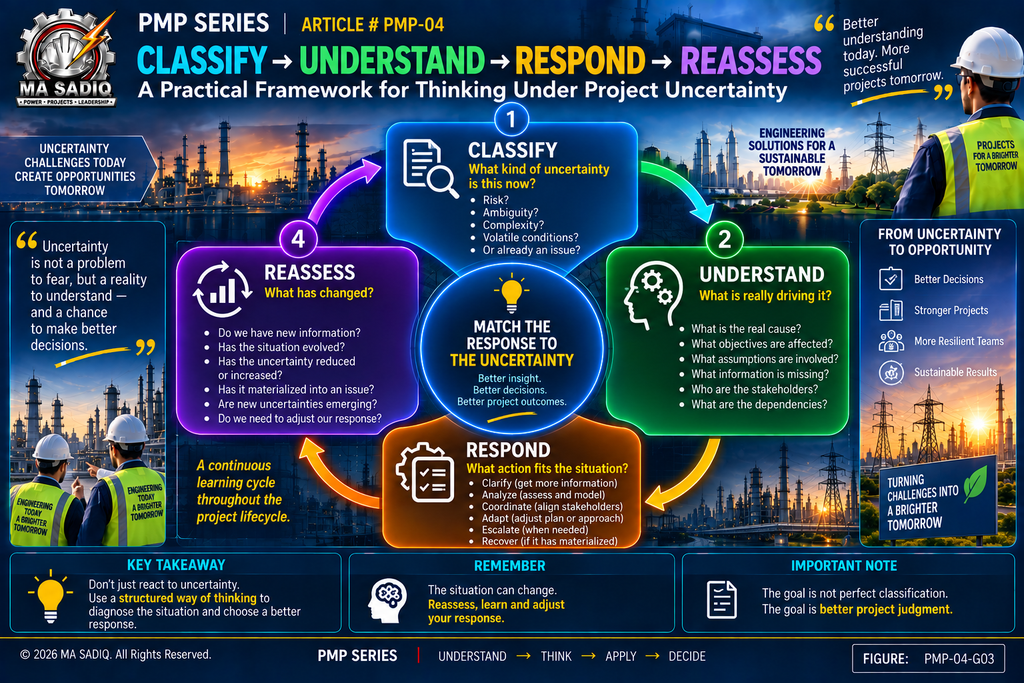
This four-step framework remains useful because it reflects how experienced project managers actually think.
Classify
Start by asking what kind of uncertainty is most visible right now. Is this mainly a future event, unclear meaning, system interaction, unstable context, or an active issue?
Understand
Look deeper before acting. What objectives are exposed? Who is affected? What assumptions are in play? What evidence do you have, and what is still missing? If several forms of uncertainty are present, which one is driving the decision that must be made now?
Respond
Choose the response that fits the situation. That may mean formal risk action, requirement clarification, interface coordination, schedule replanning, assumption testing, escalation, change control, or issue recovery. The response should match the nature and timing of the problem.
Reassess
Uncertainty evolves. A clarified ambiguity may disappear. A volatile condition may create new risks. A monitored risk may become an issue. A local issue may expose wider system complexity. Reassessment keeps the team from responding to yesterday’s version of the problem.
The strength of this framework is not that it replaces PMI terminology. It does not. Its strength is that it helps practitioners use PMI thinking with better judgment.
❓ A SHORT TEST OF YOUR OWN THINKING
A commissioning manager reports that the telecoms interface may not be ready when protection testing begins. At the same meeting, the operations team says the switching philosophy in the design package is still open to interpretation. Meanwhile, several outage approvals are linked to each other in a way that could affect the entire energization sequence.
A disciplined project manager does not treat these as one undifferentiated problem.
One part is a risk that needs assessment and response planning.
One part is ambiguity that needs clarification and alignment.
One part is complexity that needs systems-level coordination.
And if external approvals start moving unpredictably, the project may also be experiencing volatile conditions that require tighter review cycles and refreshed assumptions.
This is exactly the kind of thinking that improves both project judgment and PMP performance.
✓ KEY TAKEAWAYS
Risk matters because it affects objectives, but it does not cover the full landscape of uncertainty.
Some project uncertainty is best understood as ambiguity. Some comes from complexity. Some comes from volatile conditions around the project. These forms can overlap, and they can evolve.
A risk is future-oriented. An issue is happening now.
The project manager’s job is not to force every situation into a single label. It is to diagnose what is driving the difficulty and take the next action that fits the actual condition of the project.
That is a more useful habit than memorizing terms. It is also closer to how real projects are led.
🧠 PMP MEMORY BOX
When you face an uncertain situation, ask:
What kind of uncertainty is this now?
What objective is exposed?
What is the strongest next action?
If it is still possible, manage it as a risk.
If it is unclear, clarify it.
If it is interconnected, coordinate it as a system.
If conditions are moving quickly, shorten feedback loops.
If it has already happened, treat it as an issue.
💡 MASADIQ PROFESSIONAL INSIGHT
Many project delays are not caused by poor effort. They are caused by poor diagnosis.
Teams sometimes respond to ambiguity with mitigation, to complexity with more detail, to volatility with old assumptions, and to active issues with passive monitoring. The language sounds professional, but the action misses the problem.
Better project judgment starts with seeing the uncertainty clearly.
➜ CONTINUE LEARNING
This article sits naturally between value thinking and tailoring. PMP-03 asked what value the project is meant to create. PMP-04 asks what uncertainty could affect the creation of that value. Later articles in the series take some of these ideas further, including tailoring, threats versus opportunities, complexity, and systems thinking.
📚 REFERENCES
Project Management Institute. PMBOK® Guide – Eighth Edition.
Project Management Institute. Navigating Complexity: A Practice Guide.
Project Management Institute, Disciplined Agile. VUCA – Volatility, Uncertainty, Complexity and Ambiguity.
Thiry, Michel. Ambiguity management: the new frontier. PMI Global Congress 2011—North America.
👨💼 ABOUT THE AUTHOR
Engr. Muhammad Akram Sadiq is a Senior Electrical Engineer and Project Management Professional, with over 30 years of international experience in engineering, construction, commissioning, operation & maintenance, instrumentation & control, and project management.
Throughout his career, he has contributed to major power generation, substation and industrial infrastructure projects with a strong focus on technical excellence, leadership, quality, safety, and continuous improvement.
Through his professional brand MA SADIQ, he is committed to transforming practical experience into structured knowledge that empowers engineers, project professionals, and future leaders to achieve professional excellence.
📘 ABOUT THE PMP SERIES
The MASADIQ PMP Series is designed to help project professionals build real understanding, not just exam memory. Each article focuses on one practical idea, connects it to PMI-grounded thinking, and translates it into professional judgment that can be used both in practice and in PMP-style scenarios.
⚠️DISCLAIMER
This publication is intended solely for educational and professional development purposes. Although every effort has been made to ensure the accuracy and usefulness of the information presented, project requirements, engineering codes, standards, contractual frameworks, market conditions, regulations, and management practices may vary and are periodically revised. Readers should always consult the latest official editions of relevant publications, applicable legislation, client specifications, contractual requirements, organizational procedures, and project-specific requirements before applying any information to engineering or project-management activities.
The examples and recommendations presented in this article are intended to support professional learning and constructive discussion. They should not be considered a substitute for project-specific engineering, commercial, financial, legal, regulatory, or management judgment. The views expressed are those of the author and are intended to promote professional learning and constructive discussion.
— THE END —