📘 𝗘𝗣𝗖 𝗣𝗿𝗼𝗷𝗲𝗰𝘁 𝗠𝗮𝗻𝗮𝗴𝗲𝗺𝗲𝗻𝘁 𝗦𝗲𝗿𝗶𝗲𝘀 | 𝗔𝗿𝘁𝗶𝗰𝗹𝗲 𝗘𝗣𝗖-𝟬𝟳
🔗 𝗜𝗻𝘁𝗲𝗴𝗿𝗮𝘁𝗶𝗼𝗻 𝗠𝗮𝗻𝗮𝗴𝗲𝗺𝗲𝗻𝘁 — 𝗢𝗻𝗲 𝗣𝗿𝗼𝗷𝗲𝗰𝘁. 𝗢𝗻𝗲 𝗧𝗲𝗮𝗺. 𝗢𝗻𝗲 𝗣𝗹𝗮𝗻.
𝗗𝗲𝗮𝗿 𝗙𝗿𝗶𝗲𝗻𝗱𝘀 & 𝗣𝗿𝗼𝗳𝗲𝘀𝘀𝗶𝗼𝗻𝗮𝗹𝘀,
In an EPC project, Engineering, Procurement, Construction, Commissioning, Project Controls, Quality, HSE, Risk, and Stakeholder Management cannot operate as isolated functions.
They are interconnected—and the success of one often depends on the effectiveness of others.
That is where Integration Management becomes essential.
EPC-07 explores how the different elements of an EPC project can be aligned, coordinated, and managed as one integrated delivery system.
The article covers:
🔗 What Integration Management means in an EPC environment
🧩 The Integration Management Framework
🧠 The Integration Hub and common source of truth
⚙️ Integration across the major EPC disciplines
📅 Integrated Planning and Baselines
🔗 Interface Management
🔄 Integrated Change Control
⚠️ Integrated Risk Management
📁 Information & Data Integration
🏛️ Integration Governance
📊 Integrated Performance Management
🔄 Integration throughout the EPC lifecycle
👷 The role of the EPC Project Manager
The central message is simple:
“Integration is not a phase; it is the way the project is executed.”
A project may have excellent engineering, procurement, construction, and commissioning teams—but sustainable project performance depends on how effectively they work together.
📘 Read the complete article and explore the practical principles of EPC Integration Management.
I welcome your experience, observations, and lessons learned.
💬 Discussion Question:
In your EPC project experience, which integration gap creates the greatest impact on project performance—interfaces, information flow, decision-making, change control, or cross-functional coordination?
Learn → Share → Grow
EPC Project Management Series – Article# EPC-07
INTEGRATION MANAGEMENT
One Project. One Team. One Plan.
“Seamless integration of all EPC elements to ensure alignment, coordination, and delivery of project objectives”
Engr. Muhammad Akram Sadiq CE (SCE), PMP® (PMI)
Sr. Electrical Engineer & Projects Manager
🔗 Introduction — Why Integration Matters?
An EPC project is not a collection of independent engineering, procurement, construction, commissioning, cost, schedule, quality, HSE, risk, and stakeholder activities.
It is one integrated project.
Each function has its own responsibilities, deliverables, priorities, and performance measures. However, project success ultimately depends on how effectively these elements work together.
That is the purpose of Integration Management.
Integration Management connects project elements, aligns decisions across disciplines, establishes a common basis for execution, and ensures that changes, risks, information, interfaces, and performance are considered from an overall project perspective.
“Integration is not a phase; it is the way the project is executed.”
🎯 1. What Is Integration Management?
Integration Management is the coordinated management of the project’s different elements so that they function as one coherent delivery system.
In an EPC environment, integration connects:
- ⚙️ Engineering
- 🛒 Procurement
- 🏗️ Construction
- 🧪 Commissioning
- 📅 Schedule
- 💰 Cost
- ✅ Quality
- 🦺 HSE
- ⚠️ Risk
- 📑 Contracts
- 👥 Stakeholders
- 📊 Project Controls
- 📁 Information & Documentation
The objective is not simply to coordinate meetings. It is to ensure that:
decisions are aligned, interfaces are controlled, information flows effectively, dependencies are understood, and project objectives remain visible across all functions.
A project can have highly capable individual departments and still experience poor project performance if those departments operate in isolation.
🔄 2. Why Integration Matters in EPC Projects
EPC projects contain extensive interdependencies. A typical relationship is:
Engineering → Procurement → Construction → Commissioning
A change in engineering can affect:
- Material specifications
- Vendor requirements
- Purchase orders
- Delivery dates
- Construction activities
- Testing procedures
- Project cost
- Schedule
- Commissioning readiness
Therefore, a decision made within one discipline can create consequences across several others.
Integration Management provides the mechanism to evaluate these relationships before decisions are implemented.
⚠️ Without effective integration
Projects may experience:
- Conflicting priorities
- Interface gaps
- Repeated work
- Delayed decisions
- Inconsistent information
- Uncontrolled changes
- Procurement delays
- Construction disruptions
- Commissioning problems
- Cost and schedule impacts
✅ With effective integration
The project can achieve:

🧩 3. The Integration Management Framework
A practical EPC Integration Management framework can be viewed through five connected principles:
🔗 1. Alignment
Ensure that all functions understand the project objectives, scope, priorities, and success criteria.
📋 2. Consistency
Maintain consistency between plans, specifications, schedules, budgets, deliverables, and execution requirements.
👥 3. Collaboration
Create effective collaboration across disciplines, contractors, vendors, stakeholders, and project teams.
🛡️ 4. Control
Manage interfaces, changes, risks, decisions, information, and dependencies from an integrated perspective.
📊 5. Performance
Monitor the overall project rather than viewing each discipline’s performance in isolation.
These principles transform multiple project functions into one coordinated delivery system.
🧠 4. The Integration Hub
At the center of integration is the project’s common source of truth.
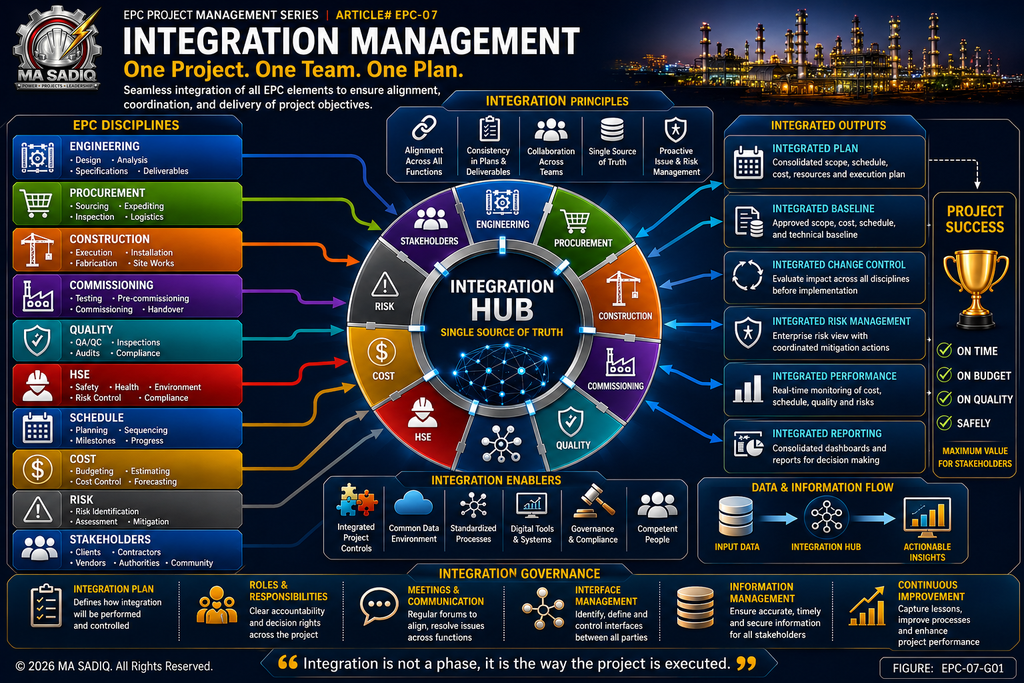
The Integration Hub concept shown in Figure EPC-07-G01 represents the mechanism through which information from different project functions is brought together, evaluated, coordinated, and converted into actionable decisions.
Typical inputs include:
- ⚙️ Engineering deliverables
- 🛒 Procurement status
- 🏗️ Construction progress
- 🧪 Commissioning readiness
- 💰 Cost information
- 📅 Schedule information
- ⚠️ Risk information
- ✅ Quality performance
- 🦺 HSE performance
- 👥 Stakeholder requirements
- 📑 Contractual information
The objective is not merely to collect data.
The objective is to transform information into integrated project understanding.

That cycle is fundamental to effective project management.
⚙️ 5. Integrating the EPC Disciplines
Integration must connect the major EPC disciplines throughout the project lifecycle.
⚙️ Engineering
Engineering establishes the technical foundation through:
- Design
- Specifications
- Calculations
- Drawings
- Technical deliverables
- Design decisions
Engineering information must remain aligned with procurement, construction, commissioning, cost, schedule, quality, and project requirements.
🛒 Procurement
Procurement converts project requirements into:
- Vendor selections
- Purchase orders
- Manufactured equipment
- Materials
- Logistics
- Deliveries
Procurement status directly influences construction readiness and therefore schedule and commissioning.
🏗️ Construction
Construction converts approved designs and available resources into physical project facilities.
Its performance depends heavily on:
- Design readiness
- Material availability
- Equipment availability
- Work packages
- Interfaces
- Permits
- Access
- Construction sequence
🧪 Commissioning
Commissioning provides the transition from constructed systems to operational readiness.
Its success depends on the integrated readiness of:
Engineering + Procurement + Construction + Testing + Documentation + Operations
This demonstrates why commissioning cannot be treated as an isolated final activity.
📅 6. Integrated Planning and Baselines
Integration begins during planning.
The project needs a coherent framework connecting:
- Scope
- WBS
- Schedule
- Cost
- Resources
- Deliverables
- Execution strategy
- Milestones
- Interfaces
- Assumptions
- Constraints
The resulting plans should support a common project baseline.
The purpose is to ensure that different project functions are not working from contradictory assumptions.
For example:
Engineering may consider a system ready for construction, while procurement has not delivered the required equipment.
Or:
Construction may plan installation based on a drawing that has subsequently changed.
Integration identifies such inconsistencies before they become major execution problems.
🔗 7. Interface Management
EPC projects contain interfaces everywhere.
Examples include:
- Engineering ↔ Procurement
- Procurement ↔ Construction
- Construction ↔ Commissioning
- Contractor ↔ Subcontractor
- EPC Contractor ↔ Client
- EPC Contractor ↔ Vendor
- Electrical ↔ Mechanical
- Controls ↔ Process
- Project ↔ Operations
Effective integration requires interfaces to be:

Clear interface ownership prevents the dangerous situation where:
Everyone assumes someone else is responsible.
Interface Management therefore becomes an important mechanism for project integration.
🔄 8. Integrated Change Control
Change is unavoidable in complex projects. The important question is not whether change occurs, but whether its consequences are understood before implementation. An apparently small change may affect:
- Scope
- Engineering
- Procurement
- Construction
- Schedule
- Cost
- Quality
- HSE
- Risk
- Commissioning
- Contracts
Therefore, changes should be evaluated from an integrated project perspective.
Never evaluate a project change in isolation when its consequences cross project boundaries.
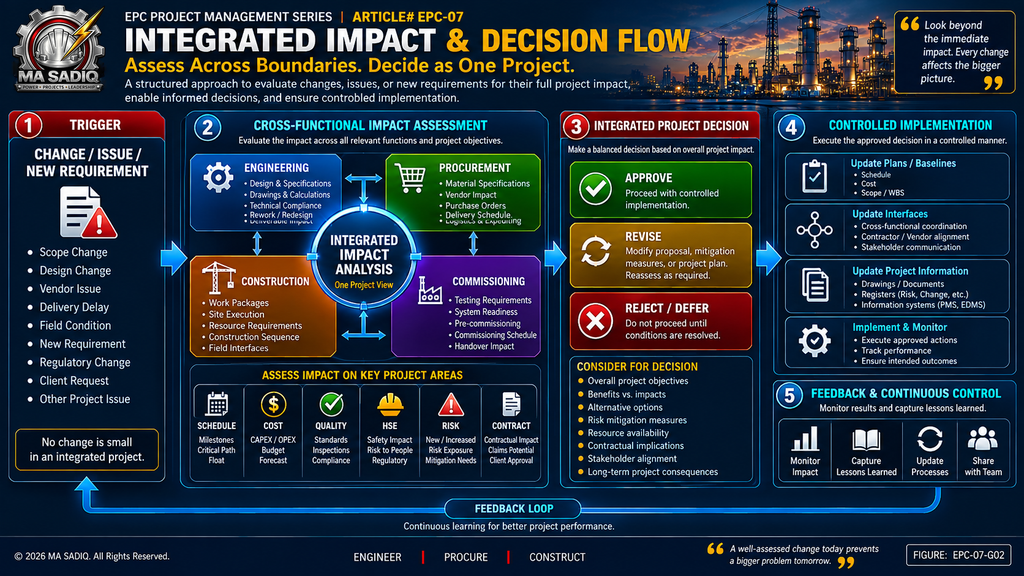
Figure EPC-07-G02 — Integrated Impact & Decision Flow
⚠️ 9. Integrated Risk Management
Risks rarely belong to only one discipline. Consider a delayed critical equipment delivery. It may begin as a procurement issue but subsequently affect:

Integration ensures that the project understands the complete chain of consequences.
Risk management therefore benefits from an enterprise-level project view rather than isolated discipline-level risk registers.
📁 10. Information and Data Integration
Modern EPC projects generate enormous volumes of information. Examples include:
- Drawings
- Specifications
- Vendor documents
- Inspection records
- Purchase orders
- Progress reports
- Schedules
- Cost reports
- NCRs
- RFIs
- Test records
- Commissioning dossiers
Integration requires information to be:

Poor information integration can create the illusion of progress while important decisions are actually being made using outdated or inconsistent information.
A reliable single source of truth is therefore essential.
🏛️ 11. Integration Governance
Integration needs governance—not bureaucracy. A practical governance framework should establish:
👥 Roles & Responsibilities: Who owns what?
🎯 Decision Rights: Who can make which decisions?
💬 Meetings & Communication: How are issues escalated and resolved?
🔗 Interface Management: How are cross-functional boundaries controlled?
📁 Information Management: Where is the authoritative information maintained?
📊 Performance Management: How is integrated project performance evaluated?
The objective is clear accountability with efficient decision-making.
📊 12. Integrated Performance Management
A project should not be judged solely by individual departmental performance. For example:
- Engineering may be ahead.
- Procurement may be behind.
- Construction may be progressing.
- Commissioning may still lack required documentation.
Looking at each function separately can produce misleading conclusions. Integration asks a more important question: Is the project as a whole moving toward successful delivery?
Integrated performance should therefore consider relationships between:
Scope • Schedule • Cost • Quality • HSE • Risk • Resources • Deliverables • Readiness
This creates a more realistic picture of project health.
🔄 13. Integration Through the EPC Lifecycle
Integration is required throughout the entire project lifecycle.
🚀 Initiation: Align objectives, scope, stakeholders, feasibility, and project strategy.
📋 Planning: Integrate scope, WBS, schedule, cost, resources, risks, and execution requirements.
⚙️ Engineering: Maintain alignment between technical requirements and downstream execution.
🛒 Procurement: Connect engineering requirements with vendor, purchasing, and logistics activities.
🏗️ Construction: Integrate site execution with engineering, materials, resources, and schedule.
🧪 Commissioning: Integrate construction completion, testing, documentation, and operational readiness.
🏁 Closeout: Integrate completion records, outstanding actions, lessons learned, and handover requirements.
Therefore, Integration is not a phase of the EPC project. It continues throughout the project lifecycle.
⚠️ 14. Common Integration Failures
Several recurring conditions can weaken EPC integration.
🧱 Silo Thinking: Departments optimize their own objectives without considering project-wide consequences.
🔗 Poor Interface Ownership: Responsibilities between organizations or disciplines remain unclear.
📁 Fragmented Information: Different teams work with different versions of information.
⏳ Delayed Decisions: Issues remain unresolved because decision authority is unclear.
🔄 Uncoordinated Changes: Changes are implemented without assessing their wider impact.
📊 Functional KPIs Only: Teams achieve departmental targets while the overall project suffers.
💬 Weak Communication: Important information does not reach the people who need it at the right time.
These are not merely communication problems—they are integration failures.
👷 15. The Role of the EPC Project Manager
The EPC Project Manager is a key integration leader. The Project Manager does not need to personally perform every technical activity. Instead, the role is to ensure that the different functions operate as one project team.
This requires the ability to:
- Establish common objectives
- Align project functions
- Resolve cross-functional conflicts
- Maintain visibility of interfaces
- Facilitate decisions
- Coordinate priorities
- Challenge inconsistent assumptions
- Escalate critical issues
- Maintain focus on project outcomes
Effective integration is therefore both a management discipline and a leadership responsibility.
📝 16. Practical Integration Checklist
Before considering an EPC project effectively integrated, ask:
🎯 Alignment ☐ Are project objectives clearly understood?
📐 Scope ☐ Are all functions working from the approved scope?
📋 Planning ☐ Are major plans and baselines aligned?
🔗 Interfaces ☐ Are cross-functional interfaces identified and owned?
📁 Information ☐ Is there a reliable source of project information?
🔄 Change ☐ Are changes evaluated for cross-functional impact?
⚠️ Risk ☐ Are project-wide consequences of risks understood?
🎯 Decisions ☐ Are decision rights and escalation routes clear?
📊 Performance ☐ Is project performance assessed holistically?
🚦 Readiness ☐ Are Engineering, Procurement, Construction, and Commissioning aligned for the next stage?
If the answers are consistently positive, the project has a stronger foundation for integrated execution.
💡 17. Key Takeaways
Successful EPC delivery is not achieved by engineering excellence alone.
It is not achieved by procurement efficiency alone.
It is not achieved by construction productivity alone.
Nor is it achieved by excellent project controls operating independently.
The real challenge is to make all these capabilities work together. That is the essence of Integration Management.
One Project. One Team. One Plan. One Direction.
When integration is effective, information flows across boundaries, decisions consider wider consequences, interfaces become manageable, and the project team can respond to challenges as one coordinated organization.
💬 Discussion Question
In your EPC project experience, which integration gap creates the greatest impact on project performance: interfaces, information flow, decision-making, change control, or cross-functional coordination?
Share your experience and lessons learned.
🏁 Conclusion
Integration Management is the discipline that connects the many moving parts of an EPC project into a coherent delivery system. It provides the framework for:
- Alignment across functions.
- Consistency across plans.
- Collaboration across teams.
- Control across interfaces.
- Visibility across performance.
The ultimate objective is simple: Turn many project functions into one integrated project.
And that is why: “Integration is not a phase; it is the way the project is executed.”
🔜 Next in the EPC Project Management Series
⚙️ EPC-08 — Engineering Management
From project integration, we now move deeper into one of the core EPC disciplines:
Engineering Management — transforming project requirements into coordinated designs, technical deliverables, and construction-ready information.
Learn → Share → Grow
Knowledge becomes more valuable when it is shared.
This article is part of the MASADIQ EPC Project Management Series.
👨💼 ABOUT THE AUTHOR
Engr. Muhammad Akram Sadiq is a Senior Electrical Engineer and Project Management Professional (PMP®) with over 30 years of international experience in engineering, construction, commissioning, operation & maintenance, instrumentation & control, and project management.
Throughout his career, he has contributed to major power generation, transmission substations, and industrial infrastructure projects with a strong focus on technical excellence, leadership, quality, safety, and continuous improvement.
Through his professional brand MA SADIQ, he is committed to transforming practical engineering experience into structured knowledge that empowers engineers, project professionals, and future leaders to achieve engineering excellence.
🏗️ ABOUT THE EPC PROJECT MANAGEMENT SERIES
The MASADIQ EPC Project Management Series is a structured educational publication developed to provide engineers, project managers, students, and industry professionals with practical knowledge covering the principles and practices of EPC project management.
Each article explores a specific EPC topic, progressing systematically from foundational concepts to advanced project-management practices while emphasizing practical experience, professional excellence, leadership, and continuous learning.
The series aims to bridge the gap between project-management principles and the realities of engineering, procurement, construction, commissioning, and project delivery.
⚠️ DISCLAIMER
This publication is intended solely for educational and professional development purposes.
Although every effort has been made to ensure the accuracy and usefulness of the information presented, project requirements, engineering codes, standards, contractual frameworks, market conditions, regulations, and management practices may vary and are periodically revised.
Readers should always consult the latest official editions of relevant publications, applicable legislation, client specifications, contractual requirements, organizational procedures, and project-specific requirements before applying any information to engineering or project-management activities.
The examples and recommendations presented in this article are intended to support professional learning and constructive discussion. They should not be considered a substitute for project-specific engineering, commercial, financial, legal, regulatory, or management judgment.
The views expressed are those of the author and are intended to promote professional learning and constructive discussion.
— THE END —