🚀 Launching the “EPC Project Management Series”
Dear Friends & Professionals,
I’m pleased to launch a new series of articles. Here is the first article of the series:
📘 Article# EPC-01: EPC Project Management – Turning Vision into Successful Project Delivery
Every power plant, substation, refinery, industrial facility, or infrastructure project begins with a vision. Turning that vision into a successful operational asset requires far more than engineering expertise — it requires effective Engineering, Procurement, and Construction (EPC) Project Management.
In this introductory article, I provide an overview of:
✅ What EPC Project Management is
✅ The three pillars of EPC: Engineering, Procurement & Construction
✅ The complete EPC Project Lifecycle
✅ Why project integration is essential
✅ The five pillars of successful EPC Project Management
✅ The evolving role of the EPC Project Manager
✅ A learning roadmap for the complete 32-article EPC Project Management Series
Rather than exploring every subject in detail, this article establishes the foundation upon which the remaining articles in the series will build. Each subsequent article will focus on a specific project management discipline, providing practical insights drawn from real-world engineering and project management experience.
This knowledge series is intended for:
🔹 Engineers
🔹 Project Managers
🔹 Construction Professionals
🔹 EPC Contractors
🔹 Consultants
🔹 Engineering Students
🔹 Anyone interested in delivering engineering projects more effectively
With more than 30 years of experience in engineering, construction, commissioning, operation, maintenance, and project management, my goal is to transform practical industry experience into structured knowledge that benefits the wider engineering community.
I hope this series becomes a valuable learning resource for professionals involved in delivering engineering projects around the world.
📖 Your feedback, comments, and experiences are always welcome.
EPC Project Management Series – Article# 1
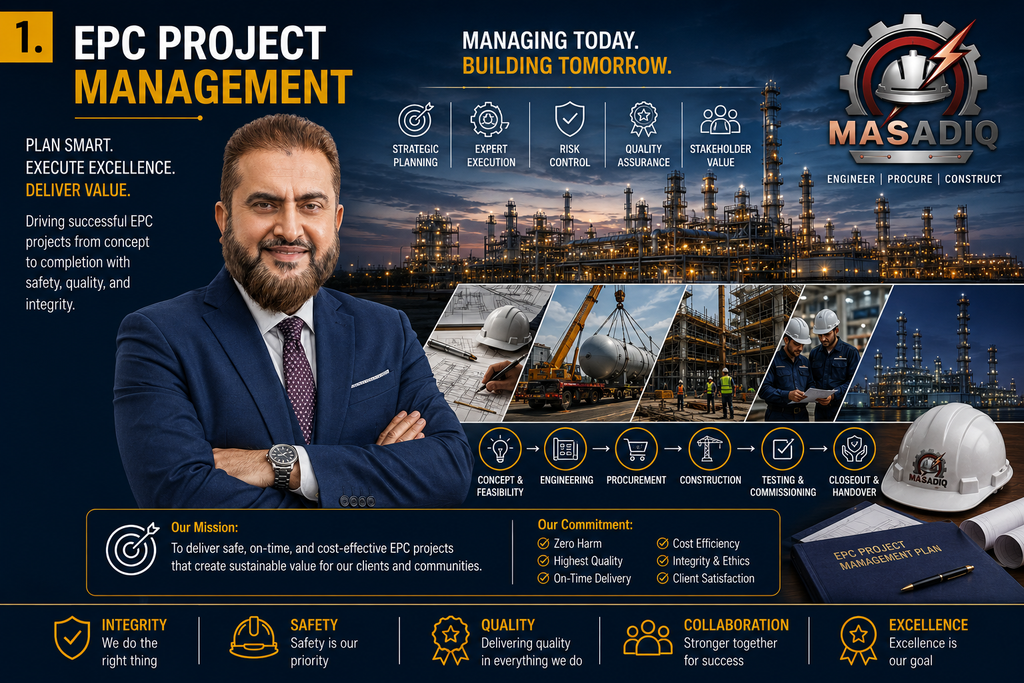
EPC Project Management
Turning Vision into Successful Project Delivery
Engr. Muhammad Akram Sadiq CE (SCE), PMP® (PMI)
Sr. Electrical Engineer & Projects Manager
📘 Introduction
Modern civilization is built upon engineering projects. Power plants generate electricity for our homes and industries. Substations transmit power across vast distances. Refineries process crude oil into essential fuels. Water treatment plants provide safe drinking water. Airports, highways, hospitals, factories, and commercial developments all begin as ideas before becoming operational facilities that serve society.
Behind every successful engineering facility lies a structured process that transforms a vision into reality. This transformation does not happen by chance. It requires the coordinated efforts of engineers, planners, procurement specialists, construction professionals, quality inspectors, safety personnel, commissioning engineers, suppliers, contractors, consultants, and clients working towards a common objective.
This coordinated approach is known as Engineering, Procurement, and Construction (EPC) Project Management.
EPC Project Management provides the framework that integrates technical expertise with disciplined planning, resource coordination, commercial management, quality assurance, risk control, stakeholder engagement, and leadership throughout the entire project lifecycle.
Regardless of whether the project involves electrical infrastructure, industrial facilities, commercial developments, transportation systems, or utility projects, the underlying management principles remain remarkably similar.
Successful projects are not simply constructed — they are planned, coordinated, executed, monitored, and continuously improved.
This article serves as the gateway to the MASADIQ EPC Project Management Series, a structured collection of thirty-two (32) interconnected articles designed to explore the complete EPC project lifecycle and the management disciplines that contribute to successful project delivery.
Rather than discussing every subject in detail, this introductory article establishes the overall framework of EPC Project Management and provides a roadmap for the articles that follow.
🎯 Learning Objectives
After studying this article, you should be able to:
✅ Explain the meaning of Engineering, Procurement, and Construction (EPC).
✅ Understand the purpose of EPC Project Management.
✅ Describe the major phases of the EPC Project Lifecycle.
✅ Appreciate the importance of project integration.
✅ Recognize the key disciplines involved in successful EPC projects.
✅ Understand how the remaining articles in this series build upon these fundamentals.
🏗️ What is EPC Project Management?
Engineering, Procurement, and Construction (EPC) Project Management is the coordinated management of all activities required to deliver an engineering project from concept through final handover.
Unlike conventional construction projects, an EPC project integrates engineering design, procurement of equipment and materials, construction activities, testing, commissioning, and project closeout within a unified project delivery approach.
The objective is straightforward:
Deliver the agreed project scope safely, on schedule, within budget, and in compliance with technical, contractual, quality, and stakeholder requirements.
Although the objective appears simple, achieving it requires the successful integration of numerous technical and management disciplines throughout the project lifecycle.
EPC Project Management provides the leadership and coordination necessary to ensure these disciplines operate together as a single, cohesive system.
⚙️ The Three Pillars of EPC
The acronym EPC represents the three primary components of project delivery:
- ⚙️ Engineering
- 🛒 Procurement
- 👷 Construction
Although presented separately, these activities are closely interconnected.
⚙️ Engineering
Engineering is the process of converting project objectives into practical technical solutions.
Typical engineering activities include:
- Feasibility studies
- Concept development
- Basic engineering
- Detailed engineering
- Design calculations
- Technical specifications
- Equipment selection
- Engineering drawings
- Design reviews
- Interdisciplinary coordination
Engineering establishes the technical foundation for all subsequent project activities. Decisions made during this phase significantly influence project cost, constructability, quality, safety, reliability, and long-term operational performance.
📘 Continue Learning
Engineering activities will be referenced throughout this series where relevant to project management. The focus of this series, however, is on managing EPC projects rather than teaching engineering design.
🛒 Procurement
Procurement ensures that the materials, equipment, and services required by the project are obtained in accordance with approved technical specifications and project schedules.
Typical procurement activities include:
- Vendor qualification
- Request for Quotations (RFQs)
- Technical evaluations
- Commercial evaluations
- Purchase Orders
- Manufacturing follow-up
- Factory Acceptance Tests (FAT)
- Logistics
- Delivery
- Material receiving
Effective procurement directly influences project schedule, cost, quality, and construction productivity.
📘 Continue Learning
Procurement planning, procurement execution, vendor management, and procurement control will be discussed in detail in Article EPC-09 – Procurement Management.
👷 Construction
Construction transforms engineering documents into completed physical facilities.
Typical construction activities include:
- Civil works
- Structural works
- Mechanical installation
- Electrical installation
- Instrumentation installation
- Equipment erection
- Inspection
- Testing
- Mechanical completion
Construction represents the most visible phase of an EPC project. However, successful construction depends heavily on the quality of planning, engineering, procurement, and coordination performed earlier in the project.
📘 Continue Learning
Construction Management will be covered comprehensively in Article EPC-19 – Construction Management.

🔄 The EPC Project Lifecycle
Every engineering project progresses through a series of interconnected phases. While organizations may use slightly different terminology, the overall lifecycle remains largely consistent across industries.
💡 Overview of the Lifecycle
- Concept & Feasibility establishes the business need and evaluates project viability.
- Engineering develops technical solutions.
- Procurement acquires the required resources.
- Construction transforms designs into physical assets.
- Testing & Commissioning verify that systems perform as intended.
- Closeout & Handover transfers the completed facility to the owner for operation.
Rather than operating independently, these phases overlap and interact throughout the project.
📘 Continue Learning
Lifecycle integration will be explored further in Article EPC-07 – Integration Management.
🌐 Why Integration Matters
One of the defining characteristics of EPC projects is that no discipline operates in isolation.
A design change may affect procurement.
A procurement delay may impact on construction.
Construction progress may influence commissioning activities.
Commissioning outcomes may require engineering clarification.
These relationships demonstrate that project success depends not only on performing individual activities well, but also on integrating them effectively.
Project integration ensures that decisions made in one discipline support the objectives of the entire project rather than creating unintended consequences elsewhere.
⭐ The Five Pillars of Successful EPC Project Management
The cover illustration accompanying this article highlights five principles that consistently influence the success of EPC projects. Although every project is unique, these principles provide a practical framework for achieving successful project delivery.
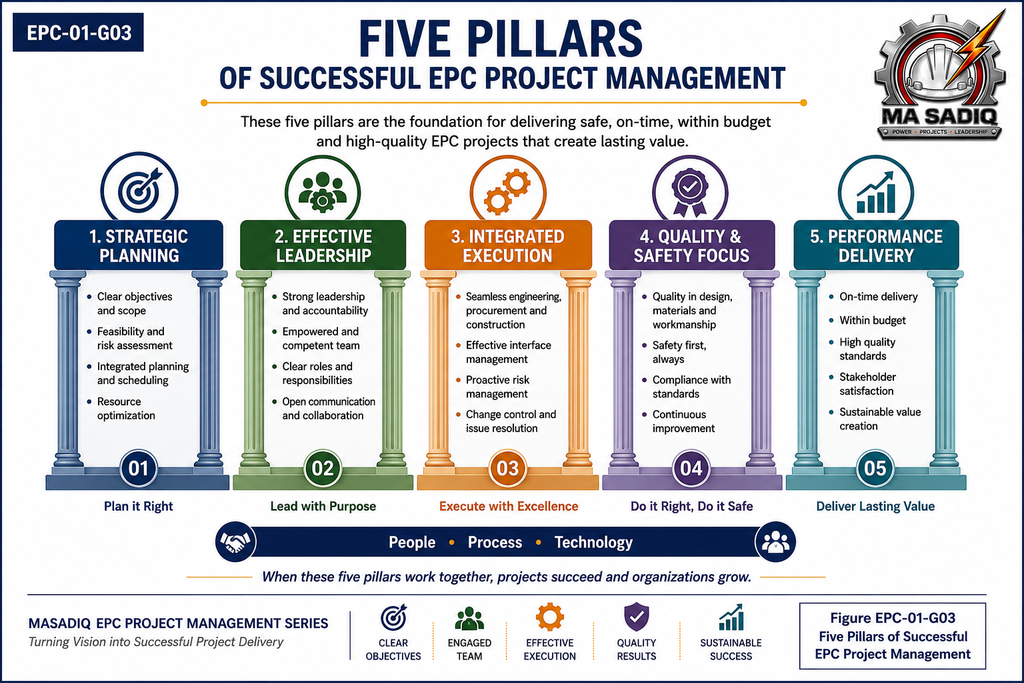
🎯 Strategic Planning
Every successful project begins with a well-defined plan. Strategic planning establishes project objectives, identifies major constraints, allocates resources, and defines the overall direction before significant work begins.
Projects that invest sufficient effort in planning generally experience fewer surprises during execution.
⚙️ Expert Execution
Plans create the roadmap, but execution produces the results. Expert execution requires competent engineering, disciplined procurement, effective construction management, and continuous coordination among all project participants.
⚠️ Risk Control
Uncertainty is inherent in every EPC project. Proactive identification and management of risks help minimize disruptions and improve decision-making throughout the project lifecycle.
📘 Continue Learning
Risk identification, assessment, response planning, and monitoring will be covered in Article EPC-16 – Risk Management.
✅ Quality Assurance
Quality is achieved through disciplined processes rather than final inspections alone. Engineering quality, procurement quality, construction quality, and commissioning quality collectively determine the performance of the completed facility.
📘 Continue Learning
Quality planning, quality assurance, quality control, inspections, audits, and continuous improvement will be discussed in Article EPC-15 – Quality Management.
🤝 Stakeholder Value
Projects exist to deliver value. Success is measured not only by technical completion but also by the satisfaction of clients, owners, operators, regulators, and other stakeholders.
Maintaining alignment with stakeholder expectations is therefore an essential responsibility throughout the project lifecycle.
📘 Continue Learning
Stakeholder identification, engagement, and communication strategies will be explored in Article EPC-10 – Stakeholder Management.
👤 The Role of the EPC Project Manager
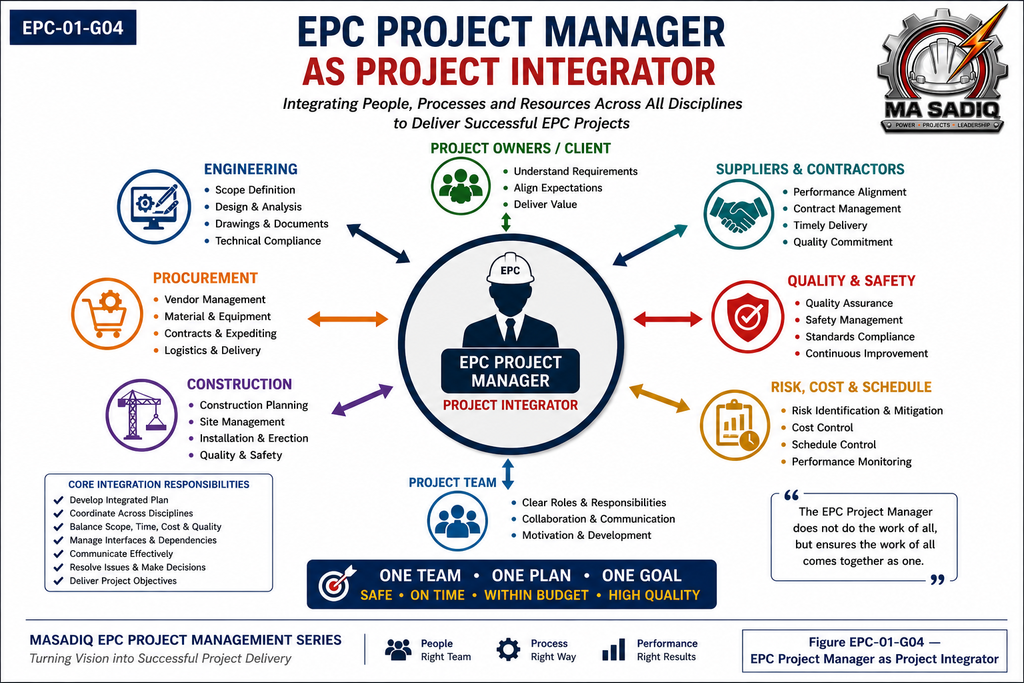
The EPC Project Manager provides the leadership required to integrate all project disciplines into one coordinated delivery system.
Rather than acting as the technical expert in every field, the Project Manager enables specialists from different disciplines to work together toward common project objectives.
The Project Manager continuously balances competing priorities such as:
- Project Scope
- Schedule
- Cost
- Quality
- Safety
- Risks
- Resources
- Stakeholder Expectations
The effectiveness of the Project Manager often determines how successfully these competing priorities are managed throughout the project.
📘 Continue Learning
Leadership, competencies, responsibilities, and decision-making will be discussed in Article EPC-02 – Role of the EPC Project Manager.
📋 Project Management Disciplines Covered in this Series
Successful EPC Project Management requires the coordinated application of multiple management disciplines.
Rather than discussing them in detail here, this article introduces them as the roadmap for the remaining series.
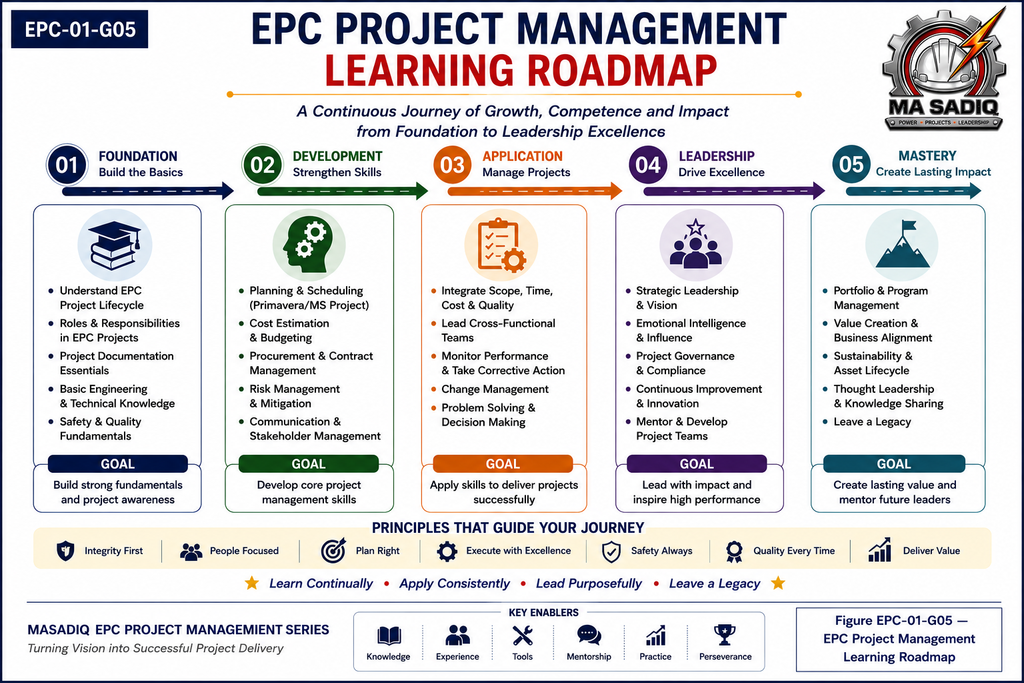
The following disciplines will be explored individually:
| Article | Topic |
| EPC-02 | Role of EPC Project Manager |
| EPC-03 | Applicable Standards Frameworks |
| EPC-04 | EPC Project Lifecycle Overview |
| EPC-05 | Project Initiation & Feasibility |
| EPC-06 | Project Planning |
| EPC-07 | Integration Management |
| EPC-08 | Scope Management |
| EPC-09 | Procurement Management |
| EPC-10 | Stakeholder Management |
| EPC-11 | Interface Management |
| EPC-12 | Communication Management |
| EPC-13 | Schedule Management |
| EPC-14 | Cost Management & Earned Value Management |
| EPC-15 | Quality Management |
| EPC-16 | Risk Management |
| EPC-17 | Resource Management |
| EPC-18 | Contract Management |
| EPC-19 | Construction Management |
| EPC-20 | Commissioning Management |
Together, these topics form the core knowledge base required for successful EPC project delivery.
⚠️ Common Challenges in EPC Projects
Every EPC project presents unique challenges, yet certain issues appear repeatedly across industries.
Examples include:
- Engineering revisions during execution
- Delayed material deliveries
- Interface coordination problems
- Scope changes
- Resource shortages
- Communication breakdowns
- Contractual disputes
- Unforeseen site conditions
- Supply chain disruptions
- Changing stakeholder expectations
Recognizing these challenges early enables project teams to take preventive rather than corrective action.
🌟 Characteristics of Successful EPC Projects
Although every project differs in size and complexity, successful projects consistently demonstrate several common characteristics.
These include:
- Clear project objectives
- Strong leadership
- Effective planning
- Timely engineering deliverables
- Efficient procurement
- Safe construction practices
- Robust quality systems
- Proactive communication
- Collaborative teamwork
- Continuous monitoring and improvement
These characteristics reinforce an important principle:
Project success is the result of many well-managed activities working together — not a single outstanding effort.
💡 Engineering Insight
Engineering creates a technical solution. Project Management integrates people, processes, and resources to transform that solution into a successful operating facility.
This integration is what distinguishes consistently successful EPC organizations.
📚 Practical Lessons Learned
Throughout my professional career, I have observed that successful projects share several common characteristics.
Among the most important lessons are:
- Good planning reduces uncertainty.
- Early coordination minimizes downstream problems.
- Effective communication prevents many avoidable issues.
- Strong teamwork consistently outperforms isolated effort.
- Continuous learning improves future project performance.
These observations emphasize that technical expertise alone is not sufficient. Sustainable project success depends upon disciplined management and collaboration.
✅ Key Takeaways
✔ EPC Project Management integrates Engineering, Procurement, and Construction into a unified delivery model.
✔ Successful projects depend upon effective planning, coordination, leadership, and communication.
✔ Integration is the thread that connects every project discipline.
✔ Project Managers enable multidisciplinary teams to work toward common objectives.
✔ The remaining articles in this series will examine each management discipline in greater practical detail.
🏁 Conclusion
EPC Project Management is far more than coordinating engineering, procurement, and construction activities. It is the discipline that aligns technical expertise, commercial considerations, contractual obligations, quality requirements, safety expectations, and stakeholder needs throughout the entire project lifecycle.
This introductory article has established the overall framework for understanding EPC projects and their management. It intentionally provides a broad overview while reserving detailed discussion of individual disciplines for the dedicated articles that follow.
Whether you are beginning your engineering career or expanding your project management knowledge, understanding these fundamentals provides a strong foundation for successful participation in EPC projects.
📖 Continue Learning
Next Article
EPC-02 — The Role of the EPC Project Manager
In the next article, we will explore the leadership responsibilities, competencies, decision-making processes, and professional skills required to successfully lead multidisciplinary EPC projects.
👤 About the Author
Engr. Muhammad Akram Sadiq is a Senior Electrical Engineer and Project Management Professional (PMP®) with over 30 years of international experience in engineering, construction, commissioning, operation & maintenance, instrumentation & control, and EPC project management. Throughout his career, he has contributed to major power generation, transmission, and industrial infrastructure projects with a strong focus on technical excellence, leadership, quality, safety, and continuous improvement.
Through his professional brand MA SADIQ, he is committed to transforming practical engineering experience into structured knowledge that empowers engineers, project professionals, and future leaders to achieve engineering excellence.
🌍 About the EPC Project Management Series
The EPC Project Management Series is a structured collection of 32 interconnected articles covering the complete lifecycle of EPC project delivery.
Each article focuses on a specific project management discipline while maintaining continuity with the overall series. Together, they are designed to become a comprehensive body of practical knowledge for engineers, project managers, students, and organizations involved in delivering engineering projects.