📘 𝗘𝗣𝗖 𝗣𝗿𝗼𝗷𝗲𝗰𝘁 𝗠𝗮𝗻𝗮𝗴𝗲𝗺𝗲𝗻𝘁 𝗦𝗲𝗿𝗶𝗲𝘀 | 𝗔𝗿𝘁𝗶𝗰𝗹𝗲 𝗘𝗣𝗖-𝟬𝟮
👨💼 𝗧𝗵𝗲 𝗥𝗼𝗹𝗲 𝗼𝗳 𝗮𝗻 𝗘𝗣𝗖 𝗣𝗿𝗼𝗷𝗲𝗰𝘁 𝗠𝗮𝗻𝗮𝗴𝗲𝗿
Dear Friends and Professionals,
🤝 Greetings! I hope you are doing well!
I am pleased to share Article EPC-02 of the M.A. Sadiq EPC Project Management Series.
Engineering, Procurement, and Construction (EPC) projects are among the most complex engineering endeavors, requiring the seamless integration of technical expertise, resources, and people. While project planning, schedules, and budgets are essential, the success of an EPC project ultimately depends on effective leadership.
An EPC Project Manager is much more than a coordinator of activities. The role requires the ability to unite multidisciplinary teams, align stakeholder expectations, make informed decisions, manage competing priorities, and guide the project toward its objectives safely, efficiently, and professionally.
In this article, we explore the responsibilities, competencies, and leadership qualities that define an effective EPC Project Manager, along with practical lessons and project management insights drawn from real-world EPC experience.
📚 𝗜𝗻 𝘁𝗵𝗶𝘀 𝗮𝗿𝘁𝗶𝗰𝗹𝗲, 𝘆𝗼𝘂’𝗹𝗹 𝗹𝗲𝗮𝗿𝗻:
✅ The core responsibilities of an EPC Project Manager.
✅ Essential leadership and management competencies.
✅ Common misconceptions about the role.
✅ Practical lessons learned from EPC projects.
✅ Project management insights for achieving sustainable project success.
Whether you are an engineering student, an early-career engineer, a project professional, or an experienced EPC practitioner, I hope this article provides practical knowledge and insights that contribute to your continuous professional development.
💬 𝗗𝗶𝘀𝗰𝘂𝘀𝘀𝗶𝗼𝗻 𝗤𝘂𝗲𝘀𝘁𝗶𝗼𝗻
In your opinion, what is the single most important quality of an outstanding EPC Project Manager?
Please share your thoughts and experiences in the comments. Your insights may help fellow engineers and project professionals learn from diverse perspectives.
🙏 𝗜𝗳 𝘆𝗼𝘂 𝗳𝗶𝗻𝗱 𝘁𝗵𝗶𝘀 𝗰𝗼𝗻𝘁𝗲𝗻𝘁 𝘂𝘀𝗲𝗳𝘂𝗹, 𝗽𝗹𝗲𝗮𝘀𝗲 𝗹𝗶𝗸𝗲 𝗮𝗻𝗱 𝗿𝗲𝗽𝗼𝘀𝘁.
📘 𝗟𝗲𝗮𝗿𝗻 > 𝗦𝗵𝗮𝗿𝗲 > 𝗚𝗿𝗼𝘄
EPC Project Management Series – Article# EPC-02
The Role of an EPC Project Manager
Leading People. Integrating Disciplines. Delivering Value.
📖 1. Introduction
Engineering, Procurement, and Construction (EPC) projects are among the most complex undertakings in the engineering industry. They involve multiple organizations, diverse technical disciplines, significant financial investments, and demanding project schedules.
In Article EPC-01, we introduced the fundamentals of EPC Project Management and explained why a structured management approach is essential for project success.
This article builds upon that foundation by focusing on the individual responsible for transforming project plans into coordinated execution—the EPC Project Manager.
An EPC Project Manager is far more than a coordinator of schedules and meetings. The role requires leadership, strategic thinking, effective communication, sound decision-making, and the ability to integrate engineering, procurement, construction, commissioning, and stakeholder expectations into a single, unified delivery effort.
Ultimately, successful EPC projects are delivered not merely through technical excellence, but through effective leadership that enables multi-disciplinary cross-functional teams to work towards a common objective.
🎯 2. Learning Objectives
After completing this article, you will be able to:
✅ Understand the primary role of an EPC Project Manager.
✅ Recognize the leadership responsibilities required to guide multi-disciplinary EPC teams.
✅ Explain how effective coordination contributes to successful project delivery.
✅ Identify the essential competencies expected from high-performing EPC Project Managers.
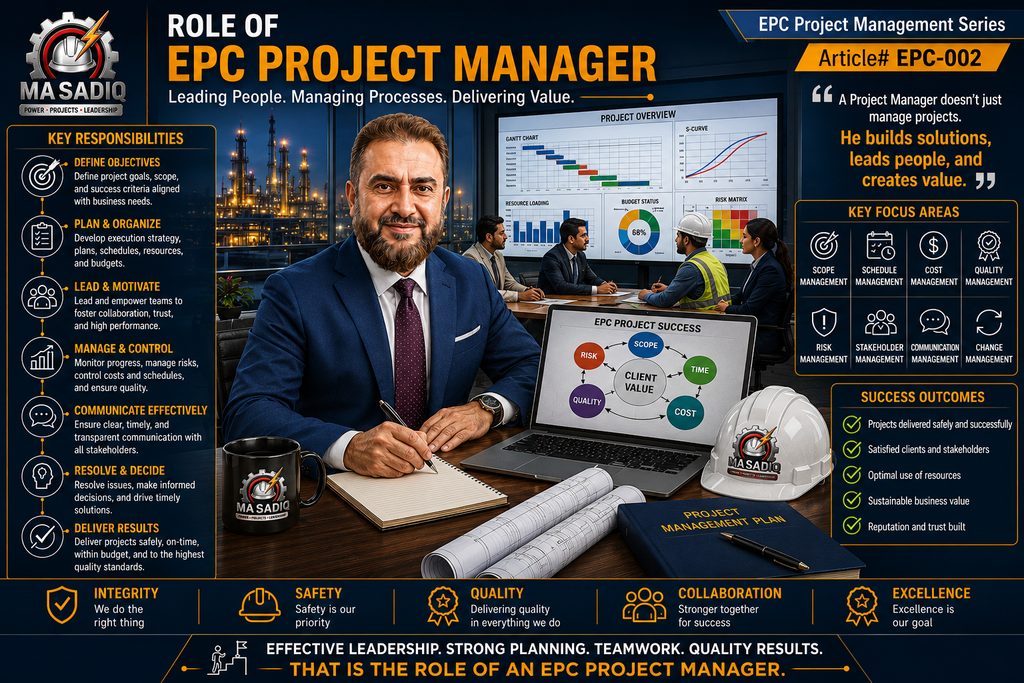
👨💼 3. The EPC Project Manager: More Than a Project Coordinator
One of the most common misconceptions is that an EPC Project Manager’s primary responsibility is to prepare schedules, organize meetings, and produce reports.
While these activities support project management, they do not define the role.
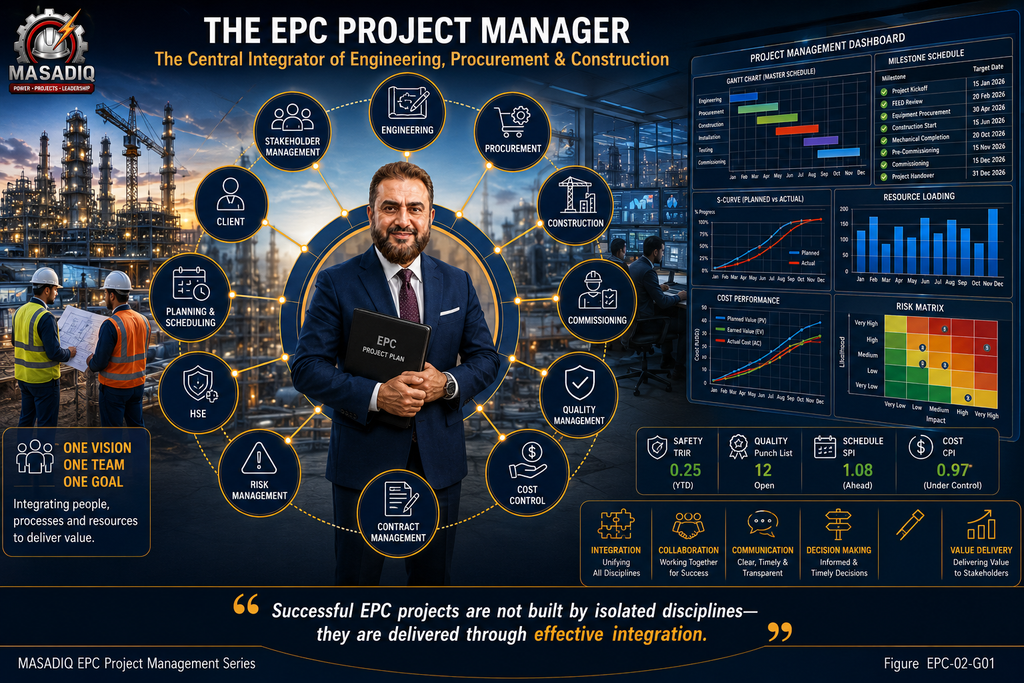
The true responsibility of an EPC Project Manager is to integrate people, processes, technical disciplines, resources, and stakeholder expectations into one coordinated project execution strategy.
The Project Manager establishes direction, aligns priorities, resolves conflicts, supports informed decision-making, and ensures that every discipline contributes effectively toward the project’s overall objectives.
Rather than becoming the technical expert in every discipline, the Project Manager enables specialists to work together efficiently and collaboratively.
The EPC Project Manager serves as the central integration point, connecting engineering, procurement, construction, commissioning, contractors, consultants, suppliers, and clients into a unified project delivery team.
🎯 4. Core Responsibilities of an EPC Project Manager
🎯 4.1. Establish Clear Project Objectives
Successful projects begin with a shared understanding of:
- Project scope
- Client expectations
- Project priorities
- Success criteria
- Major constraints
When objectives are clearly communicated from the outset, the project team develops a common direction that minimizes misunderstandings and supports informed decision-making throughout project execution.
📅 4.2. Plan and Organize Project Execution
Planning transforms project objectives into actionable work.
The Project Manager coordinates:
- Work packages
- Resource allocation
- Project schedules
- Discipline interfaces
- Project priorities
Effective planning provides structure while maintaining sufficient flexibility to respond to changing project conditions.
👥 4.3. Lead and Inspire the Project Team
Technical knowledge alone does not deliver successful EPC projects.
People do.
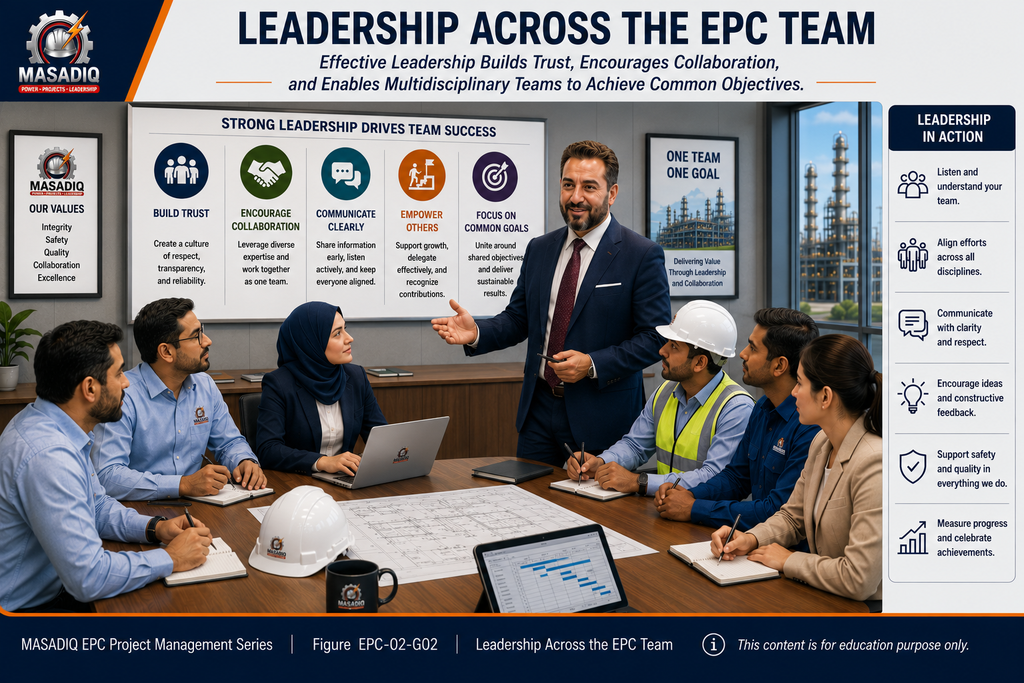
An effective Project Manager creates an environment where engineers, procurement specialists, construction professionals, quality personnel, HSE teams, and stakeholders collaborate with trust and shared commitment.
Leadership includes:
- motivating people,
- resolving conflicts,
- empowering specialists,
- encouraging collaboration,
- supporting professional growth,
- maintaining project focus.
Strong leadership promotes collaboration, builds trust, and enables multidisciplinary teams to achieve shared project objectives.
💬 4.4. Communicate Effectively
Large EPC projects involve many stakeholders with different priorities.
The Project Manager becomes the central communication link by ensuring that:
- information remains accurate,
- expectations stay aligned,
- decisions are communicated promptly,
- emerging issues are addressed early,
- stakeholder confidence is maintained.
Effective communication reduces uncertainty and strengthens project coordination.
⚖️ 4.5. Make Sound Decisions
Every EPC project encounters technical, commercial, and organizational challenges.
The Project Manager gathers information, consults specialists, evaluates alternatives, considers project risks, and makes balanced decisions that protect project objectives.
Timely decisions help maintain project momentum and reduce unnecessary delays.
✅ 4.6. Deliver Project Value
Successful project delivery extends beyond completing contractual obligations.

An EPC Project Manager strives to achieve balanced performance across multiple dimensions, including:
- Safety
- Quality
- Schedule
- Cost
- Stakeholder Satisfaction
- Long-term Operational Value
These outcomes collectively define sustainable project success.
Successful EPC Project Managers balance safety, quality, schedule, cost, stakeholder satisfaction, and long-term business value to achieve sustainable project outcomes.
⭐ 5. Essential Competencies of an EPC Project Manager
An effective EPC Project Manager continually develops competencies that strengthen leadership and project performance.
These include:
- Leadership
- Communication
- Strategic Thinking
- Decision-Making
- Problem Solving
- Negotiation
- Team Building
- Integrity
- Accountability
- Adaptability
These competencies enable multi-disciplinary expertise to become coordinated project performance.
💡 Engineering Insight
The EPC Project Manager is not expected to be the best technical specialist in every engineering discipline.
Instead, the Project Manager’s greatest strength lies in integrating the expertise of others into one coordinated execution strategy.
Projects succeed when specialists are empowered to perform their roles effectively—and when leadership enables them to work together towards achievement of common objectives.
⚠️ 6. Common Misconceptions
❌ Misconception
The EPC Project Manager’s main responsibility is preparing schedules.
✅ Reality
Schedules are management tools. Leadership, integration, and decision-making define the role.
❌ Misconception
Project success is measured only by cost and schedule.
✅ Reality
Successful projects also achieve safety, quality, stakeholder confidence, and long-term operational value.
❌ Misconception
The Project Manager must personally solve every problem.
✅ Reality
Technical specialists solve technical problems. The Project Manager enables collaboration, removes obstacles, and ensures informed decisions are made at the right time.
🛠 7. Lessons Learned
Practical experience from EPC projects consistently demonstrates that:
- Strong leadership shapes project culture.
- Effective communication prevents many avoidable problems.
- Early coordination reduces downstream risks.
- Timely decisions sustain project momentum.
- Trust is earned through consistent actions and professional integrity.
📈 Project Management Insight
One of the defining characteristics of outstanding EPC Project Managers is their ability to maintain balance.
Every decision affects multiple project objectives simultaneously. A decision that improves schedule may increase cost. A decision that accelerates procurement may affect quality. A decision that enhances safety may require additional resources.
Effective Project Managers understand these interdependencies and strive to achieve balanced outcomes that support the overall success of the project rather than optimizing a single objective at the expense of others.
✔ 8. Key Takeaways
- The EPC Project Manager integrates people, disciplines, and project objectives.
- Leadership is equally as important as technical knowledge.
- Communication is the foundation of effective coordination.
- Timely decisions maintain project momentum.
- Balanced project outcomes define sustainable project success.
- Successful Project Managers enable others to perform at their best.
🏁 9. Conclusion
The EPC Project Manager is the central leader who transforms project objectives into coordinated action.
By integrating people, disciplines, communication, resources, and decision-making, the Project Manager creates an environment where multidisciplinary teams can achieve shared objectives safely, efficiently, and professionally.
Successful EPC projects are not delivered through technical expertise alone—they are delivered through leadership that brings technical expertise together.
📖 Continue Learning
This article has focused on the leadership role of the EPC Project Manager.
In the next article:
Article EPC-003
Engineering Phase: Building the Foundation for Project Success
we will examine how robust engineering establishes the technical foundation upon which procurement, construction, commissioning, and successful project delivery are built.
About the Author
Engr. Muhammad Akram Sadiq is a Senior Electrical Engineer and Project Management Professional (PMP®) with over 30 years of international experience in engineering, construction, commissioning, operation & maintenance, instrumentation & control, and project management. Throughout his career, he has contributed to major power generation, transmission, and industrial infrastructure projects with a strong focus on technical excellence, leadership, quality, safety, and continuous improvement.
Through his professional brand MA SADIQ, he is committed to transforming practical engineering experience into structured knowledge that empowers engineers, project professionals, and future leaders to achieve engineering excellence.
📚 About the EPC Project Management Series
The MASADIQ EPC Project Management Series is a structured educational publication developed to provide engineers, project managers, students, and industry professionals with practical knowledge covering the complete lifecycle of EPC projects.
Each article explores a specific topic, progressing systematically from foundational concepts to advanced project management practices, while emphasizing professional excellence, leadership, and continuous learning.
ℹ️ Disclaimer
This content is for educational purposes only. It is intended to share professional knowledge and practical insights and should not be considered a substitute for project-specific engineering, contractual, or legal advice.