📘 𝗣𝗠𝗣 𝗦𝗲𝗿𝗶𝗲𝘀 | 𝗔𝗿𝘁𝗶𝗰𝗹𝗲 𝗣𝗠𝗣-𝟬𝟯
💎 𝗪𝗵𝗮𝘁 𝗜𝘀 𝗣𝗿𝗼𝗷𝗲𝗰𝘁 𝗩𝗮𝗹𝘂𝗲 — 𝗮𝗻𝗱 𝗪𝗵𝘆 𝗜𝘀 𝗗𝗲𝗹𝗶𝘃𝗲𝗿𝗶𝗻𝗴 𝘁𝗵𝗲 𝗣𝗿𝗼𝗷𝗲𝗰𝘁 𝗡𝗼𝘁 𝗘𝗻𝗼𝘂𝗴𝗵?
Imagine an engineering project delivered on time, within budget, according to specifications, and formally accepted by the customer.
𝗜𝘀 𝘁𝗵𝗮𝘁 𝗲𝗻𝗼𝘂𝗴𝗵 𝘁𝗼 𝘀𝗮𝘆 𝘁𝗵𝗲 𝗽𝗿𝗼𝗷𝗲𝗰𝘁 𝗵𝗮𝘀 𝗯𝗲𝗲𝗻 𝘀𝘂𝗰𝗰𝗲𝘀𝘀𝗳𝘂𝗹?
Not necessarily.
A project can deliver everything it was expected to produce and still fail to achieve the 𝗶𝗻𝘁𝗲𝗻𝗱𝗲𝗱 𝗼𝘂𝘁𝗰𝗼𝗺𝗲, 𝗯𝗲𝗻𝗲𝗳𝗶𝘁, 𝗼𝗿 𝘃𝗮𝗹𝘂𝗲.
This article explores an important shift in project-management thinking: moving beyond “Did we deliver?” to asking “What did our delivery enable, what improved, and why does that improvement matter?”
📚 𝗜𝗻 𝘁𝗵𝗶𝘀 𝗮𝗿𝘁𝗶𝗰𝗹𝗲, 𝘆𝗼𝘂’𝗹𝗹 𝗹𝗲𝗮𝗿𝗻:
✅ Why delivering project outputs is not necessarily the same as delivering intended value.
✅ The difference between 𝗗𝗲𝗹𝗶𝘃𝗲𝗿𝗮𝗯𝗹𝗲, 𝗢𝘂𝘁𝗰𝗼𝗺𝗲, 𝗕𝗲𝗻𝗲𝗳𝗶𝘁, 𝗮𝗻𝗱 𝗩𝗮𝗹𝘂𝗲.
✅ How a project connects its business need with the value it is intended to create.
✅ Why stakeholder perspectives influence how value is understood.
✅ How a technically successful project can still miss its intended operational improvement.
✅ What happens when the original business need, assumptions, or expected benefits change.
✅ Why project professionals should think about value throughout the project journey.
✅ Common PMP exam traps involving value, sunk cost, scope completion, and project performance.
✅ A practical Value Check for connecting need → outcome → benefit → value.
Whether you are a student, PMP aspirant, engineer, project professional, or experienced project leader, I hope this article provides practical knowledge for PMP preparation and real-world project management.
💡 𝗞𝗲𝘆 𝗺𝗲𝘀𝘀𝗮𝗴𝗲:
𝗗𝗲𝗹𝗶𝘃𝗲𝗿𝗶𝗻𝗴 𝘁𝗵𝗲 𝗽𝗿𝗼𝗷𝗲𝗰𝘁 𝗶𝘀 𝗶𝗺𝗽𝗼𝗿𝘁𝗮𝗻𝘁 — 𝗯𝘂𝘁 𝗱𝗲𝗹𝗶𝘃𝗲𝗿𝗶𝗻𝗴 𝘁𝗵𝗲 𝗶𝗻𝘁𝗲𝗻𝗱𝗲𝗱 𝘃𝗮𝗹𝘂𝗲 𝗶𝘀 𝘁𝗵𝗲 𝗯𝗶𝗴𝗴𝗲𝗿 𝗼𝗯𝗷𝗲𝗰𝘁𝗶𝘃𝗲.
💬 𝗗𝗶𝘀𝗰𝘂𝘀𝘀𝗶𝗼𝗻 𝗤𝘂𝗲𝘀𝘁𝗶𝗼𝗻
𝗜𝗻 𝘆𝗼𝘂𝗿 𝗲𝘅𝗽𝗲𝗿𝗶𝗲𝗻𝗰𝗲, 𝗰𝗮𝗻 𝗮 𝗽𝗿𝗼𝗷𝗲𝗰𝘁 𝗯𝗲 𝗱𝗲𝗹𝗶𝘃𝗲𝗿𝗲𝗱 𝗼𝗻 𝘁𝗶𝗺𝗲, 𝘄𝗶𝘁𝗵𝗶𝗻 𝗯𝘂𝗱𝗴𝗲𝘁, 𝗮𝗻𝗱 𝗮𝗰𝗰𝗼𝗿𝗱𝗶𝗻𝗴 𝘁𝗼 𝘀𝗽𝗲𝗰𝗶𝗳𝗶𝗰𝗮𝘁𝗶𝗼𝗻𝘀 — 𝘆𝗲𝘁 𝘀𝘁𝗶𝗹𝗹 𝗳𝗮𝗶𝗹 𝘁𝗼 𝗱𝗲𝗹𝗶𝘃𝗲𝗿 𝗶𝘁𝘀 𝗶𝗻𝘁𝗲𝗻𝗱𝗲𝗱 𝘃𝗮𝗹𝘂𝗲? 𝗪𝗵𝘆?
Please share your thoughts and experiences in the comments.
🙏 𝗜𝗳 𝘆𝗼𝘂 𝗳𝗶𝗻𝗱 𝘁𝗵𝗶𝘀 𝗰𝗼𝗻𝘁𝗲𝗻𝘁 𝘂𝘀𝗲𝗳𝘂𝗹, 𝗽𝗹𝗲𝗮𝘀𝗲 𝗹𝗶𝗸𝗲 𝗮𝗻𝗱 𝗿𝗲𝗽𝗼𝘀𝘁.
📘 𝗟𝗲𝗮𝗿𝗻 > 𝗦𝗵𝗮𝗿𝗲 > 𝗚𝗿𝗼𝘄
EPC Project Management Series – Article# PMP-03
What Is Project Value — and Why Is Delivering the Project Not Enough?
From Deliverables to Real-World Impact.

Engr. Muhammad Akram Sadiq CE (SCE), PMP® (PMI)
Sr. Electrical Engineer & Projects Manager

Introduction
Imagine an engineering project that reaches the finish line exactly as planned. The equipment has been installed. The drawings have been approved. Factory and site testing have been completed. Commissioning is finished. The contractual deliverables have been handed over. The schedule looks good. The budget is under control. From the project team’s perspective, it is a success. Then the customer asks a difficult question:
“Why are we still not getting the improvement this project was supposed to deliver?”
That question changes the conversation. Because a project can produce its planned deliverables and still fail to achieve the outcome those deliverables were intended to enable. This is one of the most important mindset shifts in project management:
“Delivering the project is not necessarily the same as delivering its intended value.”
For a PMP aspirant, this distinction matters. For a practicing project manager, it matters even more.
1. Why Project Value Matters
Projects do not exist simply to keep teams busy or to produce a collection of documents, equipment, systems, or completed activities. They exist because something needs to change. There may be a problem to solve, an opportunity to capture, a customer’s need to address, a strategic objective to support, or a required capability to create. The project is one of the vehicles for making that change possible. This means there is a natural question behind every project:
“Why are we doing this?”
And another: “What difference will it make?”
The distance between those two questions is where project value lives.
A project team can become highly efficient at delivering outputs while gradually losing sight of the reason those outputs were needed in the first place. That is the danger. A project may be:
- on schedule,
- within budget,
- compliant with specifications,
- technically complete,
- formally accepted,
yet still not produce the intended business or stakeholder outcome. Good project management requires more than managing delivery. It requires maintaining the connection between:
Purpose → Outcomes → Benefits → Value
2. Foundation — The Value Delivery System
Projects operate within a larger organizational environment. A project may be part of a program, portfolio, contractual arrangement, organizational transformation, or operational strategy. Its deliverables may eventually be part of a larger system that produces benefits. The important point is that a project is not an isolated island. Its work should contribute beyond the project boundary. A useful way to think about it is:
“A project produces something so that something else can happen.”
For example:
A new power system may be delivered so that network capability improves.
A new control system may be delivered so that operations become more effective.
A new information system may be delivered so that users can work more efficiently.
A new facility may be delivered so that an organization can expand its operations.
The physical or digital deliverable is important—but it is only part of the larger chain.
3. Understanding Value
Value can be understood as the worth, importance, or usefulness of something. In a project context, value is not necessarily the same for everyone. Consider a new electrical system.
For the client, value may be associated with improved reliability.
For operations, value may be associated with better availability and easier operation.
For maintenance personnel, value may be associated with maintainability and diagnostic capability.
For finance, value may be associated with reduced operating cost.
For senior management, value may be associated with achieving a strategic capability.
For a regulator, value may be associated with compliance and improved system performance.
The project may produce one solution, but different stakeholders may perceive its value differently.
Value is therefore not necessarily limited to financial return.
It may include:
- financial value,
- operational value,
- customer value,
- organizational value,
- social value,
- environmental value,
- strategic value,
- or a combination of these.
It may also be quantitative, qualitative, or both.
🧠 PMP Mindset
When a PMP scenario refers to value, do not automatically search for a monetary figure.
Instead ask: “What became more useful, beneficial, effective, or strategically important because of this project?”
4. Deliverable ≠ Outcome ≠ Benefit ≠ Value
These four concepts are closely related—but they are not the same.
📦 Deliverable
What the project produces—a unique and verifiable product, result, or capability required by the project.
In practical terms, it is something the project is expected to produce and that can be checked or verified as having been produced.
🔄 Outcome
What happens because the deliverable is used. It is the result or consequence enabled by the deliverable.
📈 Benefit
The resulting gain or improvement from the outcome. It represents an improvement or advantage realized by the organization or relevant stakeholders.
💎 Value
The worth, importance, or usefulness of that gain. It represents why the resulting improvement matters to the organization and/or its stakeholders.
| Concept | Simple Question | Example |
| Deliverable | What did we produce? | New control and monitoring system installed and commissioned |
| Outcome | What does the deliverable enable? | Plant personnel can use improved monitoring and control capability |
| Benefit | What gain or improvement results? | Operational performance or efficiency improves |
| Value | Why does that gain matter? | The improvement contributes meaningfully to organizational objectives |
The exact benefit and value will depend on the project’s purpose and the perspectives of relevant stakeholders.
The important distinction is this:
A project does not necessarily create value simply because it produces the planned deliverable.
The deliverable must enable the intended outcome. The outcome must contribute to the expected benefits. And the benefits must matter to the organization and its stakeholders.
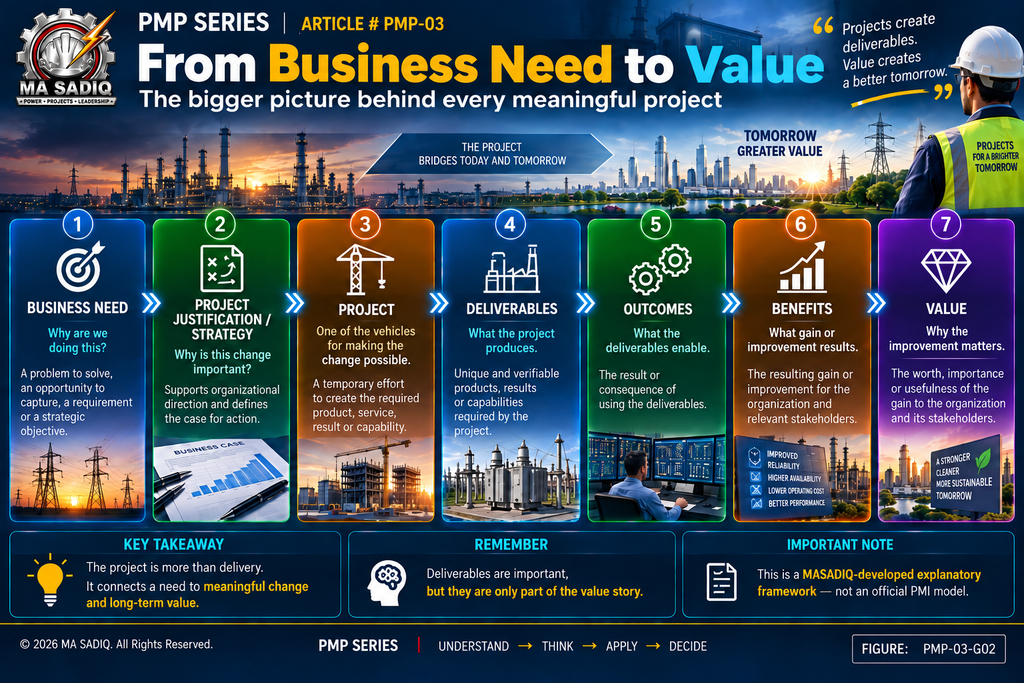
Fig PMP-03-G02 — From Business Need To Value
5. From Business Need to Value — A Practical Framework
A useful way to see the bigger picture is to look at the flow from business need to value.
The following is an explanatory framework to help visualize how these elements are connected:

Business Need
Something needs to change. There may be a problem, opportunity, requirement, strategic objective, or organizational need.
Project Justification / Strategy
The organization determines why the change is important and how the project supports its broader direction.
Project
The project is undertaken to create the required product, service, result, or capability.
Deliverables
The project produces the required outputs.
Outcomes
The deliverables enable something to happen or change.
Benefits
The resulting change produces a benefit or gain.
Value
Those benefits create worth or importance for the organization and/or stakeholders.
The key lesson is:
The project is only one part of the value story.
6. Why Can a Technically Successful Project Miss the Mark?
Imagine a project that delivers a new software system intended to improve productivity. The system works. Testing is completed successfully. Users have access. The project closes.
But productivity does not improve. What happened?
Perhaps:
- users were not adequately prepared,
- training and coaching were insufficient,
- the organizational process needed to change,
- adoption was weak,
- operational practices did not change,
- or the original assumption about how the benefit would be achieved was incorrect.
The lesson is important: A deliverable can be technically correct without being sufficient to achieve the intended outcome.
Project teams therefore need to understand not only what they are delivering, but also what that deliverable is intended to enable.
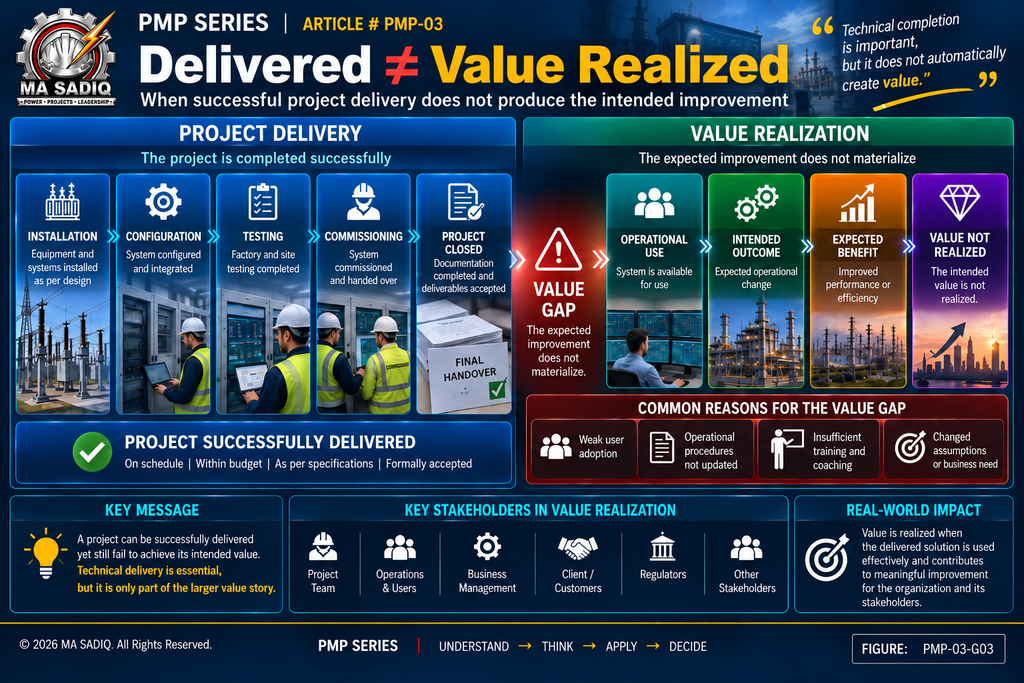
Fig PMP-03-G03 — Delivered ≠ Value Realized
7. Why Projects May Fail to Create Intended Value
Several situations can create a gap between project delivery and value realization.
- The deliverable does not enable the intended outcome
The project delivers exactly what was specified, but the solution does not produce the expected operational change.
- Stakeholders do not adopt the solution
The technical solution exists, but people do not use it effectively.
- Organizational processes do not change
The new capability is available, but old procedures continue to dominate.
- Original assumptions change
The project was justified using assumptions that are no longer valid.
- The business need changes
The organization may no longer need the capability in the same way.
- Benefits depend on activities outside the project
The project may deliver the required capability, but other organizational actions are necessary before benefits can be realized.
This is why project professionals need to think beyond the immediate project outputs.
8. Real Project Application — Power-Sector Example
Consider a typical power-sector control and monitoring project. A project team is assigned to implement a new control and monitoring system. The team:
- installs the required hardware,
- configures the applications,
- completes testing,
- performs commissioning,
- trains selected personnel,
- completes documentation,
- hands over the system.
The contractual deliverables are complete. The project can potentially be closed. Technically, it is a success.
But several months later, the expected operational improvement has not materialized. Why?
Perhaps:
- the system is not fully integrated into operational practices,
- users are not using the new functionality effectively,
- procedures were not updated,
- additional organizational changes were required,
- operational ownership was not sufficiently established,
- or the assumptions behind the expected improvement have changed.
The value-oriented question is therefore not simply: “Did we install and commission the system?”
The deeper question is: “Is the delivered solution enabling the intended operational outcome?”
That is value thinking.
It does not mean that the project manager personally controls every benefit after project completion.
Operational leaders, users, business managers, and other stakeholders may have important responsibilities in realizing the benefits.
The project manager and project team should help keep the project connected to its intended outcomes and work with relevant stakeholders so that the deliverables are positioned to enable those outcomes.
And value may be realized:
- during the project,
- at project completion,
- or after the project has ended.
9. Value Is Not Necessarily the Same for Everyone
Imagine that a project delivers an improved plant control system:
- The project sponsor may value improved operational performance.
- The plant manager may value greater availability.
- The operator may value easier monitoring.
- The maintenance engineer may value improved diagnostics.
- The finance team may value reduced operating cost.
- The customer may value improved service reliability.
- The regulator may value compliance.
- The same project can therefore create different forms of value for different stakeholders.
- This reinforces an important project-management principle:
Understanding stakeholder perspectives is essential when determining whether the project is actually creating the intended value.
10. What Happens When the Business Need Changes?
Consider a project that was approved two years ago. At that time, the organization had a particular strategy and business need. During project execution:
- the business strategy changes,
- a competing solution becomes available,
- technology advances,
- market conditions change,
- or the expected benefit decreases.
The project may still be technically feasible. It may still be possible to complete it. It may even remain within the approved budget. Should the project automatically continue?
Not necessarily.
The project should be considered in the context of the changed business need, expected outcomes, benefits, and value.
If the project is no longer aligned with organizational needs—or is unlikely to provide sufficient value—the organization may decide to terminate it.
Stopping such a project is not necessarily a failure. Continuing a project that no longer creates meaningful value may represent the greater failure.
But the correct response is not to cancel immediately. The situation needs to be understood, evaluated, and decided appropriately with the relevant stakeholders.
11. WHAT WOULD YOU DO?
Scenario
Suppose, you are managing a project involving an electrical and control system. The project is approximately 85% complete. Major equipment has been delivered. Installation is progressing. The project remains within budget. The project is slightly behind schedule. During execution, the client changes its operating strategy. The original business case assumed an operating model that would generate significant benefits from the project. Under the new strategy, the expected benefits are substantially reduced.
Your project team argues: “We are already 85% complete. We should finish the project.”
What would you do?
A. Accelerate the project to finish as quickly as possible.
B. Continue because too many resources have already been invested.
C. Review the changed business need, expected outcomes, benefits, and value with the relevant stakeholders and reassess the project justification.
D. Immediately terminate the project.
Best Answer: C
The key issue is not simply how much work has already been completed.
The key issue is whether the project remains justified in light of the changed business need and expected value.
Option A focuses on delivery speed. Option B falls into the sunk-cost trap. Option D is premature because the situation should first be understood and evaluated. Option C applies value-oriented project thinking.
PMP mindset: Understand the change → assess its impact on outcomes and value → engage the relevant stakeholders → support an informed decision.
12. PMP Exam Lens
When you see a PMP scenario involving project value, look for clues such as:
Delivery vs. Outcome
The project has delivered the required product, but the expected improvement has not occurred.
Ask: “What outcome was the deliverable supposed to enable?”
Changed Business Need
The business environment or organizational strategy has changed.
Ask: “Is the project still aligned with the current need?”
Changed Benefits
The expected benefits have declined.
Ask: “Does the project still justify the investment?”
Stakeholder Perspective
Different stakeholders see value differently.
Ask: “Whose value or outcome is being discussed?”
Sunk-Cost Trap
A large amount has already been spent.
Ask: “Does previous investment justify continuing the project?”
The answer is generally no. Past expenditure should not, by itself, determine future decisions.
On-Time and On-Budget
The project is performing well against schedule and cost.
Ask: “Is it also producing the intended outcome and value?”
Scope Complete
All contractual requirements have been fulfilled.
Ask: “Does completion of scope automatically mean realization of intended value?”
Again, not necessarily.
13. Common Mistakes / PMP Exam Traps
Trap 1 — “The project is complete; therefore, it delivered value.”
Completion does not automatically prove value realization.
Trap 2 — “The deliverable is accepted; therefore, the outcome is achieved.”
Acceptance of a deliverable and achievement of an outcome are different things.
Trap 3 — “We have already spent most of the budget.”
Previous expenditure is not a sufficient reason to continue an unjustified project.
Trap 4 — “The project is within budget, so it is successful.”
Cost performance is important, but it is not the complete definition of value.
Trap 5 — “The requirements were met, so the project cannot be questioned.”
Requirements may have been satisfied while the underlying business need has changed.
Trap 6 — “Benefits are only the project manager’s responsibility.”
Benefits often depend on activities and stakeholders beyond the project team’s direct control.
Trap 7 — “Value means financial return only.”
Value can be financial, operational, strategic, customer-related, organizational, social, environmental, qualitative, quantitative, or a combination.
14. Value Check
A practical way to test value thinking is to ask five questions:
- NEED: What need or opportunity justified the project?
- OUTCOME: What change should the deliverables enable?
- BENEFIT: What improvement should result?
- VALUE: Why does that improvement matter?
- EVIDENCE: How will we know that the expected improvement is actually occurring?
This checklist can be used during project discussions, reviews, steering meetings, lessons-learned sessions, and PMP scenario analysis.
15. Value Thinking Throughout the Project
Value thinking should not begin at project closure. It should be considered throughout the project journey.
Initiation
Ask: Why is this project needed?
Planning
Ask: What outcomes and benefits are expected?
Execution
Ask: Are we still producing the deliverables needed to enable those outcomes?
Delivery
Ask: Is the solution ready to be used effectively?
Transition
Ask: Are the relevant stakeholders prepared to use and sustain the capability?
Realization
Ask: Is the expected improvement actually occurring?
Measurement can therefore move beyond traditional project measures such as:
- schedule,
- cost,
- scope,
- quality,
toward measures associated with:
- operational performance,
- adoption,
- capability,
- reliability,
- efficiency,
- customer experience,
- strategic outcomes,
- or other relevant benefits.
The exact measures should depend on the project’s purpose and context.
16. A Deeper Engineering Perspective
Engineering professionals are naturally trained to look for physical evidence.
We ask:
- Was the equipment installed?
- Was the system tested?
- Were the drawings approved?
- Were inspections completed?
- Were commissioning activities completed?
- Were punch-list items closed?
- Was the plant handed over?
These are essential questions. But senior project leadership requires another level of thinking.
The question becomes: “What changed because we delivered this?”
An EPC project may construct a power plant or a substation. A control-system project may install and commission a new upgraded system. A plant modification project may complete all technical requirements.
These achievements matter.
But the deeper question is whether the resulting capability contributes to the operational or business outcomes for which the project was undertaken.
This is the difference between: Delivering something and Delivering something that matters.
17. The Value Story Does Not Necessarily End at Project Closure
Project closure marks the end of the project. It does not necessarily mark the end of the value story. A facility may operate for decades. A control system may support operations for many years. An organizational capability may continue to generate benefits long after the project team has disbanded.
Therefore, the contribution of a project to organizational value can extend beyond the formal project boundary. The project team may not control everything that happens after closure. But the team should understand:
What the project is expected to enable after it is completed.
That perspective helps create better decisions during the project itself.
18. Test Yourself
Question 1
A project delivers all approved scope, but the expected business improvement does not occur. What should the project professional recognize?
Answer: Deliverable completion does not necessarily mean the intended outcome or value has been achieved.
Question 2
A project’s business need has significantly changed during execution. What should be considered?
Answer: The continued alignment of the project with the current business need, expected outcomes, benefits, and value.
Question 3
A project manager argues that the project must continue because 80% of the budget has already been spent. What is the problem with this reasoning?
Answer: It relies on sunk cost rather than evaluating the project’s current justification and expected future value.
Question 4
A project deliverable is technically complete, but users are not adopting it. What should the project professional consider?
Answer: Whether the deliverable is enabling the intended outcome and whether relevant stakeholder adoption or transition activities are required.
19. Key Takeaways
- Projects exist to create change, not merely to produce deliverables.
- A deliverable is not the same as an outcome.
- An outcome is not the same as a benefit.
- A benefit is not automatically the same as value.
- Successful project delivery does not automatically guarantee value realization.
- Value depends on the project’s purpose and stakeholder perspectives.
- Changed business needs can change the justification for continuing a project.
- Past investment should not become the sole reason for continuing a project.
- Project professionals should think beyond technical completion toward intended outcomes and benefits.
- The PMP mindset asks not only “Did we deliver?” but also “What value is this delivery intended to create?”
20. PMP Memory Box
Deliver → Enable → Benefit → Value
Deliverable: What we produce
Outcome: What the deliverable enables
Benefit: What gain or improvement results
Value: Why the gain matters
And behind the entire chain:
Business Need: Why are we doing this project in the first place?
PMP Memory Rule: Do not stop your thinking at delivery. Follow the chain toward outcome, benefit, and value.
21. Professional Insight
“A technically successful project can still be strategically unsuccessful if the value it was intended to create never materializes.”
As engineers and project professionals, we naturally focus on what can be measured at the project boundary:
Scope, Cost, Schedule, Quality, Technical Compliance: These remain essential.
But mature project leadership asks a bigger question: “Did our work make the intended difference?”
That is where project management moves from simply managing execution toward managing meaningful change.
22. Conclusion
A project is more than a temporary effort that produces a deliverable. Behind every meaningful project is a reason. A need. An opportunity. A strategic objective. A desired change.
The project creates deliverables to enable outcomes. Outcomes are expected to generate benefits. And those benefits are expected to create value.
That is why:
Delivering the project is important—but delivering the intended value is the bigger objective.
For PMP aspirants, this mindset helps decode scenario-based questions.
For practicing project professionals, it helps connect day-to-day execution with the reason the project exists.
And for engineering leaders, it provides a powerful reminder:
Do not measure success only by what you built. Ask what your work enabled, what improved, and why that improvement matters.
References:
- Project Management Institute (PMI).
The Standard for Project Management and A Guide to the Project Management Body of Knowledge (PMBOK® Guide) — Seventh Edition.
Continue Learning
PMP-01 → PMI Ethics and Professional Responsibility
PMP-02 → Kanban Project Management
PMP-03 → Project Value and Value Realization
Next: PMP-04 — Risk Is Not Uncertainty: Understanding the Different Faces of Project Uncertainty
The series will progressively connect PMI principles with practical project-management thinking and real engineering/ project management scenarios.
👨💼 ABOUT THE AUTHOR
Engr. Muhammad Akram Sadiq is a Senior Electrical Engineer and Project Management Professional, with over 30 years of international experience in engineering, construction, commissioning, operation & maintenance, instrumentation & control, and project management.
Throughout his career, he has contributed to major power generation, substation and industrial infrastructure projects with a strong focus on technical excellence, leadership, quality, safety, and continuous improvement.
Through his professional brand MA SADIQ, he is committed to transforming practical experience into structured knowledge that empowers engineers, project professionals, and future leaders to achieve professional excellence.
About the PMP Series
The PMP Series is designed to bridge the gap between PMP examination concepts and practical project-management application. The series focuses on:
Understand → Think → Apply → Decide
rather than memorizing definitions alone.
Each article connects PMI concepts with realistic project situations, particularly from power sector industrial and infrastructure project environments.
Disclaimer
This publication is intended solely for educational and professional development purposes. Although every effort has been made to ensure the accuracy and usefulness of the information presented, project requirements, engineering codes, standards, contractual frameworks, market conditions, regulations, and management practices may vary and are periodically revised. Readers should always consult the latest official editions of relevant publications, applicable legislation, client specifications, contractual requirements, organizational procedures, and project-specific requirements before applying any information to engineering or project-management activities.
The examples and recommendations presented in this article are intended to support professional learning and constructive discussion. They should not be considered a substitute for project-specific engineering, commercial, financial, legal, regulatory, or management judgment. The views expressed are those of the author and are intended to promote professional learning and constructive discussion.
—THE END—