PMP Series | Article# PMP-02 Mastering the Kanban Board
—————————————————————–
Clarity is the primary driver of execution speed. In complex engineering projects or multi-tiered corporate frameworks, the greatest threat to timelines is often the unseen buildup of operational friction—untracked tasks, bottlenecks in engineering approvals, and over-allocated human capital.
To combat this, modern project managers rely heavily on visual management systems, with the “Kanban Board” being chief among them. Originating from the lean manufacturing lines of Toyota, Kanban has evolved into an indispensable, cross-industry tactical steering wheel that transforms abstract tracking into a living repository of real-time project status.
In the article, “Mastering the Kanban Board: Driving Operational Excellence in Everyday Project Management,” I share a practical breakdown of how to leverage this tool effectively:
– Beyond the Basics: How highly technical projects benefit from tailored lanes like ‘Estimation/Bidding’, ‘QMS Review’, or ‘Testing & Commissioning’.
– Enforcing WIP Limits: An explicit mechanism that eliminates multitasking bottlenecks, lowers cycle times, and forces execution focus.
– The ‘Pull’ System: Shifting away from pushing assignments onto overloaded teams, and pulling work only when capacity opens up to safeguard output quality.
– A Step-by-Step Blueprint: Mapping your actual workflow, establishing a clear “Definition of Done,” and maximizing daily 10-minute standups.
Ultimately, visual management is less about tracking cards and more about cultivating a culture of continuous improvement. Visualizing your workflow is the fastest path to mastering it.
👇 Read the full technical breakdown in the article attached below. I would welcome your insights on how you leverage visual workflows to protect your project’s critical path.
If you find this content useful, pls like and share this post.
Learn > Share > Grow
EPC Project Management Series – Article# PMP-02
Mastering the Kanban Board
Understanding the Different Faces of Project Uncertainty

Engr. Muhammad Akram Sadiq CE (SCE), PMP® (PMI)
Sr. Electrical Engineer & Projects Manager
Executive Summary
In the execution of complex engineering systems, multi-tiered construction layouts, or corporate operational frameworks, clarity is the primary driver of execution speed. One of the most pervasive risks in project management is the unseen buildup of operational friction—untracked tasks, bottlenecks in engineering approvals, and over-allocated human capital. To combat this, modern project managers rely heavily on visual management systems. Chief among these systems is the Kanban Board.
Originating from the lean manufacturing lines of Toyota in the 1940s, Kanban (literally translating to ‘signboard’ or ‘visual card’ in Japanese) has evolved into an indispensable, cross-industry project management tool. Here is a comprehensive breakdown of what Kanban boards are, why they are essential for your daily workflow, and exactly how to implement them effectively.
📦What is a Kanban Board?
At its core, a Kanban board is an agile project management tool designed to help visualize work, limit work-in-progress (WIP), and maximize efficiency (or flow). It serves as a living repository of a project’s current state, transforming abstract tasks into highly tangible visual items.
A standard Kanban board relies on three fundamental structural components:
- 📋 Columns: Representing distinct stages in a project lifecycle or process flow. The simplest implementation uses ‘To Do’, ‘In Progress’, and ‘Done’. However, highly technical projects often leverage tailored lanes such as ‘Estimation/Bidding’, ‘QMS Review’, or ‘Testing & Commissioning’.
- 📇 Cards: Each representing an individual work item or task. These cards hold critical metadata at a glance, including task descriptions, priority levels, assigned personnel, technical constraints, and deadlines.
- 🛑 Work-in-Progress (WIP) Limits: Explicit constraints placed on the maximum number of items allowed in a single column at any given moment. This is the mechanism that differentiates Kanban from a standard checklist.
- 🖼️ Visualizing Workflow: A Typical Kanban Board
Below is an analytical breakdown of a high-performance Kanban workflow, demonstrating how WIP limits optimize execution and highlight technical blockages:
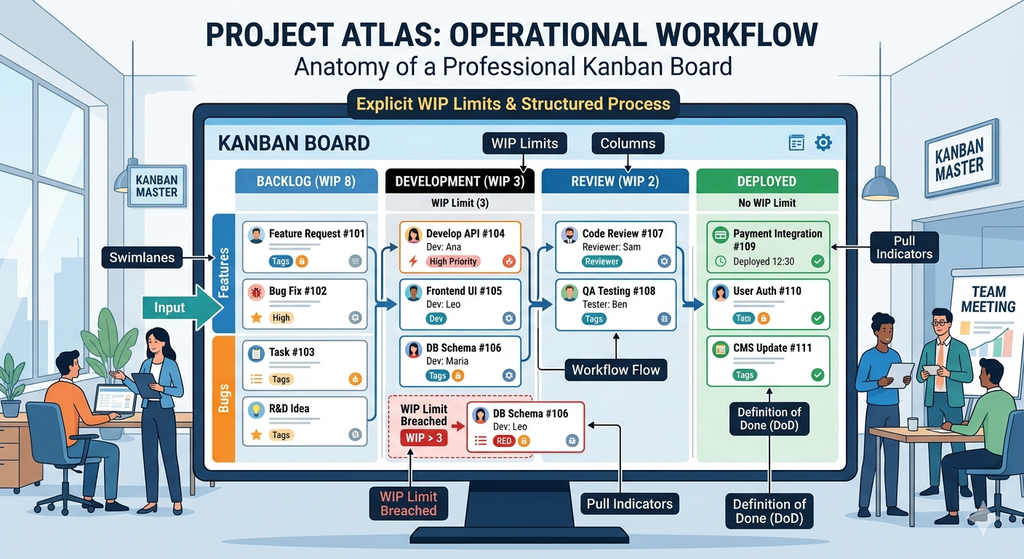
Anatomy of a professional Kanban Board showing a structured workflow with explicit WIP limits.
💡 Why Use Kanban? The Significance in Everyday Project Management
For project leaders, engineers, and department heads, a Kanban board is not merely an administrative tracking mechanism; it is a tactical steering wheel. Its significance manifests across several major domains:
1. Instantaneous Bottleneck Detection
When a project relies on spreadsheets or text-heavy status reports, workflow stagnation is often buried. On a Kanban board, if five engineering drawings are waiting for a Quality Management System (QMS) check, the ‘Review’ column immediately balloons visually. This alerts the project lead to redistribute resources before a critical path delay occurs.
2. Prevention of Over-Allocation through WIP Limits
Multitasking is a major threat to operational efficiency. By imposing strict Work-in-Progress limits (e.g., allowing a maximum of two tasks in the ‘In Progress’ column per team member), Kanban forces execution focus. Teams must complete active tasks before dragging new ones forward, directly lowering cycle times and optimizing throughput.
3. Enhanced Team Alignment and Collaboration
Instead of repetitive coordination meetings, a Kanban board acts as a single source of truth. Whether managing a structural solar PV layout optimization project or drafting a complex corporate standard operating procedure (SOP), every stakeholder can view the board and immediately understand the real-time project status without needing to interrupt the engineering team.
⚙️The Operational Principle:
Kanban operates on a ‘Pull‘ system rather than a ‘Push’ system. Instead of constantly pushing new assignments onto an overloaded engineering or project team, new work is pulled into the active lane only when capacity opens up. This preserves output quality and prevents burn-out.
🛠️How to Implement a Kanban Board: A Practical Step-by-Step Guide
🗺️Step 1: Map Your Current Workflow
Avoid copying a generic framework if it doesn’t match your reality. Trace how a task actually moves from initial conception to completion. For an engineering department, that sequence might be: Backlog → Detailed Estimation → Layout Design → Peer Review → Client Sign-off → Closed.
🎯 Step 2: Define Clear Scope on Cards
Every card must represent a clear, actionable unit of work. Ensure each card contains a descriptive title, clear ownership, and explicit completion criteria (Definition of Done) listed on the back or within the tool metadata.
✋Step 3: Establish and Enforce WIP Limits
Set realistic limits on your active columns. A good starting guideline is to set your ‘In Progress’ limit to (Number of Team Members × 1.5). For example, if you have 4 engineers, allow no more than 6 tasks to be active concurrently.
⏱️Step 4: Conduct Brief Daily Standups
Spend 10 minutes every morning standing in front of the board (physically or digitally). Rather than discussing general statuses, focus explicitly on flow:
‘What cards are blocked?
Why is this card stuck in review?
How do we move this item to Done today?
🎯 Conclusion: A Culture of Continuous Improvement
Ultimately, a Kanban board is more than just columns and cards—it is an engine for continuous improvement (Kaizen). It uncovers operational realities, highlights engineering constraints, and empowers project managers to drive predictable, high-quality delivery. Whether you deploy it via physical sticky notes on an office wall or leverage robust digital enterprise platforms, visualizing your workflow is the fastest path to mastering it.