📘 𝗘𝗣𝗖 𝗣𝗿𝗼𝗷𝗲𝗰𝘁 𝗠𝗮𝗻𝗮𝗴𝗲𝗺𝗲𝗻𝘁 𝗦𝗲𝗿𝗶𝗲𝘀 | 𝗔𝗿𝘁𝗶𝗰𝗹𝗲# 𝗘𝗣𝗖-𝟬𝟯
👨💼 𝗔𝗽𝗽𝗹𝗶𝗰𝗮𝗯𝗹𝗲 𝗖𝗼𝗱𝗲𝘀, 𝗦𝘁𝗮𝗻𝗱𝗮𝗿𝗱𝘀 & 𝗙𝗿𝗮𝗺𝗲𝘄𝗼𝗿𝗸𝘀 𝗳𝗼𝗿 𝗘𝗣𝗖 𝗣𝗿𝗼𝗷𝗲𝗰𝘁 𝗠𝗮𝗻𝗮𝗴𝗲𝗺𝗲𝗻𝘁
Dear Friends and Professionals,
🤝 𝗚𝗿𝗲𝗲𝘁𝗶𝗻𝗴𝘀! I hope you are doing well!
I am pleased to share a new article of the Series.
Engineering, Procurement, and Construction (EPC) projects rely on internationally recognized codes, standards, contractual frameworks, and project management practices. Understanding how these references complement one another is essential for delivering projects that are safe, compliant, efficient, and successful.
One common misconception is that a single standard governs the entire EPC project lifecycle. In reality, successful project delivery depends on applying multiple references, each serving a specific purpose throughout the project lifecycle.
In this article, we explore the principal codes, standards, and frameworks that every EPC Project Manager should know and how they contribute to successful EPC project delivery.
📚 𝗜𝗻 𝘁𝗵𝗶𝘀 𝗮𝗿𝘁𝗶𝗰𝗹𝗲, 𝘆𝗼𝘂’𝗹𝗹 𝗹𝗲𝗮𝗿𝗻:
✅ The differences between codes, standards, and project management frameworks.
✅ Major international references applicable to EPC projects.
✅ How these references support each phase of the EPC project lifecycle.
✅ Common misconceptions regarding codes and standards.
✅ Practical lessons and project management insights for successful EPC project delivery.
Whether you are an engineering student, an early-career engineer, a project professional, or an experienced EPC practitioner, I hope this article provides practical knowledge and valuable insights for your continuous professional development.
💬 𝗗𝗶𝘀𝗰𝘂𝘀𝘀𝗶𝗼𝗻 𝗤𝘂𝗲𝘀𝘁𝗶𝗼𝗻
Which codes, standards, or project management frameworks have had the greatest impact on the success of your EPC projects, and why?
Please share your thoughts and experiences in the comments. Your insights may help fellow engineers and project professionals learn from diverse perspectives.
🙏 𝗜𝗳 𝘆𝗼𝘂 𝗳𝗶𝗻𝗱 𝘁𝗵𝗶𝘀 𝗰𝗼𝗻𝘁𝗲𝗻𝘁 𝘂𝘀𝗲𝗳𝘂𝗹, 𝗽𝗹𝗲𝗮𝘀𝗲 𝗹𝗶𝗸𝗲 𝗮𝗻𝗱 𝗿𝗲𝗽𝗼𝘀𝘁.
📘 𝗟𝗲𝗮𝗿𝗻 > 𝗦𝗵𝗮𝗿𝗲 > 𝗚𝗿𝗼𝘄
EPC Project Management Series – Article# EPC-03
Applicable Codes, Standards & Frameworks for EPC Project Management
A Practical Overview of the Codes, Standards & Frameworks Every EPC Project Manager Should Know
Engr. Muhammad Akram Sadiq CE (SCE), PMP® (PMI)
Sr. Electrical Engineer & Projects Manager
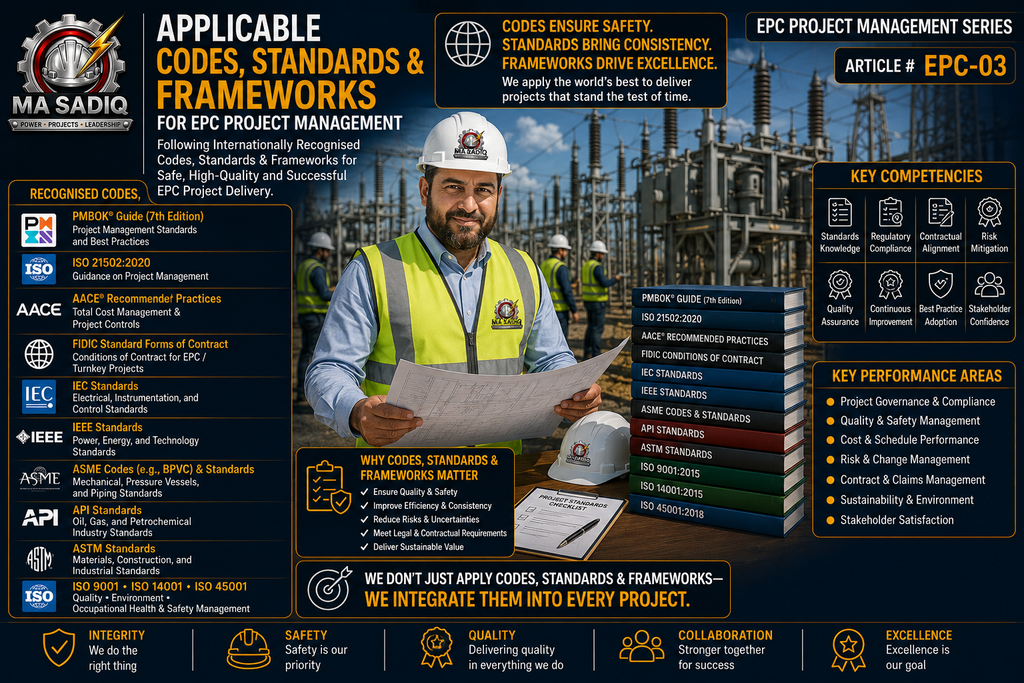
Figure EPC-03-G01 Applicable Codes, Standards & Frameworks for EPC Project Management
🚀 1. Introduction
Engineering, Procurement, and Construction (EPC) projects are among the most complex undertakings in modern industry. They involve multidisciplinary engineering teams, international suppliers, specialized contractors, consultants, regulatory authorities, inspection agencies, and project owners, all working together under demanding technical, commercial, contractual, and regulatory requirements. Successfully managing such projects requires more than technical expertise—it demands disciplined project management supported by recognized professional practices.
In Article EPC-001, we introduced the fundamentals of EPC Project Management and explained why a structured project management approach is essential for delivering successful engineering projects. In Article EPC-002, we explored the role of the EPC Project Manager and examined the leadership, coordination, and decision-making responsibilities required to integrate multidisciplinary teams and achieve balanced project outcomes.
Successful EPC Project Management, however, depends upon more than effective leadership and coordination. Every project is executed within a framework of recognized codes, standards, contractual frameworks, management system standards, client specifications, and applicable regulatory requirements that establish common engineering and management practices, improve consistency, enhance quality, strengthen safety, and support regulatory compliance.
These recognized references have been developed through decades of engineering experience, industry collaboration, and continual improvement. They provide a common professional language that enables organizations from different countries and engineering disciplines to work together efficiently while maintaining internationally accepted levels of quality, safety, reliability, and technical performance.
It is important to recognize that no single code, standard, or framework governs every aspect of an EPC project. Instead, successful project delivery depends on the coordinated application of multiple recognized references, each serving a specific purpose within the overall project environment.
This article provides a practical overview of the principal codes, standards, and frameworks that every EPC Project Manager should know. Rather than studying each reference in detail, our objective is to understand why these recognized references exist, where they are applied, how they complement one another, and how they collectively contribute to successful EPC project delivery.
🎯 2. Learning Objectives
After completing this article, you will be able to:
✅ Explain why recognized codes, standards, and frameworks are essential for EPC Project Management.
✅ Identify the principal categories of codes, standards, and frameworks commonly encountered in EPC projects.
✅ Understand the purpose of major project management frameworks, engineering codes and standards, contractual frameworks, and management system standards.
✅ Appreciate how multiple recognized references complement one another throughout the EPC project lifecycle.
📚 3. Applicable Codes, Standards & Frameworks for EPC Project Management
Modern EPC projects rely on the coordinated application of recognized codes, standards, and frameworks rather than a single governing document. Each reference has been developed to address a specific aspect of project delivery, whether it relates to project management, engineering design, contractual administration, quality management, environmental management, occupational health and safety, or organizational governance.
Collectively, these recognized references establish a common professional language that enables organizations from different countries, engineering disciplines, and industries to collaborate more effectively while maintaining consistent levels of quality, safety, technical excellence, and regulatory compliance.
For practical understanding, these references can be grouped into four broad categories:
- 📘 Project Management Standards & Frameworks
- ⚙️ Engineering & Technical Codes & Standards
- 📜 Contractual & Legal Frameworks
- 🏢 Management System Standards
Each category contributes to a different aspect of project success, yet none operates independently. Successful EPC Project Management is achieved through the effective integration of all four categories.
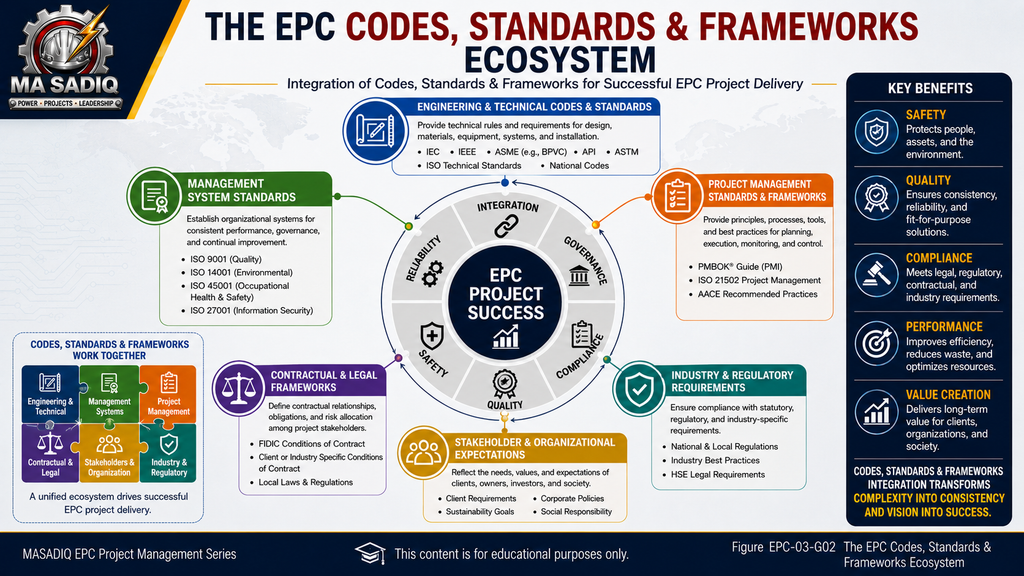
Figure EPC-03-G02 The EPC Codes, Standards & Frameworks Ecosystem
🌍 3.1 Why Codes, Standards & Frameworks Matter
As EPC projects continue to increase in size, technical complexity, and geographical diversity, the importance of recognized codes, standards, and frameworks becomes even more significant. Without common references, organizations may adopt different engineering practices, terminology, documentation methods, inspection procedures, quality requirements, contractual approaches, and management processes, leading to inconsistency, misunderstanding, increased project risk, and reduced efficiency.
Recognized codes, standards, and frameworks provide a structured foundation that enables multidisciplinary teams to work towards common objectives using internationally accepted practices.
Their consistent application helps organizations to:
- 🤝 Establish a common professional language.
- 📋 Standardize engineering and project management practices.
- 🏆 Improve quality and technical consistency.
- 🛡️ Enhance health, safety, and environmental performance.
- ⚖️ Support contractual and regulatory compliance.
- 📉 Reduce uncertainty and project risk.
- 📈 Improve stakeholder confidence.
- 🌍 Facilitate collaboration across international project teams.
Rather than replacing engineering judgement, recognized codes, standards, and frameworks provide a foundation within which engineers and project managers apply their professional knowledge, experience, and leadership to deliver safe, high-quality, and successful EPC projects.
📘 3.2 Project Management Standards & Frameworks
Project management standards and frameworks provide structured guidance for planning, organising, executing, monitoring, and controlling projects. They establish recognized principles and good practices that enable project teams to manage scope, schedule, cost, quality, resources, risks, communications, procurement, and stakeholders in a systematic and coordinated manner.
Although organizations may adopt different project management methodologies, several internationally recognized references have become widely accepted across the EPC industry because of their comprehensive guidance and proven effectiveness.
📗 PMBOK® Guide
The Project Management Body of Knowledge (PMBOK® Guide), published by the Project Management Institute (PMI), is one of the world’s most recognized project management references. It provides a recognized body of knowledge comprising principles, performance domains, and good practices that support effective project delivery across a wide range of industries.
For EPC Project Managers, the PMBOK® Guide provides recognized good practices for project planning, stakeholder engagement, risk management, communications, schedule management, cost management, and performance monitoring.
🌍 ISO 21502
ISO 21502 – Project, Programme and Portfolio Management — Guidance on Project Management provides internationally recognized guidance for project management. It establishes common concepts, principles, and terminology that support consistent project management practices across organizations and geographical regions.
For multinational EPC projects involving diverse stakeholders, ISO 21502 establishes common terminology and promotes a consistent understanding of project management principles, strengthening organizational consistency across international teams.
📈 AACE International Recommended Practices
AACE International publishes recognized recommended practices that focus primarily on cost engineering and project controls. These practices provide valuable guidance in areas such as estimating, planning, scheduling, cost control, progress measurement, earned value management, and risk analysis.
Together, the PMBOK® Guide, ISO 21502, and AACE International Recommended Practices complement one another by strengthening project governance, planning, estimating, scheduling, cost control, and overall project performance.
⚙️ 3.3 Engineering & Technical Codes & Standards
While project management frameworks provide guidance for planning and controlling projects, engineering codes and standards define how engineering work should be performed. They establish recognized technical requirements for the design, manufacture, installation, inspection, testing, commissioning, operation, and maintenance of engineering systems and equipment.
Although the terms code and standard are often used together, they serve different purposes. Engineering codes establish technical requirements that become mandatory when adopted by legislation, regulation, contractual agreement, or client requirements. Engineering standards, on the other hand, provide recognized technical specifications, recommended practices, testing methods, and performance requirements that support consistent engineering design and execution.
Engineering codes and standards promote consistency, compatibility, reliability, safety, and quality throughout the project lifecycle. They also provide a common technical language that enables equipment manufacturers, engineering consultants, contractors, inspection agencies, and project owners to work together effectively.
The specific codes and standards applied on an EPC project depend upon factors such as the engineering discipline, industry sector, project location, client requirements, statutory regulations, and contractual obligations. Consequently, EPC organizations typically apply codes and standards developed by several internationally recognized organizations.
⚡ IEC – International Electrotechnical Commission
The International Electrotechnical Commission (IEC) develops internationally recognized standards for electrical, electronic, and related technologies. IEC standards are extensively applied in power generation, transmission, distribution, industrial automation, renewable energy, and electrical infrastructure projects.
For EPC projects, IEC standards support:
- Electrical system design
- Equipment specifications
- Protection and control systems
- Switchgear and substations
- Cables and wiring systems
- Electrical testing and commissioning
Because IEC standards are recognized worldwide, they facilitate compatibility between equipment supplied by manufacturers from different countries, promoting interoperability and reliable system performance.
🔌 IEEE – Institute of Electrical and Electronics Engineers
The Institute of Electrical and Electronics Engineers (IEEE) publishes internationally recognized technical standards covering electrical engineering, electronics, communications, automation, power systems, instrumentation, and emerging technologies.
IEEE standards are particularly valuable in projects involving:
- Power system studies
- Protection systems
- Industrial automation
- Smart grids
- Communication systems
- Digital substations
- Control systems
Many EPC projects apply IEEE standards alongside IEC standards, enabling project teams to benefit from internationally recognized engineering practices while meeting specific client or regional requirements.
🏗️ ASME – American Society of Mechanical Engineers
The American Society of Mechanical Engineers (ASME) develops internationally recognized codes and standards for mechanical engineering applications.
ASME publications are widely used in projects involving:
- Pressure vessels
- Boilers
- Piping systems
- Mechanical equipment
- Rotating machinery
- Power plants
- Process facilities
Among its best-known publications is the ASME Boiler and Pressure Vessel Code (BPVC), which establishes requirements for the design, fabrication, inspection, testing, and certification of pressure-retaining equipment. The BPVC is widely recognized as a benchmark for ensuring the safety and integrity of pressure equipment used across numerous industries.
🛢️ API – American Petroleum Institute
The American Petroleum Institute (API) publishes standards that are extensively applied within the oil, gas, petrochemical, and energy sectors.
API standards provide guidance for:
- Storage tanks
- Pipelines
- Pumps
- Compressors
- Pressure-relieving systems
- Drilling equipment
- Refinery facilities
- Inspection and integrity management
For EPC contractors working in the energy industry, API standards help ensure equipment reliability, operational safety, and regulatory compliance throughout the lifecycle of industrial facilities.
🧱 ASTM International
ASTM International develops voluntary consensus standards covering materials, products, systems, and testing methods across numerous engineering disciplines.
ASTM standards are frequently referenced for:
- Material specifications
- Concrete
- Steel
- Protective coatings
- Fasteners
- Construction materials
- Laboratory testing
- Quality verification
These standards help ensure that materials supplied to EPC projects meet defined performance and quality requirements before they are incorporated into the completed engineering asset.
Engineering codes and standards are not intended to replace engineering judgement. Rather, they establish recognized technical requirements and accepted engineering practices that support consistent decision-making while improving safety, reliability, quality, and the long-term performance of engineering assets.
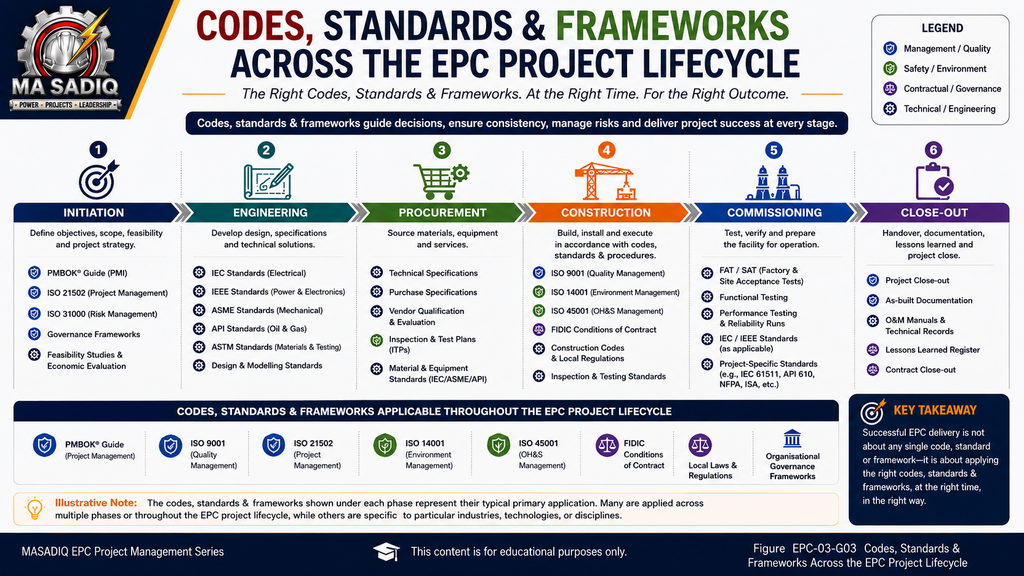
Figure EPC-03-G03 Codes, Standards & Frameworks Across the EPC Project Lifecycle
Note: The codes, standards, and frameworks shown under each phase represent their typical primary application. In practice, many of these recognized references apply across multiple phases of the EPC project lifecycle. Their applicability depends on the project type, engineering discipline, contractual requirements, client specifications, statutory regulations, and organizational procedures.
📜 3.4 Contractual & Legal Frameworks
Engineering excellence alone cannot guarantee project success. Every EPC project is also governed by contractual arrangements that define the rights, responsibilities, obligations, and allocation of risks among project stakeholders. A well-structured contract establishes clear expectations, promotes effective collaboration, and provides mechanisms for managing changes, claims, payments, and dispute resolution.
Contractual frameworks therefore play a critical role in transforming technical designs into successfully executed projects.
🤝 FIDIC Conditions of Contract
The International Federation of Consulting Engineers (FIDIC) publishes one of the world’s most widely recognized families of standard forms of contract for engineering and construction projects.
FIDIC contracts provide balanced contractual frameworks by clearly defining the responsibilities of employers, contractors, engineers, and other project participants while establishing procedures for administering projects fairly and consistently.
Common areas addressed by FIDIC include:
- Scope of work
- Time for completion
- Payment mechanisms
- Variations and change management
- Quality requirements
- Risk allocation
- Claims procedures
- Dispute avoidance and resolution
Because FIDIC contracts are internationally recognized, they are extensively used in infrastructure, energy, transportation, water, industrial, and utility projects funded by governments, private organizations, and international financial institutions.
Although FIDIC is one of the most widely recognized contractual frameworks for international EPC projects, many organizations also adopt other recognized standard forms of contract or employer-specific contractual conditions depending on the project type, jurisdiction, procurement strategy, and client requirements.
For EPC Project Managers, a sound understanding of contractual obligations is just as important as technical knowledge. Effective contract administration helps minimize disputes, supports timely decision-making, and contributes significantly to successful project delivery.
🏢 3.5 Management System Standards
Successful EPC organizations do not rely solely on competent engineers or well-written contracts. They also establish robust organizational management systems that ensure projects are delivered consistently, efficiently, and in accordance with recognized international best practices.
Unlike engineering codes and standards, which establish technical requirements for engineering activities, management system standards define how organizations manage their processes to achieve consistent performance and continual improvement. They provide structured frameworks that strengthen organizational governance, improve operational efficiency, and enhance long-term business performance.
Management system standards support organizations in managing quality, environmental stewardship, occupational health and safety, information security, asset management, and continual improvement in a systematic and disciplined manner.
Among the most widely recognized management system standards applicable to EPC organizations are:
- ISO 9001 — Quality Management Systems
- ISO 14001 — Environmental Management Systems
- ISO 45001 — Occupational Health and Safety Management Systems
- ISO 55001 — Asset Management Systems
- ISO/IEC 27001 — Information Security Management Systems
✅ ISO 9001 — Quality Management Systems
ISO 9001 specifies the requirements for establishing, implementing, maintaining, and continually improving a Quality Management System (QMS).
Its primary objective is to ensure that organizations consistently deliver products and services that satisfy customer requirements while promoting continual improvement throughout the organisation.
Within EPC projects, ISO 9001 supports:
- Controlled engineering and project delivery processes
- Document and record management
- Design verification and validation
- Supplier and subcontractor quality management
- Inspection and testing
- Corrective and preventive actions
- Continual improvement
An effective Quality Management System reduces rework, improves customer satisfaction, strengthens stakeholder confidence, and enhances overall project performance.
🌱 ISO 14001 — Environmental Management Systems
ISO 14001 establishes the framework for an Environmental Management System (EMS).
It assists organizations in identifying environmental aspects, managing environmental impacts, complying with applicable legal and regulatory requirements, and continually improving environmental performance throughout the project lifecycle.
Environmental management is increasingly integrated into project planning from the earliest stages of EPC projects, enabling organizations to minimize environmental impacts while supporting sustainable development.
Typical applications include:
- Waste management
- Pollution prevention
- Resource conservation
- Energy efficiency
- Environmental compliance
- Sustainable project practices
By integrating environmental management into project execution, EPC organizations contribute to sustainable development while reducing environmental risks and strengthening their environmental performance.
🦺 ISO 45001 — Occupational Health and Safety Management Systems
ISO 45001 specifies the requirements for an Occupational Health and Safety Management System (OHSMS).
Its purpose is to create safer workplaces by systematically identifying hazards, assessing risks, implementing appropriate controls, and promoting continual improvement in occupational health and safety performance.
Within EPC projects, ISO 45001 supports:
- Hazard identification
- Risk assessment
- Safe systems of work
- Incident prevention
- Worker participation
- Emergency preparedness
- Safety culture improvement
The effective implementation of ISO 45001 helps protect personnel, minimize workplace incidents, strengthen organizational resilience, and foster a proactive safety culture throughout project execution.
🔄 3.6 Integrating Codes, Standards & Frameworks Throughout the EPC Project Lifecycle
One of the most common misconceptions among new project professionals is that codes, standards, and frameworks are applied independently. In reality, successful EPC projects achieve their objectives through the coordinated application of multiple recognized references throughout the entire project lifecycle.
An EPC Project Manager rarely relies on a single reference document. Instead, they coordinate the application of project management frameworks, engineering codes and standards, contractual frameworks, management system standards, client specifications, and applicable regulatory requirements to ensure that every phase of the project is executed consistently and effectively.
Each category contributes a distinct but complementary role:
- 📘 Project Management Standards & Frameworks provide structured guidance for planning, monitoring, controlling, and closing projects.
- ⚙️ Engineering & Technical Codes & Standards establish recognized technical requirements for design, procurement, manufacturing, installation, testing, commissioning, operation, and maintenance.
- 📜 Contractual & Legal Frameworks define commercial obligations, contractual responsibilities, the allocation of risks, and mechanisms for managing changes and claims.
- 🏢 Management System Standards ensure that organizational processes consistently support quality, environmental stewardship, occupational health and safety, information security, asset management, and continual improvement.
Rather than operating in isolation, these recognized references complement one another to establish a comprehensive governance structure that supports informed decision-making, effective stakeholder collaboration, regulatory compliance, and successful project delivery.
Figure EPC-03-G03 illustrates the typical primary application of selected codes, standards, and frameworks across the EPC project lifecycle. In practice, many of these recognized references extend across multiple project phases, while others apply only to specific industries, engineering disciplines, technologies, contractual arrangements, or regulatory environments.
The role of the EPC Project Manager is not to become a technical expert in every individual code or standard. Rather, it is to understand when each recognized reference applies, why it is important, how different references complement one another, and when specialist expertise is required.
Successful EPC organizations therefore do not treat codes, standards, and frameworks merely as compliance documents. Instead, they integrate them into project planning, engineering design, procurement, construction, commissioning, organizational governance, and continual improvement, creating a disciplined environment that consistently supports successful project delivery.
💡 4. Engineering Insight
One of the distinguishing characteristics of experienced EPC Project Managers is their ability to recognize which codes, standards, and frameworks apply at different stages of a project and to ensure they are integrated effectively.
Technical specialists are responsible for applying discipline-specific engineering codes and standards within their areas of expertise. However, the EPC Project Manager must coordinate the work of multiple engineering disciplines, contractors, suppliers, consultants, and stakeholders to ensure that all applicable technical, contractual, regulatory, and organizational requirements are addressed throughout the project lifecycle.
Rather than attempting to memorize every engineering code or management standard, successful EPC Project Managers develop a practical understanding of:
- Which recognized references apply to their projects.
- Why each reference is important.
- When each reference should be applied.
- How different codes, standards, and frameworks complement one another.
- Where specialist expertise is required.
This holistic project perspective enables Project Managers to make informed decisions, coordinate multidisciplinary teams effectively, reduce project risks, and deliver projects that satisfy technical, contractual, regulatory, quality, safety, and stakeholder expectations.
❌ 5. Common Misconceptions
Several misconceptions frequently arise among engineers and project professionals who are new to EPC Project Management. Clarifying these misconceptions helps establish a more realistic understanding of how recognized codes, standards, and frameworks contribute to successful project delivery.
❌Misconception: “One standard covers the entire EPC project.”
✅ Reality: No single code, standard, or framework governs every aspect of an EPC project. Successful project delivery depends on the coordinated application of multiple recognized references, each serving a different purpose. Project management frameworks, engineering codes and standards, contractual frameworks, management system standards, client specifications, and applicable regulatory requirements work together to support the successful execution of engineering projects.
❌Misconception: “Engineering standards are only relevant to design engineers.”
✅ Reality: Engineering codes and standards influence the entire project lifecycle, including procurement, manufacturing, construction, inspection, testing, commissioning, operation, and maintenance. Although technical specialists are responsible for their detailed implementation, Project Managers should understand their overall application to ensure effective coordination across multidisciplinary teams.
❌Misconception: “FIDIC is mandatory for every EPC project.”
✅ Reality: FIDIC is one of the world’s most widely recognized contractual frameworks, particularly for international infrastructure and EPC projects. However, organizations may adopt other recognized standard forms of contract or employer-specific contractual conditions depending on the project type, jurisdiction, procurement strategy, client requirements, and applicable legislation.
❌Misconception: “Compliance with management system standards guarantees project success.”
✅ Reality: Management system standards provide structured organizational processes and support continual improvement. However, successful projects also depend on competent leadership, sound engineering judgement, effective communication, stakeholder collaboration, disciplined project execution, and a culture of continuous learning and accountability.
📖 6. Lessons Learned
Over more than three decades of professional practice, I have observed that successful EPC projects are rarely achieved through technical expertise alone. The organizations that consistently deliver outstanding project outcomes integrate recognized project management frameworks, engineering codes and standards, contractual frameworks, management system standards, client specifications, and regulatory requirements into their everyday project practices.
Projects often experience avoidable delays, quality issues, contractual disputes, or increased costs—not because recognized references are unavailable, but because they are misunderstood, applied inconsistently, or overlooked during project planning and execution.
One of the most valuable lessons I have learned is that effective Project Managers do not need to become specialists in every individual code or standard. Instead, they should understand the purpose of each recognized reference, know when specialist expertise is required, and ensure that multidisciplinary teams work together within a coordinated project management framework.
Ultimately, recognized codes, standards, and frameworks should not be viewed merely as compliance requirements. When applied thoughtfully and consistently, they become practical tools that support safer engineering, higher quality, stronger collaboration, better decision-making, reduced project risk, and more successful project outcomes.
📊 7. Project Management Insight
Project success is achieved through the effective integration of people, processes, technology, and recognized professional practices.
Codes establish technical requirements. Standards promote consistency and accepted engineering practices. Frameworks provide structured guidance for project management and contractual administration. Together, they create an environment in which multidisciplinary teams can collaborate effectively while delivering projects that satisfy technical, commercial, regulatory, quality, safety, and stakeholder expectations.
An effective EPC Project Manager understands that project leadership is not about knowing every technical detail. It is about coordinating the right expertise, applying the appropriate recognized references at the appropriate time, enabling informed decision-making, and fostering collaboration that leads to successful project outcomes.
The ability to integrate these recognized references into practical project execution is one of the defining characteristics of high-performing EPC Project Managers and a key contributor to long-term organizational success.
🎯 8. Key Takeaways
Now that you have gone through the article, remember these important points:
- EPC projects rely on the coordinated application of recognized codes, standards, and frameworks, not a single governing document.
- Project management standards and frameworks provide structured guidance for planning, execution, monitoring, control, and project governance.
- Engineering codes and standards establish recognized technical requirements and accepted engineering practices that support safe and reliable engineering solutions.
- Contractual frameworks define commercial relationships, contractual responsibilities, and the allocation of project risks.
- Management system standards strengthen organizational governance, support continual improvement, and promote consistent project delivery.
- Different recognized references complement one another throughout the EPC project lifecycle and should be applied in an integrated manner.
- Effective EPC Project Managers understand when, why, and how recognized references should be applied rather than attempting to master every technical detail.
- Successful project delivery depends not only on technical competence but also on effective leadership, collaboration, disciplined execution, and the coordinated application of recognized professional practices.
🏁 9. Conclusion
Engineering, Procurement, and Construction (EPC) projects are among the most technically demanding and organizationally complex undertakings in modern industry. Successfully delivering these projects requires far more than engineering expertise alone. It requires disciplined project management, effective leadership, structured governance, sound contractual administration, and the coordinated application of recognized codes, standards, and frameworks.
Throughout this article, we have explored the principal categories of recognized references that support successful EPC project delivery. We have seen how project management standards and frameworks provide structured guidance for planning and controlling projects, engineering codes and standards establish recognized technical requirements and accepted engineering practices, contractual frameworks define commercial relationships and contractual responsibilities, and management system standards promote organizational consistency and continual improvement.
No single code, standard, or framework can address every aspect of an EPC project. Instead, successful projects depend upon the effective integration of multiple recognized references, each contributing to a specific aspect of project planning, engineering, procurement, construction, commissioning, and organizational governance.
For EPC Project Managers, the objective is not to become specialists in every individual code or standard. Rather, it is to understand which recognized references apply, why they are important, when they should be applied, and how they complement one another throughout the project lifecycle.
Ultimately, recognized codes, standards, and frameworks represent far more than compliance requirements. They embody decades of collective engineering knowledge, professional experience, and industry best practices that help organizations improve safety, enhance quality, reduce project risks, strengthen stakeholder confidence, and deliver successful, sustainable engineering projects.
As EPC projects continue to increase in complexity, Project Managers who understand how to integrate these recognized references into practical project execution will be better equipped to lead multidisciplinary teams, make informed decisions, and consistently deliver successful project outcomes.
📚 Continue Learning
This article introduced the principal codes, standards, and frameworks commonly encountered in EPC Project Management. Each represents a specialized body of knowledge that warrants further study and practical application.
To strengthen your professional competence, consider exploring:
- PMBOK® Guide – Project Management Institute (PMI)
- ISO 21502 – Project, Programme and Portfolio Management — Guidance on Project Management
- FIDIC Conditions of Contract
- IEC Standards
- IEEE Standards
- ASME Codes and Standards
- API Standards
- ASTM International Standards
- ISO 9001 – Quality Management Systems
- ISO 14001 – Environmental Management Systems
- ISO 45001 – Occupational Health and Safety Management Systems
- AACE International Recommended Practices
A broad understanding of these recognized references will help Project Managers communicate more effectively with multidisciplinary teams, make better-informed project decisions, and contribute to the successful delivery of complex engineering projects.
👤 About the Author
Engr. Muhammad Akram Sadiq is a Senior Electrical Engineer and Project Management Professional (PMP®) with over 30 years of international experience in engineering, construction, commissioning, operation & maintenance, instrumentation & control, and project management. Throughout his career, he has contributed to major power generation, transmission, and industrial infrastructure projects with a strong focus on technical excellence, leadership, quality, safety, and continuous improvement.
Through his professional brand MA SADIQ, he is committed to transforming practical engineering experience into structured knowledge that empowers engineers, project professionals, and future leaders to achieve engineering excellence.
📚 About the EPC Project Management Series
The MASADIQ EPC Project Management Series is a structured educational publication developed to provide engineers, project managers, students, and industry professionals with practical knowledge covering the complete lifecycle of EPC projects.
Each article explores a specific topic, progressing systematically from foundational concepts to advanced project management practices, while emphasizing professional excellence, leadership, and continuous learning.
⚠️ Disclaimer
This publication is intended solely for educational and professional development purposes.
Although every effort has been made to ensure the accuracy of the information presented, engineering codes, standards, contractual frameworks, and management system standards are periodically revised. Readers should always consult the latest official editions of the relevant publications, applicable legislation, client specifications, contractual requirements, and organizational procedures before applying any information to engineering projects.
The views expressed are those of the author and are intended to promote professional learning and constructive discussion.
📚 References
- Project Management Institute (PMI). A Guide to the Project Management Body of Knowledge (PMBOK® Guide).
- ISO 21502. Project, Programme and Portfolio Management — Guidance on Project Management.
- FIDIC. Conditions of Contract.
- International Electrotechnical Commission (IEC). IEC Standards.
- Institute of Electrical and Electronics Engineers (IEEE). IEEE Standards.
- American Society of Mechanical Engineers (ASME). Codes and Standards.
- American Petroleum Institute (API). Standards.
- ASTM International. Standards.
- ISO 9001. Quality Management Systems — Requirements.
- ISO 14001. Environmental Management Systems — Requirements with Guidance for Use.
- ISO 45001. Occupational Health and Safety Management Systems — Requirements with Guidance for Use.
- AACE International. Recommended Practices.
📘 Glossary
Code
A document that establishes technical requirements that become mandatory when adopted by legislation, regulation, contractual agreement, or client requirements.
Standard
A recognized document that provides technical specifications, recommended practices, testing methods, or performance requirements to promote consistency, quality, safety, and interoperability.
Framework
A structured set of principles, processes, or guidance that supports the consistent management or execution of projects and organizational activities.
EPC
Engineering, Procurement, and Construction.
FIDIC
International Federation of Consulting Engineers.
PMBOK® Guide
Project Management Body of Knowledge published by the Project Management Institute (PMI).
ISO
International Organization for Standardization.
💬 Closing Message
Thank you for reading the article!
A sound understanding of recognized codes, standards, and frameworks enables Project Managers to bridge the gap between technical excellence and effective project leadership. As engineering projects continue to evolve in complexity, continuous learning and the disciplined application of recognized professional practices remain essential for delivering safe, reliable, high-quality, and successful project outcomes.
In the next article, we will continue building this foundation by exploring another important aspect of EPC Project Management.
— THE END —