📘 𝗘𝗣𝗖 𝗣𝗿𝗼𝗷𝗲𝗰𝘁 𝗠𝗮𝗻𝗮𝗴𝗲𝗺𝗲𝗻𝘁 𝗦𝗲𝗿𝗶𝗲𝘀 | 𝗔𝗿𝘁𝗶𝗰𝗹𝗲 𝗘𝗣𝗖-𝟬𝟰
🏗️ 𝗘𝗣𝗖 𝗣𝗿𝗼𝗷𝗲𝗰𝘁 𝗟𝗶𝗳𝗲𝗰𝘆𝗰𝗹𝗲 𝗢𝘃𝗲𝗿𝘃𝗶𝗲𝘄 — 𝗙𝗿𝗼𝗺 𝗖𝗼𝗻𝗰𝗲𝗽𝘁 𝘁𝗼 𝗖𝗹𝗼𝘀𝗲𝗼𝘂𝘁
Dear Friends and Professionals,
🤝 𝗚𝗿𝗲𝗲𝘁𝗶𝗻𝗴𝘀! I hope you are doing well!
I am pleased to share Article EPC-04 of the Series.
Engineering, Procurement, and Construction (EPC) projects are complex, multidisciplinary undertakings that transform an initial business need or project concept into a fully engineered, constructed, tested, commissioned, and operational asset.
The EPC lifecycle is not simply a sequence of independent phases. Each stage is interconnected, and decisions made during one stage can significantly influence performance, risks, cost, schedule, and outcomes in subsequent stages.
In this article, we explore the seven major stages of the EPC project lifecycle and the role of integrated project management in delivering safe, high-quality, on-time, and cost-effective projects that create lasting value.
📚 𝗜𝗻 𝘁𝗵𝗶𝘀 𝗮𝗿𝘁𝗶𝗰𝗹𝗲, 𝘆𝗼𝘂’𝗹𝗹 𝗹𝗲𝗮𝗿𝗻:
✅ The seven major stages of a typical EPC project lifecycle.
✅ Key activities and Project Manager’s focus at each stage.
✅ How interfaces between lifecycle stages influence project performance.
✅ Common misconceptions about the EPC lifecycle.
✅ Practical lessons and project management insights for successful EPC project delivery.
Whether you are an engineering student, an early-career engineer, a project professional, or an experienced EPC practitioner, I hope this article provides practical knowledge and valuable insights for your continuous professional development.
💬 𝗗𝗶𝘀𝗰𝘂𝘀𝘀𝗶𝗼𝗻 𝗤𝘂𝗲𝘀𝘁𝗶𝗼𝗻
𝗜𝗻 𝘆𝗼𝘂𝗿 𝗲𝘅𝗽𝗲𝗿𝗶𝗲𝗻𝗰𝗲, 𝘄𝗵𝗶𝗰𝗵 𝘀𝘁𝗮𝗴𝗲 𝗼𝗳 𝘁𝗵𝗲 𝗘𝗣𝗖 𝗹𝗶𝗳𝗲𝗰𝘆𝗰𝗹𝗲 𝗵𝗮𝘀 𝘁𝗵𝗲 𝗴𝗿𝗲𝗮𝘁𝗲𝘀𝘁 𝗶𝗺𝗽𝗮𝗰𝘁 𝗼𝗻 𝗼𝘃𝗲𝗿𝗮𝗹𝗹 𝗽𝗿𝗼𝗷𝗲𝗰𝘁 𝘀𝘂𝗰𝗰𝗲𝘀𝘀 — 𝗮𝗻𝗱 𝘄𝗵𝘆?
Please share your thoughts and experiences in the comments. Your insights may help fellow engineers and project professionals learn from diverse perspectives.
🙏 𝗜𝗳 𝘆𝗼𝘂 𝗳𝗶𝗻𝗱 𝘁𝗵𝗶𝘀 𝗰𝗼𝗻𝘁𝗲𝗻𝘁 𝘂𝘀𝗲𝗳𝘂𝗹, 𝗽𝗹𝗲𝗮𝘀𝗲 𝗹𝗶𝗸𝗲 𝗮𝗻𝗱 𝗿𝗲𝗽𝗼𝘀𝘁.
📘 𝗟𝗲𝗮𝗿𝗻 > 𝗦𝗵𝗮𝗿𝗲 > 𝗚𝗿𝗼𝘄
EPC Project Management Series – Article# EPC-04
EPC Project Lifecycle Overview
From Concept to Closeout — Delivering Value at Every Stage

Engr. Muhammad Akram Sadiq CE (SCE), PMP® (PMI)
Sr. Electrical Engineer & Projects Manager
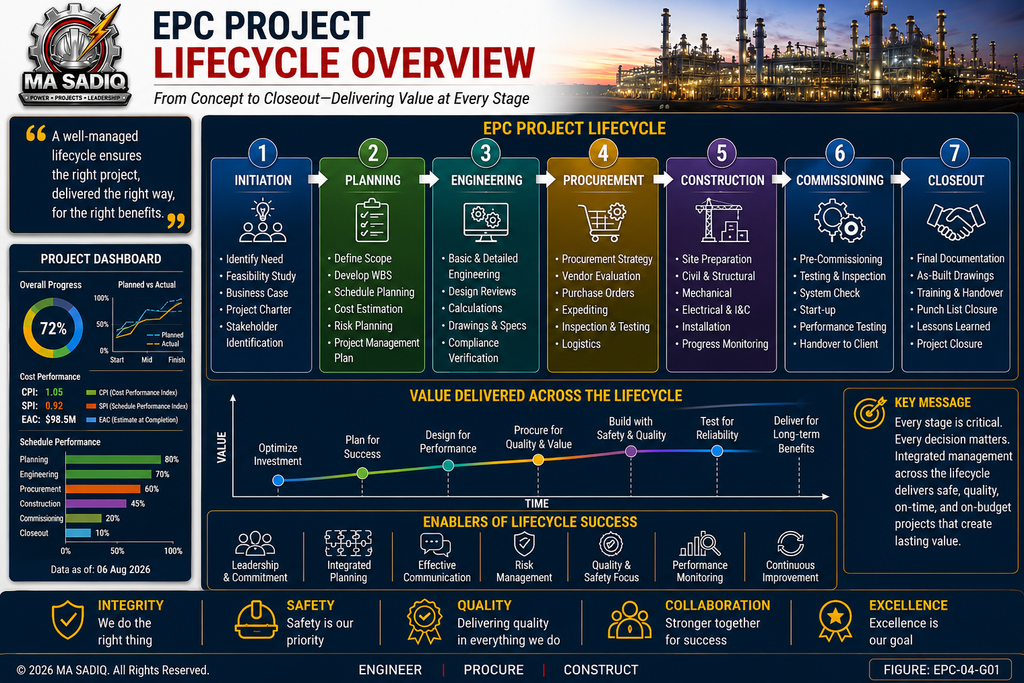
Figure EPC-04-G01 — EPC Project Lifecycle Overview
🚀 1. Introduction
Engineering, Procurement, and Construction (EPC) projects are complex, multidisciplinary undertakings that transform an initial business need or project concept into a fully engineered, constructed, tested, commissioned, and operational asset.
Although EPC projects differ significantly by industry, technology, size, contractual strategy, and project environment, successful projects generally follow a structured lifecycle in which activities, decisions, deliverables, and responsibilities evolve from one stage to the next.
Understanding this lifecycle is fundamental to effective EPC Project Management.
An EPC Project Manager must look beyond individual activities and understand how decisions made during one stage influence performance in subsequent stages. A poorly defined requirement during initiation can create design changes later. Incomplete planning can lead to procurement delays. Procurement decisions can affect construction progress, while construction quality can directly influence commissioning and start-up performance.
The EPC lifecycle is therefore not simply a sequence of independent phases. It is an interconnected system in which decisions, information, risks, resources, and deliverables flow continuously from one stage to another.
A typical EPC project lifecycle can be viewed through seven major stages: Initiation, Planning, Engineering, Procurement, Construction, Commissioning and Closeout
Each stage has its own primary objectives, activities, deliverables, and decision points. At the same time, effective project management requires continuous attention to safety, quality, risk, cost, schedule, communication, stakeholder expectations, and overall project value throughout the lifecycle.
This article provides a practical overview of the EPC project lifecycle and explains how an EPC Project Manager can integrate these stages to deliver the right project, in the right way, for the right outcome.
🎯 2. Learning Objectives
After completing this article, you will be able to:
✅ Understand the major stages of a typical EPC project lifecycle.
✅ Recognize the key activities and deliverables associated with each lifecycle stage.
✅ Understand how decisions and outputs from one stage influence subsequent stages.
✅ Appreciate the importance of integrated management across the entire project lifecycle.
✅ Identify the key management practices that support safe, high-quality, on-time, and cost-effective project delivery.
📚 3. The EPC Project Lifecycle
The EPC project lifecycle provides a structured pathway for transforming a project concept into an operational asset and completing all contractual and administrative obligations.
While the exact lifecycle varies according to project type and contractual arrangement, the following seven-stage model provides a practical framework for understanding a typical EPC project:

The stages should not be viewed as completely isolated activities. Significant overlap can occur between them, and effective project management requires continuous coordination across their interfaces.
For example, procurement activities may begin while engineering is still being finalized. Construction may start in areas where engineering deliverables have been completed while other design packages remain under development. Similarly, commissioning planning should begin well before construction is complete.
The EPC Project Manager therefore has a critical role in managing both individual stage performance and the interfaces between stages.
💡 3.1 Initiation — Establishing the Foundation
The Initiation stage establishes why the project is required, what it is expected to achieve, and whether it is sufficiently justified to proceed.
Typical activities include:
- Identifying the project need.
- Conducting feasibility studies.
- Developing the business case.
- Establishing preliminary project objectives.
- Developing the project charter.
- Identifying key stakeholders.
- Defining initial project requirements.
- Establishing the initial project strategy.
The quality of decisions made during initiation can significantly influence the entire project lifecycle.
A poorly defined project objective or incomplete understanding of stakeholder requirements can result in scope uncertainty, changes, cost growth, schedule delays, and disputes later in the project.
The primary objective of initiation is therefore to establish a clear and realistic foundation for the project before significant resources are committed.
🎯 Project Manager’s Focus
At this stage, the EPC Project Manager should focus on:
- Clarity of objectives.
- Initial scope definition.
- Stakeholder alignment.
- Project feasibility.
- Major risks and constraints.
- Preliminary execution strategy.
- Clear decision-making authority.
A strong initiation stage creates the foundation for effective planning and controlled project execution.
📋 3.2 Planning — Preparing for Successful Execution
Once the project is authorized to proceed, the Planning stage converts the project objectives into an executable delivery strategy.
Planning establishes how the project will be organized, executed, monitored, controlled, and ultimately delivered.
Typical planning activities include:
- Defining and developing the project scope.
- Developing the Work Breakdown Structure (WBS).
- Establishing the project schedule.
- Developing cost estimates and budgets.
- Identifying and assessing project risks.
- Developing procurement and contracting strategies.
- Establishing project controls.
- Developing the Project Management Plan.
- Defining communication and reporting requirements.
- Establishing quality, safety, and environmental strategies.
Effective planning does not attempt to predict every future event. Instead, it establishes a structured basis for making informed decisions and responding effectively when conditions change.
The project schedule, cost baseline, risk register, procurement strategy, quality plans, and execution plans created during this stage become important management tools throughout project execution.
📋 Project Manager’s Focus
The Project Manager should ensure that the project has:
- A clearly defined scope.
- A realistic and integrated schedule.
- A credible cost baseline.
- Identified risks and response strategies.
- Defined responsibilities and interfaces.
- Appropriate project controls.
- A practical execution strategy.
Planning for success is not an administrative exercise—it is one of the most important management activities in the entire EPC lifecycle.
🛠️ 3.3 Engineering — Converting Requirements into Solutions
The Engineering stage transforms project requirements and performance objectives into detailed technical solutions that can be procured, constructed, tested, and commissioned.
Engineering may include conceptual, basic, and detailed design activities depending on the project delivery strategy and scope.
Typical activities include:
- Developing basic and detailed engineering.
- Performing engineering calculations and analyses.
- Preparing drawings and technical specifications.
- Developing equipment and material requirements.
- Conducting interdisciplinary design reviews.
- Verifying compliance with applicable codes, standards, regulations, and client requirements.
- Resolving technical interfaces between disciplines.
- Incorporating approved changes and design improvements.
Engineering is one of the most influential stages of the EPC lifecycle because design decisions directly affect procurement, construction, commissioning, operation, maintainability, safety, and project cost.
A technically sound design that is not constructible, procurable, maintainable, or aligned with project requirements can still create significant project problems.
🔧 Project Manager’s Focus
The EPC Project Manager should ensure:
- Engineering deliverables are aligned with the approved scope.
- Engineering progress supports procurement and construction requirements.
- Interfaces between engineering disciplines are effectively managed.
- Design reviews and technical approvals are completed on time.
- Changes are properly evaluated and controlled.
- Applicable codes, standards, specifications, and regulatory requirements are addressed.
Good engineering does more than produce drawings — it creates a practical and controlled path toward successful project execution.
📦 3.4 Procurement — Securing the Right Resources
The Procurement stage converts engineering requirements into the materials, equipment, services, and resources needed to construct and commission the project.
Procurement activities may begin while engineering is still progressing, particularly for long-lead equipment. This makes coordination between engineering, procurement, vendors, project controls, and construction essential.
Typical procurement activities include:
- Developing procurement strategies.
- Preparing purchase and procurement specifications.
- Identifying and prequalifying vendors.
- Issuing requests for quotation.
- Evaluating technical and commercial offers.
- Placing purchase orders.
- Reviewing vendor documents.
- Expediting manufacturing and delivery.
- Conducting inspections and testing.
- Coordinating transportation and logistics.
Procurement performance can have a direct impact on the project schedule. Delayed equipment, incomplete documentation, quality problems, or ineffective vendor management can create downstream impacts on construction and commissioning.
📦 Project Manager’s Focus
The Project Manager should maintain visibility of:
- Procurement priorities.
- Long-lead items.
- Vendor performance.
- Manufacturing progress.
- Inspection and testing.
- Documentation status.
- Transportation and logistics.
- Interfaces between procurement and construction schedules.
Procurement is not simply purchasing — it is securing the right resources, from the right sources, at the right quality and at the right time.
🏗️ 3.5 Construction — Turning Design into Reality
The Construction stage transforms approved engineering designs, materials, equipment, and project resources into the physical facility.
Construction may involve multiple disciplines and work fronts, including civil, structural, mechanical, electrical, instrumentation, and control activities.
Typical activities include:
- Site preparation.
- Civil and structural works.
- Mechanical installation.
- Electrical installation.
- Instrumentation and control installation.
- Equipment installation.
- Pre-commissioning preparation.
- Inspection and testing.
- Construction quality control.
- Progress monitoring and reporting.
- Punch-list management.
Construction is where many earlier project decisions become visible in physical form. Engineering quality, procurement performance, site planning, resource availability, and change management can all have a direct impact on construction productivity and quality.
🦺 Project Manager’s Focus
The EPC Project Manager should maintain strong control over:
- Safety performance.
- Construction quality.
- Schedule progress.
- Labor and equipment productivity.
- Material availability.
- Engineering and construction interfaces.
- Subcontractor performance.
- Site changes and technical queries.
- Inspection and testing.
- Punch-list development and closure.
Successful construction requires disciplined execution, effective coordination, and continuous attention to safety, quality, schedule, and productivity.
⚙️ 3.6 Commissioning — Preparing the Facility for Operation
The Commissioning stage verifies that the completed systems and facilities are ready to operate safely, reliably, and in accordance with the approved design and performance requirements.
Commissioning should not be treated as an activity that begins only after construction is complete. Effective commissioning planning starts much earlier and should be integrated with engineering, procurement, and construction activities.
Typical activities include:
- Pre-commissioning inspections.
- System and equipment checks.
- Testing and inspection.
- Functional testing.
- Energization and start-up activities.
- Performance testing.
- Reliability verification.
- Deficiency and punch-list closure.
- Preparation for handover to the client or operating organization.
Commissioning provides an important opportunity to verify whether the project has successfully transformed the original design intent into a functioning operational asset.
⚙️ Project Manager’s Focus
The Project Manager should ensure:
- Commissioning requirements are incorporated into project planning.
- Systems are progressively released for commissioning.
- Required documentation and test records are available.
- Outstanding construction and engineering issues are controlled.
- Safety requirements are strictly maintained during energization and start-up.
- Performance testing is conducted according to approved procedures.
- Handover requirements are clearly defined and tracked.
Commissioning is not simply the final test—it is the transition from project execution to operational performance.
🤝 3.7 Closeout — Completing the Project and Capturing Value
The Closeout stage formally completes the project and transfers the completed asset, documentation, knowledge, and contractual responsibilities to the client or operating organization.
Typical activities include:
- Final documentation.
- As-built drawings and records.
- Operation and maintenance manuals.
- Training and knowledge transfer.
- Final punch-list closure.
- Completion of contractual obligations.
- Final acceptance and handover.
- Lessons learned.
- Project records and archival.
- Contract and commercial closeout.
A project should not be considered fully successful simply because construction is complete or the facility has been commissioned. Effective closeout ensures that the client receives the complete physical asset, documentation, knowledge, and contractual deliverables required for sustainable operation.
🤝 Project Manager’s Focus
The Project Manager should ensure:
- All contractual deliverables are completed.
- As-built documentation is accurate and complete.
- Outstanding technical and commercial issues are resolved.
- Training and knowledge transfer are completed.
- Lessons learned are captured.
- Project records are properly archived.
- Formal project closure is achieved.
A successful closeout preserves the value created by the project and converts project experience into organizational knowledge.
🔄 4. Managing the Interfaces Across the Lifecycle
The seven EPC lifecycle stages provide a useful structure for organizing project activities, but successful delivery depends heavily on how effectively the interfaces between stages are managed.
For example:
Initiation → Planning
Clear objectives and scope provide the foundation for realistic planning.
Planning → Engineering
The approved scope, requirements, schedule, budget, and execution strategy guide engineering development.
Engineering → Procurement
Technical specifications and approved engineering deliverables establish the basis for purchasing equipment and materials.
Procurement → Construction
Timely delivery of compliant materials, equipment, and vendor documentation enables construction activities to proceed as planned.
Construction → Commissioning
Completed and tested systems must be progressively released to support commissioning and start-up.
Commissioning → Closeout
Successful testing, performance verification, documentation, and handover enable formal project completion.
These interfaces demonstrate an important principle:
A delay or quality problem in one stage can create consequences in several subsequent stages.
For this reason, EPC Project Managers must manage the project as an integrated system, rather than as a collection of independent departments or phases.
💡 5. Engineering Insight
A key lesson from EPC project experience is that project success is largely determined by the quality of decisions made before the final result becomes visible.
A project may appear to be progressing well during construction, while underlying issues in scope definition, engineering, procurement, or planning are already creating future problems.
For example:
- An unclear requirement during Initiation may become a scope change during Engineering.
- An incomplete design may create procurement uncertainty.
- A delayed long-lead item may disrupt Construction.
- Poor construction quality may increase Commissioning effort.
- Incomplete documentation may delay Closeout and handover.
This demonstrates the cumulative nature of EPC project performance.
The earlier a problem is identified and addressed, the greater the opportunity to control its impact.
An effective EPC Project Manager therefore looks forward as well as backward:
What decisions made today will affect the next project stage?
This forward-looking mindset helps the project team identify interfaces, anticipate risks, protect the schedule, and preserve project value.
⚠️ 6. Common Misconceptions About the EPC Lifecycle
❌ Misconception 1: Each EPC phase is completely independent.
✅Reality: The phases are interconnected. Decisions and deliverables from one phase directly influence subsequent phases.
❌ Misconception 2: Planning ends when execution begins.
✅Reality: Planning continues throughout the project as conditions change, information becomes available, and risks evolve.
❌ Misconception 3: Engineering must be completely finished before procurement starts.
✅Reality: Depending on the project strategy, procurement of critical or long-lead items may begin while portions of engineering are still progressing.
❌ Misconception 4: Commissioning starts after construction is finished.
✅Reality: Commissioning requirements should be considered during planning and progressively prepared throughout engineering, procurement, and construction.
❌ Misconception 5: Project success means completing construction.
✅Reality: True project completion requires successful commissioning, documentation, handover, contractual completion, and knowledge transfer.
❌ Misconception 6: The Project Manager mainly manages the current phase.
✅Reality: An effective EPC Project Manager manages the entire lifecycle and its interfaces, anticipating how current decisions will affect future outcomes.
📖 7. Lessons Learned from EPC Projects
Several practical lessons emerge from managing projects across the EPC lifecycle.
1️⃣ Define before you execute.
Investing sufficient effort in understanding the need, scope, requirements, and project objectives reduces uncertainty later.
2️⃣ Plan before problems arrive.
Risk identification, schedule development, procurement planning, and interface management should occur before they become urgent site issues.
3️⃣ Manage interfaces—not just activities.
Many EPC problems occur at the boundaries between engineering, procurement, construction, commissioning, and other stakeholders.
4️⃣ Protect the critical path.
Not every activity has the same impact on project completion. Management attention should remain focused on activities and interfaces that can materially affect the project schedule.
5️⃣ Treat quality as a lifecycle responsibility.
Quality should be built into engineering, procurement, construction, testing, and commissioning rather than inspected only at the end.
6️⃣ Start commissioning early.
Commissioning requirements, system boundaries, documentation, test procedures, and handover strategies should be considered well before start-up.
7️⃣ Closeout should not become an afterthought.
Documentation, as-built records, training, punch-list closure, lessons learned, and contractual completion require deliberate planning and follow-up.
📊 8. Project Management Insight
The EPC lifecycle can be viewed as a continuous value-delivery process.
At the beginning, the project is primarily an idea or business need. As the project progresses, that idea is progressively transformed into:

At every stage, the Project Manager must protect five fundamental dimensions of delivery:
🛡️ Safety: People, assets, and the environment must remain protected throughout the lifecycle.
⭐ Quality: Deliverables must meet defined requirements and be fit for their intended purpose.
⏱️ Schedule: Activities, interfaces, and milestones must be coordinated to achieve required completion dates.
💰 Cost: Resources must be managed to deliver the approved scope within the authorized financial framework.
🎯 Value: Decisions should support the long-term objectives of the client and the project — not merely short-term activity completion.
These dimensions are interconnected.
For example, accelerating construction without adequate quality controls may create rework and commissioning delays. Reducing procurement cost without considering equipment reliability may increase lifecycle costs. Compressing engineering without sufficient technical review may create downstream construction and operational problems.
Therefore:
The objective is not simply to complete each stage. The objective is to optimize the overall lifecycle outcome.
🔑 9. Key Takeaways
The following principles summarize the most important lessons from the EPC project lifecycle:
✅ The EPC lifecycle is an integrated system, not a collection of isolated phases.
✅ Strong initiation creates clarity for the entire project.
✅ Effective planning establishes the foundation for controlled execution.
✅ Engineering decisions influence procurement, construction, commissioning, and operation.
✅ Procurement performance can directly affect construction and project schedule.
✅ Construction converts approved design into a physical asset and requires disciplined execution.
✅ Commissioning verifies that the completed systems can perform safely and reliably.
✅ Closeout ensures that the physical asset, documentation, knowledge, and contractual obligations are properly transferred.
✅ Lifecycle interfaces require continuous management.
✅ Successful EPC Project Management focuses on delivering long-term value—not simply completing individual activities.
🏁 10. Conclusion
An EPC project is a journey from concept to operational asset.
Each stage of the lifecycle has a distinct purpose, but none operates in isolation. The quality of decisions, information, resources, and deliverables transferred between stages can significantly influence the final project outcome.
For the EPC Project Manager, the challenge is therefore much greater than managing individual tasks. It requires understanding the complete lifecycle, anticipating interfaces, coordinating multidisciplinary teams, managing risks, controlling performance, and keeping the project aligned with its intended objectives.
A successful EPC project is one in which the lifecycle is managed as an integrated whole:
Initiate with clarity.
Plan with discipline.
Engineer with purpose.
Procure strategically.
Construct safely.
Commission systematically.
Close out professionally.
When these principles are applied consistently, every stage contributes to the ultimate objective:
Delivering a safe, high-quality, on-time, and cost-effective project that creates lasting value for the client and stakeholders.
📚 11. Continue Learning
The EPC Project Lifecycle provides the foundation for understanding how engineering, procurement, construction, commissioning, and closeout activities work together.
Future articles in the MASADIQ EPC Project Management Series will explore specific aspects of EPC Project Management in greater depth, including planning, project controls, risk management, contracts, engineering management, procurement, construction management, commissioning, and leadership.
Continuous learning is essential because every EPC project presents new challenges, interfaces, risks, and opportunities to improve.
📚 12. References
The following recognized references provide useful background for understanding EPC Project Management and project lifecycle practices:
- Project Management Institute (PMI) — A Guide to the Project Management Body of Knowledge (PMBOK® Guide).
- ISO 21502 — Project, Programme and Portfolio Management — Guidance on Project Management.
- FIDIC — Conditions of Contract and associated guidance.
- AACE International — Recommended Practices for cost engineering and project controls.
- Applicable IEC, IEEE, ASME, API, ASTM, ISO, national, and local codes and standards, as relevant to the project.
- Applicable client specifications, contractual requirements, and project procedures.
📖 13. Glossary
EPC — Engineering, Procurement, and Construction.
WBS — Work Breakdown Structure; a hierarchical decomposition of project scope into manageable components.
Project Lifecycle — The sequence of stages through which a project progresses from initiation through completion and closeout.
Long-Lead Item — Equipment or material requiring significant time for engineering, manufacturing, testing, or delivery.
Pre-Commissioning — Activities performed to verify that systems and equipment are ready for commissioning.
Commissioning — The systematic process of testing, verifying, and preparing systems and facilities for safe and reliable operation.
Punch List — A documented list of incomplete, deficient, or outstanding items requiring resolution before final completion.
As-Built Documentation — Final documentation reflecting the facility as actually constructed and installed.
👤 About the Author
Engr. Muhammad Akram Sadiq is a Senior Electrical Engineer and Project Management Professional (PMP®) with over 30 years of international experience in engineering, construction, commissioning, operation & maintenance, instrumentation & control, and project management. Throughout his career, he has contributed to major power generation, transmission, and industrial infrastructure projects with a strong focus on technical excellence, leadership, quality, safety, and continuous improvement.
Through his professional brand MA SADIQ, he is committed to transforming practical engineering experience into structured knowledge that empowers engineers, project professionals, and future leaders to achieve engineering excellence.
📚 About the EPC Project Management Series
The MASADIQ EPC Project Management Series is a structured educational publication developed to provide engineers, project managers, students, and industry professionals with practical knowledge covering the complete lifecycle of EPC projects.
Each article explores a specific topic, progressing systematically from foundational concepts to advanced project management practices, while emphasizing professional excellence, leadership, and continuous learning.
⚠️ Disclaimer
This publication is intended solely for educational and professional development purposes.
Although every effort has been made to ensure the accuracy of the information presented, engineering codes, standards, contractual frameworks, and management system standards are periodically revised. Readers should always consult the latest official editions of the relevant publications, applicable legislation, client specifications, contractual requirements, and organizational procedures before applying any information to engineering projects.
The views expressed are those of the author and are intended to promote professional learning and constructive discussion.
— THE END —