Dear Friends and Professionals,
🤝 Greetings! I hope you are doing well!
I am pleased to share Article PMP-05 of the PMP Series.
Two engineering projects can involve similar disciplines, technologies, clients, or deliverables—and still require very different ways of being managed.
So, should every project follow the same methodology in exactly the same way?
Not necessarily.
A methodology provides structure. Project context determines how that structure should be applied.
This article explores tailoring—the disciplined adaptation of the project management approach to the realities of the project while respecting governance, contractual, regulatory, safety, and quality boundaries.
📚 In this article, you’ll learn:
✅ What tailoring really means from a PMI perspective.
✅ Why one methodology should not be applied blindly.
✅ How organizational methodology differs from project-level tailoring.
✅ What can be added, modified, removed, blended, or aligned.
✅ Why governance boundaries must always be respected.
✅ Why tailoring should be reviewed as the project evolves.
✅ How two similar engineering/EPC projects can require different management approaches.
✅ How to apply the CONTEXT → ASSESS → TAILOR → ALIGN → REVIEW learning framework.
✅ Common PMP exam traps related to tailoring and project context.
Whether you are a PMP aspirant, engineer, project professional, or experienced project leader, I hope this article provides practical insight into applying project-management discipline with sound professional judgment.
🌐 Read or Download the Full Article below:
💡 Key Message:
Don’t fit every project to the methodology.
Fit the approach to the project context.
💬 Discussion Question
Have you ever worked on two projects within the same technical discipline where the management approach needed to be significantly different because of project context?
Please share your thoughts and experiences in the comments.
🙏 If you find this content useful, please like and repost.
📘 Learn > Share > Grow
EPC Project Management Series – Article# PMP-05
Tailoring – Why the Best Project Manager Does Not Follow One Methodology Blindly
Adapting the Project Management Approach to Context, Constraints and Reality

Engr. Muhammad Akram Sadiq CE (SCE), PMP® (PMI)
Sr. Electrical Engineer & Projects Manager
🎯 INTRODUCTION
Projects may involve similar disciplines, technologies, clients, or deliverables and still need to be managed in very different ways. Two engineering projects can both require planning, coordination, reporting, quality control, and stakeholder engagement, yet the level of rigor, formality, speed, and governance they need may not be the same. The real challenge is not whether a team has a methodology. The challenge is whether the way that methodology is being applied actually fits the project in front of them.
An approach that works well in one context may be excessive in another. It can create layers of meetings, approvals, documents, and reporting that consume effort without improving outcomes. The opposite problem is just as dangerous. If the approach is too light for the project’s level of complexity, risk, regulation, contractual exposure, or stakeholder sensitivity, the team can lose control precisely where discipline matters most.
That is why strong project management is not about following one methodology mechanically. It is about making sound judgments about how the project management approach should be applied in its actual environment. The central professional question is simple: Does the management approach fit the project context?
This is where tailoring matters. Tailoring is the disciplined adaptation of the project management approach to the realities of the project so that governance, processes, controls, reporting, and ways of working are appropriate to the work being done. A methodology provides structure. Project context determines how that structure should be used. The goal is not improvisation for its own sake, but a fit-for-purpose approach that supports delivery, decision-making, control, and value.
That boundary is critical. Tailoring does not mean ignoring methodology, bypassing governance, weakening required controls, or setting aside contractual, regulatory, safety, or quality obligations. It means adapting responsibly within legitimate boundaries so the project is neither over-managed nor under-managed.
With that distinction in place, we can now examine what tailoring really means from a PMI perspective.
🧭 THE PMI FOUNDATION: WHAT TAILORING REALLY MEANS
PMI treats tailoring as a normal part of professional project management, not as an exception and not as a shortcut. The project manager does not begin with a blank page and invent a management system from scratch. The starting point is usually an organizational project management approach, governance structure, life cycle model, set of processes, templates, approval rules, reporting expectations, and quality controls. The professional task is to determine how that starting point should be applied to this project.
That matters because no single approach works equally well for all projects all the time. A project with stable requirements, limited interfaces, low external exposure, and familiar technology may not need the same level of control, escalation, documentation, or coordination structure as a project operating under regulatory scrutiny, contractual complexity, multiple contractors, technical interdependence, and strict commissioning constraints. The work may be in the same industry, yet the management approach should not be identical by default.

Figure: PMP-05-G01 — Tailoring the Approach to Project Context
PMI’s tailoring logic is practical. First, understand the project context. Then identify what must remain fixed because of governance, policy, regulation, safety, quality, or contractual commitments. After that, adapt what can legitimately be adapted so that the project management approach is proportional to the project’s actual conditions. That may include decisions about life cycle, reporting cadence, review gates, roles, controls, engagement methods, documentation depth, and decision pathways. The point is not to make the project lighter or heavier in the abstract. The point is to make it more appropriate.
Tailoring also extends beyond choosing between predictive, adaptive, or hybrid delivery patterns. Those choices matter, but they are only one part of the picture. A project may still need tailored governance, stakeholder engagement, approval thresholds, risk reviews, change handling, or quality controls regardless of which development approach is selected. Treating tailoring as nothing more than “choose Agile or not” is too narrow and misses the management reality.
⚖️ WHY ONE METHODOLOGY SHOULD NOT BE APPLIED BLINDLY
Methodology has real value. It provides structure, consistency, shared language, repeatability, and a basis for governance. It helps teams avoid improvising every step and reduces the risk that important work is forgotten. Strong organizations rely on that structure for good reason.
But structure becomes a problem when it is applied without judgment. A project can become over-managed, with too many reviews, too much reporting, too many signoffs, and too much administrative effort relative to the real needs of delivery. Teams start serving the system instead of the project. In that environment, process burden can slow decisions, delay execution, obscure priorities, and reduce responsiveness without adding meaningful control.
The reverse is equally serious. A project can also be under-managed. Teams may simplify governance, reduce documentation, loosen reviews, or compress approvals in ways that feel efficient at first but later expose the project to avoidable risk. Where obligations are strict, interfaces are numerous, safety matters, or contractual accountability is high, weak structure is not agility. It is loss of control.
This is why mature project managers do not ask, “What methodology do we always use?” and stop there. They ask:
“What does this project require, what boundaries are non-negotiable, and how should the approach be applied so it is fit for purpose?”
That is the difference between mechanical compliance and professional judgment.
🏢 ORGANIZATIONAL METHODOLOGY AND PROJECT TAILORING ARE NOT THE SAME THING
Many organizations have an approved project delivery model. That is useful and often necessary. It creates consistency across projects, supports oversight, and helps leadership understand how work is expected to be managed. It may define required stage gates, reporting formats, change authority, quality processes, procurement controls, and approval responsibilities.
Project tailoring does not replace that organizational model. It works within it.
The project team begins with the approved approach, studies the specific context of the project, identifies which elements are mandatory and which can be adapted, proposes a suitable fit-for-purpose application, obtains required approval where necessary, and then implements and reviews that tailored approach as the project evolves.
That distinction is important because some teams misunderstand tailoring in two opposite ways.
One group assumes the organizational approach must be used exactly as written in every case, even when parts of it clearly do not fit the project.
Another group treats tailoring as permission to remove discipline whenever a process feels inconvenient.
Both interpretations are weak.
Good tailoring respects the organizational framework while still exercising judgment about how that framework should be applied.
🔎 WHAT INFLUENCES TAILORING DECISIONS
Tailoring decisions should be grounded in context rather than personal preference.
Project size may matter, but it is only one factor. Two projects of similar budget or duration can still need very different management treatment.
Key influences include:
- the nature of the deliverable;
- the stability of requirements;
- the degree of technical novelty;
- the number of interfaces;
- the pace of change;
- stakeholder expectations;
- contractual exposure;
- regulatory obligations;
- safety sensitivity;
- organizational maturity;
- team capability;
- geographical distribution;
- supplier involvement;
- the level of uncertainty affecting the work.
A project with extensive external interfaces and high consequence of failure may require stronger governance than a larger but more routine project with fewer dependencies and a stable operating environment.
Culture also matters.
A highly empowered, experienced team working inside a mature organization may succeed with lighter internal coordination mechanisms than a fragmented team spread across contractors, disciplines, and locations.
Tailoring decisions should reflect not only what the project is trying to deliver, but also who is delivering it, under what constraints, and with what level of organizational support.
🛠️ WHAT CAN BE TAILORED
PMI’s treatment of tailoring is broad and practical. It is not limited to one document or one meeting cadence.
The project manager may tailor:
- the development approach;
- governance pathways;
- processes;
- controls;
- engagement methods;
- review points;
- roles;
- the depth or formality of documentation.
In practical terms, five actions are especially useful.
➕ Add
Some projects need additional controls or practices because the base organizational model does not fully address a specific condition.
A project with critical system interfaces may need an additional integration readiness review, even if that review is not standard on every project.
🔧 Modify
A process may remain necessary but require adjustment in frequency, depth, participants, or decision thresholds.
A weekly steering update might become a monthly one on a stable project, while a monthly risk review might become biweekly on a project facing supply-chain instability.
➖ Remove
Some activities may add little value in a particular project context and can be removed if governance allows it.
The key condition is that they are genuinely unnecessary, not simply inconvenient.
🔀 Blend
A project may combine elements from different ways of working.
For example, detailed predictive control may suit civil works and long-lead procurement, while adaptive planning may suit digital interfaces or analytics components being refined with user feedback.
🔗 Align
Different parts of the project must still work together coherently.
Tailoring is not just about changing pieces in isolation. Reporting, decision rights, approvals, delivery rhythm, stakeholder engagement, and controls should reinforce rather than contradict each other.
💡 Key Point
These actions are simple to state, but they require judgment.
The test is always the same:
Does the tailored approach improve the fit between management effort and project reality without violating required boundaries?
🛡️ TAILORING HAS BOUNDARIES
This is where many discussions become careless.
Tailoring is legitimate adaptation within approved limits.
It is not a justification for:
- bypassing governance;
- skipping required reviews;
- weakening safety practice;
- ignoring legal obligations;
- overlooking quality requirements;
- avoiding contractual discipline.
If a contract requires formal client approval before a change is implemented, that is not optional.
If a regulated environment requires documented traceability or evidence of compliance, that cannot simply be removed to make the project feel faster.
If safety-critical work requires defined controls and competent review, those controls cannot be treated as bureaucratic overhead.
Professional tailoring respects those realities.
It may improve how compliance is achieved, streamline interfaces, reduce duplication, clarify authority, or make decision pathways more efficient.
What it cannot do is redefine non-negotiable requirements as if they were merely preferences.
When teams cross that line, the issue is no longer tailoring.
It is noncompliance.
🔄 TAILORING IS NOT A ONE-TIME DECISION
A common mistake is to treat tailoring as something done only during project setup.
In practice, the approach often needs review as conditions change.
A project that begins with relative stability may later face:
- supplier volatility;
- regulatory changes;
- stakeholder escalation;
- technical surprises;
- delivery pressure;
that make the original management setup inadequate.
The reverse can also happen.
A project may begin with heavier coordination and oversight because of early uncertainty, then later simplify once interfaces are stabilized and execution becomes more routine.
That is why tailoring should be revisited during the life of the project.
Phase transitions, major change points, governance reviews, lessons learned, retrospectives, and performance signals can all indicate that the current approach is no longer well aligned to project reality.
The objective is not endless redesign.
It is disciplined adjustment when the context materially changes.
⚡ Engineering and EPC Reality: Same Discipline, Different Management Approach
Consider two power-sector projects.
🏗️ Project A
The first project involves a relatively contained substation extension using:
- familiar equipment;
- a stable client team;
- proven design standards;
- limited external interfaces;
- a straightforward construction sequence.
The project still requires planning, design control, quality checks, safety management, risk review, and stakeholder coordination.
But it may not need a heavily layered governance model, dense reporting structures, multiple escalation forums, or extensive bespoke interface management.

Figure: PMP-05-G02 — Same Discipline, Different Management Approach
⚙️ Project B
The second project involves modernization of a live facility with:
- multiple contractors;
- legacy system integration;
- telecom and SCADA dependencies;
- strict outage windows;
- regulator visibility;
- significant commissioning risk;
- several stakeholders with approval authority.
Even if the technical discipline looks similar on the surface, this project may require:
- stronger change control;
- tighter interface management;
- more formal decision escalation;
- stricter configuration discipline;
- more structured stakeholder communication;
- deeper testing governance;
- more frequent integrated reviews.
The difference is not simply that one project is smaller and one is larger.
The difference is that the project context changes what good management looks like.
Criticality, interfaces, uncertainty, stakeholder complexity, operating constraints, contractual exposure, and governance expectations all influence how the management approach should be applied.
That is why experienced engineering and EPC professionals do not confuse consistency with uniformity.
A consistent professional standard may exist across projects, but the actual application of that standard should reflect the realities of the work.
🧩 A Practical Scenario
Imagine you are managing an EPC package on an infrastructure program.
The organization has a standard reporting rhythm, standard approval flows, and a standard set of review meetings.
Early in the project, those arrangements seem sensible.
As execution progresses, however, two problems appear.
1️⃣ Reporting burden
Several recurring reports are being produced in detail but are rarely used for decision-making. They absorb engineering and controls effort without clearly improving visibility or control.
2️⃣ Interface problems
A growing number of interface issues between design, procurement, construction, and commissioning are emerging, and they are not being resolved quickly enough under the current meeting and escalation structure.
A weak response would be to remove reporting wholesale in the name of efficiency.
Another weak response would be to keep everything exactly as it is because:
“This is our standard methodology.”
The better response is to reassess the project context, identify which reporting elements genuinely support governance and which do not, confirm what must remain mandatory, then redesign the working-level coordination and escalation approach so that interface risks are addressed more effectively.
That might mean:
- simplifying low-value reports;
- strengthening integrated interface reviews;
- clarifying ownership;
- tightening decision timelines.
This is tailoring in practice.
The goal is not to make the project lighter in general.
The goal is to reduce waste where it adds no value and increase control where the project genuinely needs it.
🎯 PMP Exam Lens
For the PMP exam, tailoring is less about memorizing slogans and more about understanding PMI’s logic.
The exam mindset is usually not:
“Apply the same process every time.”
It is closer to:
“Understand the context, respect constraints, choose the most appropriate action, and keep governance intact.”
That means a strong PMP response often follows a sequence like this:
Understand the project situation
↓
Identify constraints and required boundaries
↓
Determine whether the current approach is overbuilt or insufficient
↓
Adapt the approach appropriately
↓
Secure approvals where required
↓
Continue to review the fit of the approach as the project evolves
The exam may present situations where the wrong answer sounds efficient but bypasses governance, or sounds compliant but ignores context.
The better answer usually shows judgment.
It does not throw away structure, and it does not apply process mechanically without considering the project environment.
⚠️ Common PMP Traps
1️⃣ Trap: Treating tailoring as abandoning methodology
Tailoring adapts the approach; it does not eliminate discipline.
2️⃣ Trap: Assuming one approved organizational approach must be applied identically on every project
An organizational standard is a starting point, not a ban on context-based adaptation.
3️⃣ Trap: Treating tailoring as a synonym for Agile
Choosing a development approach is only one aspect of tailoring.
4️⃣ Trap: Removing controls because they feel slow
Required contractual, regulatory, safety, quality, and governance controls are not optional.
5️⃣ Trap: Assuming more process is always safer
Excessive process can create waste and slow decisions without improving outcomes.
6️⃣ Trap: Assuming lighter process is always better
Insufficient structure can expose the project where discipline is essential.
7️⃣ Trap: Treating tailoring as a one-time setup activity
The fit of the approach should be reviewed as the project changes.
8️⃣ Trap: Tailoring for convenience instead of project need
The basis for tailoring should be project context, not personal preference.
🔄 A Practical Framework
A useful way to think about tailoring in practice is:
CONTEXT → ASSESS → TAILOR → ALIGN → REVIEW
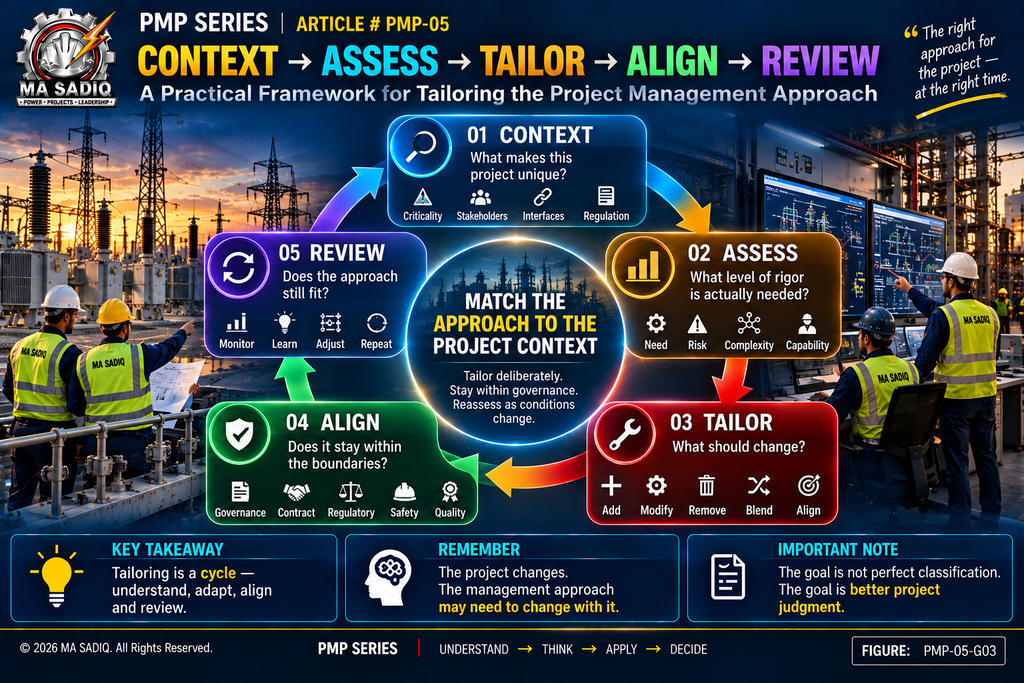
Figure: PMP-05-G03 — A Practical Framework for Tailoring the Project Management Approach
🔎 CONTEXT
Understand the project environment, constraints, stakeholders, delivery conditions, uncertainty profile, and required controls.
Question:
What makes this project unique?
📊 ASSESS
Identify what the project genuinely needs, where the current approach is too heavy or too light, and what must remain fixed.
Question:
What level and type of management rigor does this project actually need?
🛠️ TAILOR
Add, modify, remove, blend, or adjust elements of the project management approach within legitimate boundaries.
Question:
What should be changed?
🧭 ALIGN
Make sure the tailored elements work coherently across governance, reporting, decision rights, stakeholders, risk handling, and delivery execution.
Question:
Does the tailored approach remain within the required boundaries?
🔄 REVIEW
Reassess the fit of the approach as the project progresses and conditions evolve.
Question:
Does the approach still fit?
Used properly, this framework keeps tailoring disciplined.
It helps teams avoid two common failures:
- blindly following a method that does not fit;
- weakening structure in ways that create preventable problems later.
🧪 Test Yourself
❓ 1. A project manager says:
“Our organization uses one methodology, so every project must follow the same control structure without adjustment.”
Is that strong PMI-aligned thinking?
✅ Answer
No.
An organizational approach provides a baseline, but the project manager still needs to determine how that approach should be applied to the specific project context.
❓ 2. A team proposes removing a required approval step because it slows delivery.
Is that tailoring?
⚠️ Answer
Not by itself.
If the approval is a governance, contractual, regulatory, safety, or quality requirement, simply removing it would be noncompliance, not professional tailoring.
❓ 3. Two EPC projects both involve substation work. One uses lighter coordination and the other uses stronger governance and interface control.
Does that automatically mean one team is over-managing?
✅ Answer
No.
Similar technical disciplines do not guarantee identical management needs.
The right approach depends on context, including:
- interfaces;
- criticality;
- stakeholders;
- uncertainty;
- risk exposure;
- operating constraints.
🔑 Key Takeaways
A methodology provides structure, but structure alone is not enough.
Projects with similar subject matter can still need meaningfully different management treatment.
Tailoring is the disciplined adaptation of the project management approach so that governance, processes, controls, and ways of working fit the project context.
Good tailoring works within legitimate boundaries.
It does not ignore:
- contractual obligations;
- regulatory requirements;
- safety requirements;
- quality requirements;
- governance controls.
The objective is a fit-for-purpose approach:
Not over-managed.
Not under-managed.
Not mechanically copied from another context.
🧠 PMP Memory Box
Remember:
🔹 Methodology gives structure.
🔹 Context determines application.
🔹 Tailoring is disciplined adaptation within boundaries.
🔹 The goal is fit for purpose, not blind consistency.
💭 Memory Question
Does the management approach fit the project I actually have — not merely the methodology I started with?
💡 MASADIQ Professional Insight
Less experienced project managers often look for the single correct methodology.
More experienced project managers look for the right application of a sound approach in a specific environment.
That shift matters.
Professional maturity is not shown by following a method rigidly, and it is not shown by discarding structure when pressure increases.
It is shown by:
adapting responsibly, protecting what must be protected, and shaping the management approach so the project can actually succeed in the conditions it faces.
🏁 Conclusion
The best project manager does not follow one methodology blindly because projects do not present themselves blindly. They come with different:
- constraints;
- risks;
- interfaces;
- levels of uncertainty;
- stakeholder dynamics;
- governance demands.
Applying the same management intensity everywhere may create bureaucracy in one project and insufficient control in another.
That is why tailoring matters.
A project management approach should be deliberate, appropriate, and responsive to the actual project environment.
It should preserve required discipline while adapting the application of that discipline to reality.
That is the essence of fit-for-purpose project management, and it is one of the clearest differences between merely using a methodology and actually managing a project well.
📚 REFERENCES
- Project Management Institute. A Guide to the Project Management Body of Knowledge (PMBOK® Guide) – Eighth Edition.
- Project Management Institute. Process Groups: A Practice Guide.
- Project Management Institute. Agile Practice Guide.
📖 CONTINUE LEARNING
For the broader foundation behind value and project success, continue with PMP-03.
For a deeper exploration of uncertainty, risk, ambiguity, complexity, and volatility, continue with PMP-04.
👨💼 ABOUT THE AUTHOR
Engr. Muhammad Akram Sadiq is a Senior Electrical Engineer and Project Management Professional, with over 30 years of international experience in engineering, construction, commissioning, operation & maintenance, instrumentation & control, and project management.
Throughout his career, he has contributed to major power generation, substation and industrial infrastructure projects with a strong focus on technical excellence, leadership, quality, safety, and continuous improvement.
Through his professional brand MA SADIQ, he is committed to transforming practical experience into structured knowledge that empowers engineers, project professionals, and future leaders to achieve professional excellence.
📘 ABOUT THE PMP SERIES
The MASADIQ PMP Series is designed to help project professionals build real understanding, not just exam memory. Each article focuses on one practical idea, connects it to PMI-grounded thinking, and translates it into professional judgment that can be used both in practice and in PMP-style scenarios.
⚠️DISCLAIMER
This publication is intended solely for educational and professional development purposes. Although every effort has been made to ensure the accuracy and usefulness of the information presented, project requirements, engineering codes, standards, contractual frameworks, market conditions, regulations, and management practices may vary and are periodically revised. Readers should always consult the latest official editions of relevant publications, applicable legislation, client specifications, contractual requirements, organizational procedures, and project-specific requirements before applying any information to engineering or project-management activities.
The examples and recommendations presented in this article are intended to support professional learning and constructive discussion. They should not be considered a substitute for project-specific engineering, commercial, financial, legal, regulatory, or management judgment. The views expressed are those of the author and are intended to promote professional learning and constructive discussion.
— THE END —