📘 𝗘𝗣𝗖 𝗣𝗿𝗼𝗷𝗲𝗰𝘁 𝗠𝗮𝗻𝗮𝗴𝗲𝗺𝗲𝗻𝘁 𝗦𝗲𝗿𝗶𝗲𝘀 | 𝗔𝗿𝘁𝗶𝗰𝗹𝗲 𝗘𝗣𝗖-𝟬𝟱
🏗️ 𝗣𝗿𝗼𝗷𝗲𝗰𝘁 𝗜𝗻𝗶𝘁𝗶𝗮𝘁𝗶𝗼𝗻 & 𝗙𝗲𝗮𝘀𝗶𝗯𝗶𝗹𝗶𝘁𝘆 — 𝗦𝘁𝗮𝗿𝘁 𝗦𝗺𝗮𝗿𝘁. 𝗔𝘀𝘀𝗲𝘀𝘀 𝗥𝗶𝗴𝗵𝘁. 𝗕𝘂𝗶𝗹𝗱 𝘄𝗶𝘁𝗵 𝗖𝗼𝗻𝗳𝗶𝗱𝗲𝗻𝗰𝗲.
Dear Friends and Professionals,
🤝 𝗚𝗿𝗲𝗲𝘁𝗶𝗻𝗴𝘀! I hope you are doing well!
I am pleased to share 𝗔𝗿𝘁𝗶𝗰𝗹𝗲 𝗘𝗣𝗖-𝟬𝟱 of the EPC Project Management Series.
Every successful EPC project begins long before engineering, procurement, or construction. It begins with a 𝗻𝗲𝗲𝗱 — 𝗮𝗻𝗱 𝗮 𝗱𝗲𝗰𝗶𝘀𝗶𝗼𝗻.
Project Initiation & Feasibility is more than an administrative starting point. It is where we determine whether the need, objectives, alternatives, risks, investment requirements, and feasibility are understood well enough to justify moving forward.
A technically feasible project may not be commercially or financially attractive. A financially attractive project may be operationally impractical. Strong early decisions can therefore prevent costly downstream surprises.
📚 𝗜𝗻 𝘁𝗵𝗶𝘀 𝗮𝗿𝘁𝗶𝗰𝗹𝗲, 𝘆𝗼𝘂’𝗹𝗹 𝗹𝗲𝗮𝗿𝗻:
✅ How to define the business need, objectives, and preliminary scope.
✅ How to identify stakeholders, assumptions, constraints, dependencies, and early risks.
✅ The purpose and limitations of a Rough Order of Magnitude (ROM) estimate.
✅ How to assess technical, commercial, financial, and operational feasibility.
✅ Why alternatives should be evaluated before selecting a solution.
✅ How early decisions influence EPC cost, schedule, risk, and performance.
✅ Common misconceptions and practical lessons from EPC project management.
Whether you are a student, early-career engineer, project professional, or experienced EPC practitioner, I hope this article provides practical knowledge for your continuous professional development.
💡 𝗞𝗲𝘆 𝗺𝗲𝘀𝘀𝗮𝗴𝗲:
𝗧𝗵𝗲 𝗼𝗯𝗷𝗲𝗰𝘁𝗶𝘃𝗲 𝗼𝗳 𝗶𝗻𝗶𝘁𝗶𝗮𝘁𝗶𝗼𝗻 𝗶𝘀 𝗻𝗼𝘁 𝗽𝗲𝗿𝗳𝗲𝗰𝘁 𝗰𝗲𝗿𝘁𝗮𝗶𝗻𝘁𝘆; 𝗶𝘁 𝗶𝘀 𝘀𝘂𝗳𝗳𝗶𝗰𝗶𝗲𝗻𝘁 𝘂𝗻𝗱𝗲𝗿𝘀𝘁𝗮𝗻𝗱𝗶𝗻𝗴 𝗳𝗼𝗿 𝗮 𝗿𝗲𝘀𝗽𝗼𝗻𝘀𝗶𝗯𝗹𝗲 𝗱𝗲𝗰𝗶𝘀𝗶𝗼𝗻.
💬 𝗗𝗶𝘀𝗰𝘂𝘀𝘀𝗶𝗼𝗻 𝗤𝘂𝗲𝘀𝘁𝗶𝗼𝗻
𝗜𝗻 𝘆𝗼𝘂𝗿 𝗲𝘅𝗽𝗲𝗿𝗶𝗲𝗻𝗰𝗲, 𝘄𝗵𝗮𝘁 𝗲𝗮𝗿𝗹𝘆-𝘀𝘁𝗮𝗴𝗲 𝗽𝗿𝗼𝗷𝗲𝗰𝘁 𝗱𝗲𝗰𝗶𝘀𝗶𝗼𝗻 𝗺𝗼𝘀𝘁 𝗼𝗳𝘁𝗲𝗻 𝗰𝗿𝗲𝗮𝘁𝗲𝘀 𝗺𝗮𝗷𝗼𝗿 𝗽𝗿𝗼𝗯𝗹𝗲𝗺𝘀 𝗱𝘂𝗿𝗶𝗻𝗴 𝗲𝗻𝗴𝗶𝗻𝗲𝗲𝗿𝗶𝗻𝗴, 𝗽𝗿𝗼𝗰𝘂𝗿𝗲𝗺𝗲𝗻𝘁, 𝗼𝗿 𝗰𝗼𝗻𝘀𝘁𝗿𝘂𝗰𝘁𝗶𝗼𝗻 — 𝗮𝗻𝗱 𝘄𝗵𝘆?
Please share your thoughts and experiences in the comments.
🙏 𝗜𝗳 𝘆𝗼𝘂 𝗳𝗶𝗻𝗱 𝘁𝗵𝗶𝘀 𝗰𝗼𝗻𝘁𝗲𝗻𝘁 𝘂𝘀𝗲𝗳𝘂𝗹, 𝗽𝗹𝗲𝗮𝘀𝗲 𝗹𝗶𝗸𝗲 𝗮𝗻𝗱 𝗿𝗲𝗽𝗼𝘀𝘁.
📘 𝗟𝗲𝗮𝗿𝗻 > 𝗦𝗵𝗮𝗿𝗲 > 𝗚𝗿𝗼𝘄
EPC Project Management Series – Article# EPC-05
PROJECT INITIATION & FEASIBILITY
Start Smart. Assess Right. Build with Confidence.

Engr. Muhammad Akram Sadiq CE (SCE), PMP® (PMI)
Sr. Electrical Engineer & Projects Manager
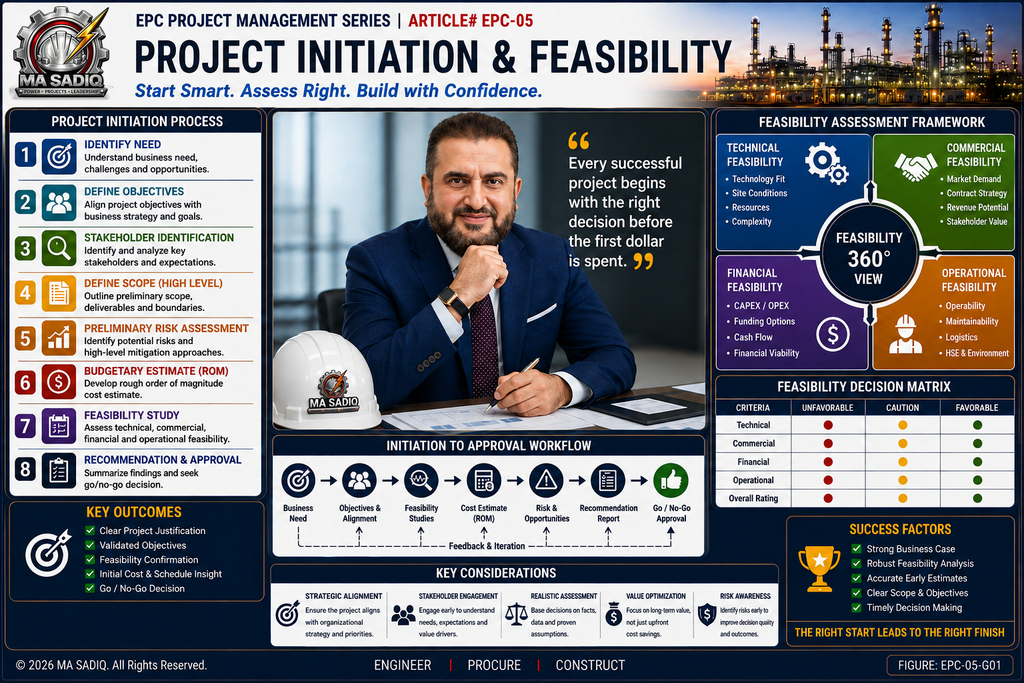
Figure EPC-05-G01 — Project Initiation & Feasibility
🎯 1. INTRODUCTION
Every successful EPC project begins long before engineering drawings are issued, purchase orders are placed, or construction activities begin at site. It begins with a need—and a decision.
A business may identify a capacity constraint, an aging facility, a reliability problem, a regulatory requirement, a market opportunity, an operational challenge, or a strategic objective. At that point, the project may exist only as an idea.
The organization must then determine:
- Why is the project needed?
- What problem or opportunity is being addressed?
- What should the project achieve?
- Who are the key stakeholders?
- What is the preliminary scope?
- What constraints and assumptions exist?
- What risks could prevent success?
- How much investment may be required?
- Is the proposed solution technically feasible?
- Is it commercially and financially justified?
- Can the organization operate and sustain the resulting asset?
- Should the project proceed?
These questions form the foundation of Project Initiation and Feasibility.
Initiation converts a business need or opportunity into a sufficiently defined project proposition. Feasibility then tests whether that proposition can realistically deliver the intended outcome.
This stage is sometimes underestimated because the physical project has not yet started. In reality, it is one of the stages with the greatest potential influence on the eventual outcome.
An unclear requirement during initiation may become scope growth during engineering.
An unrealistic objective may become an impossible schedule.
An incomplete feasibility assessment may become a major cost problem.
An overlooked stakeholder may later become an approval or interface constraint.
An untested assumption may eventually become a project risk.
By the time these problems become visible during procurement or construction, correcting them may require significant cost, time, and management effort.
This leads to a fundamental EPC principle: The earlier a project decision is made, the greater the opportunity to influence its outcome.
Project initiation is therefore not simply an administrative starting point. It is a strategic decision-making process that establishes whether the organization is preparing to execute the right project, for the right reasons, with a sufficiently understood risk and value proposition.
Feasibility adds another critical dimension.
A project may be technically possible but financially unattractive.
It may be financially attractive but operationally impractical.
It may have strong market potential but depend on technology that is not sufficiently mature.
It may appear viable under optimistic assumptions but become unattractive when cost, schedule, or revenue assumptions are stressed.
The objective of feasibility is not to eliminate all uncertainty. That is rarely possible at the beginning of an EPC project. The objective is to understand the important uncertainties sufficiently to make a responsible decision.
A strong project therefore does not begin with: “How quickly can we execute this project?”
It begins with: “Do we understand the need, the expected outcome, the alternatives, the risks, the investment, and the feasibility well enough to justify moving forward?”
That is where professional EPC Project Management begins.
🎯 2. LEARNING OBJECTIVES
After completing this article, you will be able to:
- Understand the purpose and importance of project initiation in EPC projects.
- Distinguish between a business need, project opportunity, objective, and scope.
- Understand the major activities involved in project initiation.
- Identify and engage key stakeholders at an early stage.
- Establish appropriate preliminary scope boundaries.
- Identify important assumptions, constraints, dependencies, and early risks.
- Understand the purpose and limitations of a Rough Order of Magnitude (ROM) estimate.
- Understand the major dimensions of feasibility assessment.
- Evaluate technical, commercial, financial, and operational feasibility.
- Recognize the importance of alternatives analysis.
- Understand how early information and uncertainty affect decision quality.
- Develop a structured basis for a Go, Go-with-Conditions, Revise, Defer, or No-Go recommendation.
- Recognize common misconceptions associated with project initiation and feasibility.
- Apply practical EPC project-management lessons to early-stage decision-making.
🏗️ 3. PROJECT INITIATION & FEASIBILITY
Project initiation and feasibility should be viewed as an integrated process rather than two completely separate activities.
A practical sequence is:
Business Need → Objectives → Stakeholders → Preliminary Scope → Risks & Assumptions → ROM Estimate → Feasibility Assessment → Alternatives → Recommendation → Decision
The sequence is directional, but not necessarily strictly linear.
New information may change the scope.
A feasibility finding may require an alternative solution.
A stakeholder requirement may change the technical concept.
A revised estimate may change the financial assessment.
A newly identified risk may require additional investigation.
Therefore, iteration is a normal part of good project initiation.
3.1 💡 From Business Need to Project Opportunity
The first question is: Why should this project exist?
The need may originate from:
- Business growth.
- Production expansion.
- Capacity limitations.
- Aging infrastructure.
- Reliability problems.
- Safety improvement.
- Regulatory requirements.
- Environmental requirements.
- Customer requirements.
- Asset replacement.
- Energy efficiency.
- Digital transformation.
- Cost reduction.
- Market opportunity.
- Strategic expansion.
However, the business need is not automatically the project solution.
Consider an organization experiencing insufficient electrical capacity.
Possible solutions could include:
- expanding the existing electrical system;
- improving energy efficiency;
- modifying operating practices;
- installing additional generation;
- strengthening the utility connection;
- adding energy storage;
- replacing inefficient equipment; or
- developing a new facility.
The need is therefore: Insufficient electrical capacity.
The project solution is something that must be evaluated and selected.
This distinction is important because premature commitment to a preferred solution can introduce confirmation bias. Once an organization becomes committed to a particular concept, inconvenient feasibility findings may be overlooked.
A disciplined initiation process keeps a proper sequence:

rather than:

3.2 🎯 Defining Project Objectives
Once the need is understood, the organization must establish what the project is expected to achieve.
Objectives should provide sufficient direction for later scope definition, planning, engineering, procurement, construction, commissioning, and performance evaluation. Typical objectives may address:
- Capacity.
- Production.
- Reliability.
- Availability.
- Safety.
- Environmental performance.
- Quality.
- Completion date.
- Regulatory compliance.
- Operational capability.
- Capital investment.
- Business benefits.
A useful objective answers:
What must be achieved, within what important constraints, and by when?
For example:
Increase the facility’s electrical capacity to meet forecast demand while maintaining specified reliability, protection, safety, and operational requirements within the approved implementation period.
Clear objectives become an important decision filter.
If an engineering proposal does not support the objective, it should be questioned.
If a procurement decision threatens the objective, its impact should be evaluated.
If a construction change affects the objective, the consequences should be understood before approval.
The objective therefore provides continuity from the initial business decision through final project delivery.
3.3 👥 Stakeholder Identification & Alignment
A technically excellent project can still experience major problems when important stakeholders are not identified or engaged early.
Potential stakeholders may include:
- Project sponsor.
- Client or owner.
- End users.
- Operations and maintenance teams.
- Engineering disciplines.
- Finance.
- Procurement.
- Commercial and contracts teams.
- HSE.
- Quality.
- Regulatory authorities.
- Utility providers.
- Contractors.
- Vendors.
- Customers.
- Local authorities.
- Other affected parties.
Different stakeholders may have different priorities.
Operations may emphasize maintainability.
Engineering may emphasize technical performance.
Finance may emphasize investment efficiency.
HSE may emphasize risk reduction.
Commercial teams may emphasize contractual exposure.
Regulators may emphasize compliance.
The Project Manager must help convert these different expectations into a sufficiently aligned project direction.
Stakeholder Expectations Are Not Automatically Requirements
This distinction is critical.
A stakeholder may request a particular solution because it appears convenient, familiar, or desirable.
The Project Manager should determine whether that request represents:
- a mandatory requirement;
- a regulatory obligation;
- a contractual requirement;
- a technical requirement;
- an operational requirement;
- a business preference; or
- an assumption requiring further validation.
Early stakeholder engagement should therefore create clarity and alignment, not simply produce a larger list of requests.
3.4 📋 Preliminary Scope Definition
Detailed scope will normally not be available during initiation.
That is expected.
The objective at this stage is to establish a credible high-level scope boundary.
The project team should begin identifying:
In Scope
What the project is expected to provide.
Out of Scope
What the project is explicitly not expected to provide.
Interfaces
Where the project connects to existing facilities, systems, utilities, organizations, or other projects.
Constraints
Conditions that restrict the available execution options.
Assumptions
Conditions currently believed to be true but requiring validation.
Exclusions
Items intentionally excluded from the project definition.
This early scope definition is particularly important in EPC projects because scope ambiguity can propagate through:
Engineering → Procurement → Construction → Cost → Schedule → Claims
Scope Is More Than Equipment
Consider a simple statement:
“Install a new transformer.”
That is not necessarily the complete EPC scope.
The project may also require:
- Civil foundations.
- Structural modifications.
- Transformer procurement.
- Protection and control.
- Cabling.
- Earthing.
- Fire protection.
- Cooling systems.
- Testing.
- Commissioning.
- Existing-system modifications.
- Shutdown requirements.
- Documentation.
- Training.
- Spare parts.
- Regulatory approvals.
The Project Manager must therefore think in terms of the complete required outcome, rather than only the major equipment.
3.5 🛡️ Preliminary Risk Assessment
Risk management begins during initiation.
The purpose at this stage is not to create an enormous detailed risk register before project authorization.
The purpose is to identify major uncertainties that could materially influence the decision to proceed or fundamentally affect project viability.
Potential early risks include:
- Technology uncertainty.
- Site conditions.
- Land availability.
- Utility availability.
- Regulatory approvals.
- Environmental constraints.
- Market uncertainty.
- Funding availability.
- Supply-chain constraints.
- Long-lead equipment.
- Foreign exchange exposure.
- Inflation.
- Resource availability.
- Interface complexity.
- Stakeholder resistance.
- Schedule constraints.
- Construction access.
- Existing-facility constraints.
The Project Manager should distinguish between:
Known facts, Assumptions, Uncertainties and Risks
This distinction improves decision quality.
An assumption may become a risk when it proves incorrect.
An uncertainty may require additional investigation.
A known constraint may require a specific mitigation strategy.
The objective is to make decision-critical uncertainty visible before significant commitments are made.
3.6 📊 Rough Order of Magnitude (ROM) Estimate
A Rough Order of Magnitude (ROM) estimate provides an early indication of potential project cost before sufficient engineering has been completed to establish a detailed estimate.
A ROM estimate may draw upon:
- Historical project data.
- Benchmark costs.
- Capacity-based estimates.
- Parametric estimating.
- Equipment-level estimates.
- Vendor budgetary quotations.
- Similar completed projects.
- Market information.
- Preliminary engineering information.
The methodology should match the maturity and quality of available information.
Why ROM Matters?
A technically attractive project may still be financially unrealistic.
A ROM estimate helps management determine:
- whether the potential investment is within financial capability;
- whether the expected benefits justify further development;
- whether alternative solutions should be considered;
- whether additional feasibility work is justified; and
- whether obvious economic barriers exist.
ROM Is Not a Final Budget
A ROM estimate should never be presented with greater certainty than the underlying information supports.
At initiation:
- equipment selections may remain preliminary
- site conditions may be incompletely understood
- quantities may be uncertain
- vendor pricing may not be firm
- construction methodology may not be finalized
- market conditions may change
- logistics may remain uncertain.
A credible early estimate therefore communicates not only a number, but also its:
Basis + Assumptions + Exclusions + Uncertainty + Confidence
A precise-looking number with weak foundations can create more danger than a clearly qualified estimate.
⚙️ 3.7 Feasibility Assessment
Feasibility assessment asks whether the proposed project can realistically achieve its intended objectives within the relevant technical, commercial, financial, operational, regulatory, and other constraints.
For EPC project initiation, four primary dimensions provide a practical framework:
- Technical Feasibility
- Commercial Feasibility
- Financial Feasibility
- Operational Feasibility
These dimensions should not be treated as independent silos. The project is viable only when their combined implications are acceptable.
3.8 ⚙️ Technical Feasibility
Technical feasibility asks: Can the proposed project realistically be designed, built, tested, commissioned, and operated using appropriate technology and available or obtainable resources?
Key considerations include:
Technology Fit
Is the proposed technology suitable for the intended application?
Site Conditions
Can the project be physically developed at the proposed location?
Consider:
- Topography
- Geotechnical conditions
- Climate
- Accessibility
- Existing infrastructure
- Utilities
- Space limitations
Resource Availability
Are required equipment, materials, technical skills, specialist contractors, utilities and infrastructure reasonably available?
System Complexity
Does the proposed solution introduce technical interfaces or complexity that could materially increase execution risk?
Standards & Compliance
Can the proposed solution satisfy applicable codes, standards, regulations, client requirements and performance criteria?
Technical feasibility should therefore ask more than: “Can we build it?”
The stronger question is: “Can we build it safely, reliably, maintainably, and in compliance with the required performance criteria?”
3.9 🤝 Commercial Feasibility
Commercial feasibility examines whether the project makes sense from a market, contracting, supply-chain, and broader business perspective.
Questions may include:
- Is there sufficient market demand?
- Is the proposed product or service commercially relevant?
- Is the contracting strategy appropriate?
- Are suitable EPC contractors available?
- Is sufficient vendor competition available?
- Are critical suppliers accessible?
- Are long-term commercial arrangements viable?
- Are contractual risks manageable?
- Does the project create sufficient stakeholder or customer value?
Commercial feasibility is particularly important when project success depends on market conditions or external counterparties.
A technically successful facility can still produce disappointing results if the commercial assumptions supporting the project are wrong.
3.10 💰 Financial Feasibility
Financial feasibility asks:
Does the expected economic outcome justify the investment and associated risks?
Depending on project type, the assessment may consider:
- CAPEX
- OPEX
- Funding requirements
- Cash-flow requirements
- Expected revenue
- Expected savings
- Financial benefits
- Payback considerations
- Financing conditions
- Economic assumptions
- Sensitivity to cost and revenue changes
The financial assessment should not rely solely on the most optimistic scenario.
Management should understand what happens if:
- capital cost increases
- project completion is delayed
- operating costs increase
- expected revenue decreases
- financing conditions change or
- key assumptions prove incorrect
A project that appears attractive under one set of assumptions may become unattractive when critical assumptions are stressed.
3.11 🏭 Operational Feasibility
Operational feasibility asks:
Can the completed facility actually operate and be maintained successfully within the intended operating environment?
This dimension is sometimes underestimated during project development.
Operability
Can the facility be operated safely and effectively?
Maintainability
Can equipment be maintained using available skills, tools, spares, access, and support?
Logistics
Can personnel, materials, consumables, fuel, spares, and other operational requirements be supported?
HSE & Environment
Can the facility operate within required health, safety, and environmental conditions?
Organizational Capability
Does the owner have the capability to operate and maintain the completed asset?
A sophisticated technical solution may be feasible to build but difficult to operate or sustain.
Therefore: Buildability does not automatically mean operability.
3.12 🔄 Integrating the Four Feasibility Dimensions
The four primary dimensions should ultimately converge into one integrated project assessment:
Technical + Commercial + Financial + Operational
↓
Overall Feasibility
↓
Recommendation
↓
Decision
Possible outcomes include:
| 🟢 GO | Proceed to the next stage. |
| 🟡 GO WITH CONDITIONS | Proceed while specific risks, studies, approvals, or conditions are addressed. |
| 🟠 REVISE | Modify the proposed scope, technology, commercial strategy, or other fundamental elements before proceeding. |
| 🔵 DEFER | The project may remain strategically valid, but current conditions do not justify immediate progression. |
| 🔴 NO-GO | The project should not proceed under the evaluated conditions. |
This is more useful than treating project authorization as a simple binary decision.
3.13 🔍 Alternatives Analysis
The first technically feasible solution is not necessarily the best solution.
Alternatives may differ in:
- Technology
- Capacity
- Location
- Execution strategy
- Contracting model
- Phasing
- Equipment selection
- Existing-asset modification
- New-build approach
The alternatives should be compared against the overall project outcome. A lower CAPEX option may introduce:
- higher operating cost
- greater maintenance requirements
- lower reliability
- greater technical risk
- longer execution duration or
- higher lifecycle cost.
Therefore: Lowest initial cost does not necessarily mean lowest total cost.
A sound feasibility assessment considers value over the relevant project and operational lifecycle.
3.14 📝 Assumptions, Constraints & Dependencies
Early decisions are inevitably based on incomplete information. Important assumptions should therefore be explicitly identified. Examples may include:
- Land will be available by a defined date
- Required utility capacity will be available
- Required permits can be obtained
- The proposed technology will remain available
- Vendor budgetary pricing is representative
- Funding will be available
- Existing infrastructure has sufficient capacity
- Required shutdown windows will be available
- Key stakeholders will support the project
The Project Manager should ask:
What are we assuming?
What must be true for this project to work?
Which assumptions could invalidate the project if they prove incorrect?
An assumption that proves false may become a risk.
An overlooked dependency may become a schedule constraint.
An unidentified constraint may become a major cost driver.
Making these relationships visible is one of the most valuable outputs of initiation.
🧩 4. INTEGRATION / INTERFACE PERSPECTIVE
Project initiation does not exist independently from later EPC stages. Every major early decision creates downstream consequences.
Initiation → Planning
Clear objectives, scope, constraints, and assumptions provide the basis for realistic planning.
Initiation → Engineering
Preliminary requirements and performance objectives establish the foundation for engineering development.
Initiation → Procurement
Technology choices, equipment requirements, commercial strategy, and long-lead considerations influence procurement.
Initiation → Construction
Site conditions, constructability, logistics, access, and execution constraints influence construction planning.
Initiation → Commissioning
Performance requirements and operational objectives eventually become commissioning and acceptance requirements.
Initiation → Operations
Maintainability, operability, reliability, and lifecycle requirements must be considered before design becomes fixed.
This creates a powerful EPC principle:
The project is already being shaped before detailed EPC execution begins.
A decision made during initiation may not become visible until engineering, procurement, construction, or commissioning.
That time delay can make the original cause difficult to recognize.
An experienced Project Manager therefore asks not only:
“What does this decision mean now?”
but also:
“What will this decision mean six months, one year, or several years from now?”
💡 5. ENGINEERING INSIGHT
One of the strongest lessons from practical EPC project experience is that many problems visible during construction were actually created much earlier.
A construction team may encounter:
- an unexpected scope change
- an unsuitable equipment specification
- an inaccessible installation area
- a missing utility
- an unrealistic completion date
- an unavailable shutdown window
- an underestimated quantity or
- an unresolved stakeholder requirement
The immediate problem may appear to be a construction problem. Its root cause may actually lie in initiation.
This is why experienced Project Managers look beyond the current activity. They ask: “Where did this problem begin?” and: “What decision, assumption, or omission allowed it to reach this stage?”
The earlier a problem is identified, the greater the opportunity to control its consequences.
This is particularly important because the cost of change generally increases as the project progresses.
At initiation, changing a concept may require a management decision only.
During detailed engineering, it may require redesign.
During procurement, it may affect specifications, vendor commitments, and purchase orders.
During construction, it may require rework, site changes, delays, or commercial action.
During commissioning, it may affect testing, startup, performance, and handover.
The lesson is simple:
Good initiation is not about predicting the future perfectly. It is about making the future less uncertain before the cost of change becomes high.
⚠️ 6. COMMON MISCONCEPTIONS ABOUT PROJECT INITIATION & FEASIBILITY
❌ Misconception 1: Project initiation is mainly administrative.
Reality: Documentation supports initiation, but the real purpose is structured decision-making and project definition.
❌ Misconception 2: If management wants the project, feasibility is unnecessary.
✅ Reality: Feasibility provides evidence that the proposed project can realistically achieve its intended outcome.
❌ Misconception 3: Technical feasibility means the project is viable.
✅ Reality: A project must also be considered from commercial, financial, operational, regulatory, and risk perspectives.
❌ Misconception 4: A ROM estimate is the project budget.
✅ Reality: ROM is an early decision-support estimate whose uncertainty, assumptions, and limitations must be understood.
❌ Misconception 5: Scope can be defined later.
✅ Reality: Detailed scope evolves, but fundamental project boundaries and objectives must be established early.
❌ Misconception 6: Stakeholders can be engaged after project approval.
✅ Reality: Early stakeholder alignment can materially influence requirements, approvals, interfaces, scope, and feasibility.
❌ Misconception 7: The lowest-cost option is automatically the best option.
✅ Reality: Reliability, maintainability, operating cost, schedule, risk, and lifecycle value must also be considered.
❌ Misconception 8: More information always produces a better decision.
✅ Reality: The objective is to obtain the decision-critical information, not unlimited information.
❌ Misconception 9: A No-Go recommendation means the feasibility process failed.
✅ Reality: A well-supported No-Go decision may prevent significant financial loss and protect organizational resources.
❌ Misconception 10: Once approved, initiation decisions are finished.
✅ Reality: Early assumptions and decisions should continue to be validated as better information becomes available.
📚 7. LESSONS LEARNED FROM EPC PROJECTS
- Define the need before defining the solution.
Understand the business problem or opportunity before becoming committed to a particular technical solution.
- Make objectives clear.
Objectives provide direction for scope, engineering, procurement, construction, commissioning, and performance evaluation.
- Establish scope boundaries early.
Detailed engineering can come later; fundamental project boundaries should not.
- Identify the stakeholders who can influence project success.
Early alignment is usually easier and less expensive than resolving major conflicts during execution.
- Treat assumptions as potential future risks.
An assumption that has not been validated should not silently become a project fact.
- Make early estimates transparent.
Communicate the basis, assumptions, exclusions, uncertainty, and confidence of the ROM estimate.
- Assess feasibility from multiple perspectives.
Technical feasibility alone does not establish overall project viability.
- Evaluate alternatives before committing.
The first proposed solution may not provide the best lifecycle value.
- Focus on decision-critical uncertainty.
Investigate the unknowns that could materially change the project decision.
- Do not confuse optimism with feasibility.
Strategic enthusiasm does not replace technical, commercial, financial, or operational evidence.
- Use conditional decisions intelligently.
A project may proceed with defined conditions where complete certainty is neither possible nor necessary.
- Recognize that stopping can be successful project management.
Avoiding the wrong investment can be as valuable as approving the right one.
📊 8. PROJECT MANAGEMENT INSIGHT
Project initiation is where strategic intent begins to become project reality.
The Project Manager may be working with incomplete information, competing expectations, uncertain estimates, and pressure to move quickly.
The professional challenge is to create enough clarity for an informed decision without pretending that uncertainty has disappeared.
A strong Project Manager therefore acts as an integrator.
The Project Manager connects:
Business Need
→ Objectives
→ Stakeholders
→ Scope
→ Risks & Assumptions
→ Alternatives
→ Cost
→ Schedule
→ Feasibility
→ Recommendation
→ Decision
The quality of this chain matters.
If the business need is misunderstood, objectives may be wrong.
If objectives are unclear, scope may be wrong.
If scope is wrong, the estimate may be wrong.
If the estimate is wrong, the financial assessment may be wrong.
If feasibility is incomplete, the Go/No-Go decision may be wrong.
Project management at this stage is therefore not simply the collection of information.
It is the disciplined integration of:
information + assumptions + risks + alternatives + consequences + decisions
This is where project management becomes a leadership discipline rather than an administrative function.
🔑 9. KEY TAKEAWAYS
- Every EPC project begins with a decision before it begins with execution.
- The business need should be understood before the solution is selected.
- Clear objectives create direction for the project lifecycle.
- High-level scope should be established before detailed execution begins.
- Stakeholder alignment is an early project-management responsibility.
- Major assumptions, constraints, dependencies, and risks should be visible.
- A ROM estimate is a decision-support tool, not a final budget.
- Technical feasibility does not automatically establish overall project viability.
- Commercial, financial, and operational feasibility must be considered alongside technical feasibility.
- Alternatives should be evaluated before committing to one solution.
- Decision-critical uncertainty deserves focused investigation.
- Go, Go-with-Conditions, Revise, Defer, and No-Go are all legitimate decision outcomes.
- A No-Go decision can represent successful project management.
- Many downstream EPC problems originate from early decisions.
- The Project Manager must think beyond the current stage and anticipate future consequences.
- The objective of initiation is not perfect certainty; it is sufficient understanding for a responsible decision.
🏁 10. CONCLUSION
Project Initiation & Feasibility is where an EPC project earns the right to move forward.
Before engineering becomes fully developed, before procurement commitments are made, before construction resources are mobilized, and before major capital is committed, the organization must answer a fundamental question:
Is this the right project to pursue, and are we sufficiently confident that it can succeed?
A disciplined initiation process does not guarantee project success.
It does, however, improve the quality of the decisions that determine whether success is achievable.
The strongest projects begin by understanding the need.
They establish clear objectives.
They engage the right stakeholders.
They define meaningful scope boundaries.
They recognize risks and uncertainties.
They develop realistic early estimates.
They assess technical, commercial, financial, and operational feasibility.
They evaluate alternatives.
And they make a deliberate decision to proceed, revise, defer, or stop.
The Project Manager’s responsibility is not to force every project toward execution.
It is to help the organization make the right decision, at the right time, with the best available understanding of the consequences.
A powerful EPC principle therefore emerges:
Start Smart. Assess Right. Build with Confidence.
The quality of the project start influences the quality of everything that follows.
📚 11. CONTINUE LEARNING
Project Initiation & Feasibility establishes the foundation for the next stages of EPC project management.
Once a project has been sufficiently justified and authorized, the Project Manager must convert the approved concept into an executable delivery strategy.
This leads naturally to the next major discipline:
Project Planning.
Planning transforms objectives and preliminary scope into an integrated framework covering:
- scope
- Work Breakdown Structure (WBS)
- schedule
- cost
- resources
- risks
- procurement
- quality
- HSE
- communication
- project controls and
- execution strategy
Future articles in the MASADIQ EPC Project Management Series will progressively explore these areas in greater depth.
Continuous learning remains essential because every EPC project presents different technologies, stakeholders, contractual environments, risks, constraints, and opportunities.
👨💼 12. ABOUT THE AUTHOR
Engr. Muhammad Akram Sadiq is a Senior Electrical Engineer and Project Management Professional (PMP®) with over 30 years of international experience in engineering, construction, commissioning, operation & maintenance, instrumentation & control, and project management.
Throughout his career, he has contributed to major power generation, transmission, and industrial infrastructure projects with a strong focus on technical excellence, leadership, quality, safety, and continuous improvement.
Through his professional brand MA SADIQ, he is committed to transforming practical engineering experience into structured knowledge that empowers engineers, project professionals, and future leaders to achieve engineering excellence.
🏗️ 13. ABOUT THE EPC PROJECT MANAGEMENT SERIES
The MASADIQ EPC Project Management Series is a structured educational publication developed to provide engineers, project managers, students, and industry professionals with practical knowledge covering the principles and practices of EPC project management.
Each article explores a specific EPC topic, progressing systematically from foundational concepts to advanced project-management practices while emphasizing practical experience, professional excellence, leadership, and continuous learning.
The series aims to bridge the gap between project-management principles and the realities of engineering, procurement, construction, commissioning, and project delivery.
⚠️ 14. DISCLAIMER
This publication is intended solely for educational and professional development purposes.
Although every effort has been made to ensure the accuracy and usefulness of the information presented, project requirements, engineering codes, standards, contractual frameworks, market conditions, regulations, and management practices may vary and are periodically revised.
Readers should always consult the latest official editions of relevant publications, applicable legislation, client specifications, contractual requirements, organizational procedures, and project-specific requirements before applying any information to engineering or project-management activities.
The examples and recommendations presented in this article are intended to support professional learning and constructive discussion. They should not be considered a substitute for project-specific engineering, commercial, financial, legal, regulatory, or management judgment.
The views expressed are those of the author and are intended to promote professional learning and constructive discussion.
📖 15. REFERENCES
The following recognized references provide useful background for project initiation, feasibility, project management, and EPC delivery:
- Project Management Institute (PMI) — A Guide to the Project Management Body of Knowledge (PMBOK® Guide— Eighth Edition).
- ISO 21502 — Project, Programme and Portfolio Management — Guidance on Project Management.
- FIDIC — Conditions of Contract and associated guidance.
- AACE International — Recommended Practices relating to cost engineering, estimating, and project controls.
- Applicable IEC, IEEE, ASME, API, ASTM, ISO, national, and local codes and standards, as relevant to the project.
- Applicable client specifications, contractual requirements, organizational procedures, and project-development requirements.
Specific requirements and practices should always be verified against the applicable contractual, regulatory, organizational, and project-specific framework.
📘 16. GLOSSARY
Assumption — A condition accepted as true for planning or assessment purposes but requiring validation.
Business Case — A structured justification for undertaking a project, normally considering expected benefits, costs, risks, and strategic alignment.
Business Need — The underlying problem, requirement, opportunity, or strategic objective that creates the reason for considering a project.
CAPEX — Capital Expenditure; expenditure associated with acquiring, constructing, or significantly improving long-term assets.
Commercial Feasibility — Assessment of the project’s market, contractual, supply-chain, and broader commercial viability.
Constraint — A condition that restricts or limits project options, execution, or outcomes.
Feasibility Study — A structured assessment of whether a proposed project is realistically achievable and justified.
Financial Feasibility — Assessment of whether the project is financially justified considering investment, costs, benefits, funding, and economic assumptions.
Go/No-Go Decision — A formal decision to proceed, not proceed, or proceed subject to defined conditions or revisions.
Operational Feasibility — Assessment of whether the completed project can be operated and maintained effectively within the intended organizational and operational environment.
OPEX — Operating Expenditure; ongoing costs associated with operating and maintaining an asset or facility.
Project Objective — A defined result or outcome that the project is intended to achieve.
Project Scope — The defined boundaries of the work and deliverables required to achieve the project objectives.
ROM Estimate — Rough Order of Magnitude estimate; an early-stage estimate used to provide an indicative understanding of potential project cost before detailed engineering and estimating are completed.
Stakeholder — An individual, organization, or group that can affect, be affected by, or perceive itself to be affected by the project.
Technical Feasibility — Assessment of whether the proposed project can realistically be designed, constructed, tested, commissioned, and operated using appropriate technology and resources.
— THE END —