📘 𝗘𝗣𝗖 𝗣𝗿𝗼𝗷𝗲𝗰𝘁 𝗠𝗮𝗻𝗮𝗴𝗲𝗺𝗲𝗻𝘁 𝗦𝗲𝗿𝗶𝗲𝘀 | 𝗔𝗿𝘁𝗶𝗰𝗹𝗲 𝗘𝗣𝗖-𝟬𝟲
🏗️ 𝗣𝗿𝗼𝗷𝗲𝗰𝘁 𝗣𝗹𝗮𝗻𝗻𝗶𝗻𝗴 — 𝗣𝗹𝗮𝗻𝗻𝗶𝗻𝗴 𝗦𝘂𝗰𝗰𝗲𝘀𝘀 𝗕𝗲𝗳𝗼𝗿𝗲 𝗘𝘅𝗲𝗰𝘂𝘁𝗶𝗼𝗻 𝗕𝗲𝗴𝗶𝗻𝘀
Dear Friends and Professionals,
🤝 𝗚𝗿𝗲𝗲𝘁𝗶𝗻𝗴𝘀! I hope you are doing well!
I am pleased to share 𝗔𝗿𝘁𝗶𝗰𝗹𝗲 𝗘𝗣𝗖-𝟬𝟲 of the EPC Project Management Series.
A project does not become successful simply because execution has started. By the time engineering is progressing, purchase orders are being issued, equipment is being manufactured, and construction teams are mobilized, many decisions that influence project performance have already been made.
Those decisions are shaped during 𝗽𝗿𝗼𝗷𝗲𝗰𝘁 𝗽𝗹𝗮𝗻𝗻𝗶𝗻𝗴.
Project Planning is not merely about preparing a schedule or producing a collection of documents. It is the disciplined process of converting an approved project into an 𝗶𝗻𝘁𝗲𝗴𝗿𝗮𝘁𝗲𝗱, 𝗿𝗲𝗮𝗹𝗶𝘀𝘁𝗶𝗰, 𝗮𝗻𝗱 𝗲𝘅𝗲𝗰𝘂𝘁𝗮𝗯𝗹𝗲 𝗱𝗲𝗹𝗶𝘃𝗲𝗿𝘆 𝗽𝗹𝗮𝗻.
📚 𝗜𝗻 𝘁𝗵𝗶𝘀 𝗮𝗿𝘁𝗶𝗰𝗹𝗲, 𝘆𝗼𝘂’𝗹𝗹 𝗹𝗲𝗮𝗿𝗻:
✅ How to convert an approved project into a structured delivery framework.
✅ How scope definition and the WBS establish the foundation for planning.
✅ Why a WBS must remain distinct from the project schedule.
✅ How work packages make project planning actionable.
✅ How time, milestones, resources, cost, and dependencies are incorporated into the plan.
✅ Why assumptions and constraints must be made visible during planning.
✅ How planning requirements from engineering, procurement, construction, quality, HSE, and approvals influence execution readiness.
✅ Why a project plan must be reviewed, challenged, validated, approved, and baselined before execution.
✅ Why planning must continue as reliable project information develops.
Whether you are a student, early-career engineer, project professional, or experienced EPC practitioner, I hope this article provides practical knowledge for your continuous professional development.
💡 𝗞𝗲𝘆 𝗺𝗲𝘀𝘀𝗮𝗴𝗲:
𝗧𝗵𝗲 𝗯𝗲𝘀𝘁 𝗽𝗹𝗮𝗻 𝗶𝘀 𝗻𝗼𝘁 𝗻𝗲𝗰𝗲𝘀𝘀𝗮𝗿𝗶𝗹𝘆 𝘁𝗵𝗲 𝗹𝗼𝗻𝗴𝗲𝘀𝘁 𝗽𝗹𝗮𝗻; 𝗶𝘁 𝗶𝘀 𝘁𝗵𝗲 𝗽𝗹𝗮𝗻 𝘁𝗵𝗮𝘁 𝗰𝗿𝗲𝗮𝘁𝗲𝘀 𝗰𝗹𝗮𝗿𝗶𝘁𝘆, 𝗮𝗹𝗶𝗴𝗻𝗺𝗲𝗻𝘁, 𝗮𝗻𝗱 𝗰𝗼𝗻𝗳𝗶𝗱𝗲𝗻𝗰𝗲 𝗯𝗲𝗳𝗼𝗿𝗲 𝗲𝘅𝗲𝗰𝘂𝘁𝗶𝗼𝗻 𝗯𝗲𝗴𝗶𝗻𝘀.
💬 𝗗𝗶𝘀𝗰𝘂𝘀𝘀𝗶𝗼𝗻 𝗤𝘂𝗲𝘀𝘁𝗶𝗼𝗻
𝗜𝗻 𝘆𝗼𝘂𝗿 𝗲𝘅𝗽𝗲𝗿𝗶𝗲𝗻𝗰𝗲, 𝘄𝗵𝗮𝘁 𝗶𝘀 𝘁𝗵𝗲 𝗺𝗼𝘀𝘁 𝗰𝗼𝗺𝗺𝗼𝗻 𝗽𝗹𝗮𝗻𝗻𝗶𝗻𝗴 𝘄𝗲𝗮𝗸𝗻𝗲𝘀𝘀 𝘁𝗵𝗮𝘁 𝗹𝗮𝘁𝗲𝗿 𝗰𝗿𝗲𝗮𝘁𝗲𝘀 𝗽𝗿𝗼𝗯𝗹𝗲𝗺𝘀 𝗱𝘂𝗿𝗶𝗻𝗴 𝗘𝗣𝗖 𝗽𝗿𝗼𝗷𝗲𝗰𝘁 𝗲𝘅𝗲𝗰𝘂𝘁𝗶𝗼𝗻 — 𝗮𝗻𝗱 𝘄𝗵𝘆?
Please share your thoughts and experiences in the comments.
🙏 𝗜𝗳 𝘆𝗼𝘂 𝗳𝗶𝗻𝗱 𝘁𝗵𝗶𝘀 𝗰𝗼𝗻𝘁𝗲𝗻𝘁 𝘂𝘀𝗲𝗳𝘂𝗹, 𝗽𝗹𝗲𝗮𝘀𝗲 𝗹𝗶𝗸𝗲 𝗮𝗻𝗱 𝗿𝗲𝗽𝗼𝘀𝘁.
📘 𝗟𝗲𝗮𝗿𝗻 > 𝗦𝗵𝗮𝗿𝗲 > 𝗚𝗿𝗼𝘄
EPC Project Management Series – Article# EPC-06
PROJECT PLANNING
Planning Success Before Execution Begins.

Engr. Muhammad Akram Sadiq CE (SCE), PMP® (PMI)
Sr. Electrical Engineer & Projects Manager
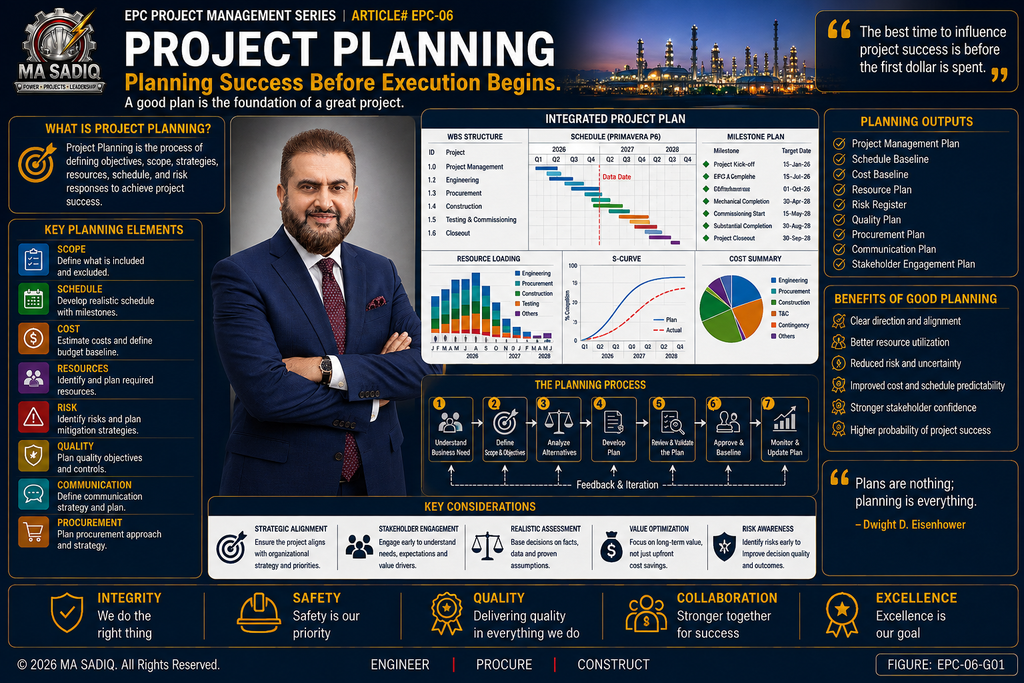
1. INTRODUCTION
A project does not become successful simply because execution has started. By the time engineering is progressing, purchase orders are being issued, equipment is being manufactured, and construction teams are mobilized, many decisions that influence project performance have already been made. Those decisions are shaped during project planning.
Project planning is the disciplined process of converting an approved project into an integrated, realistic, and executable delivery plan.
It establishes:
What → Why → How → When → Who → With What → Under What Constraints → Against Which Baselines
In an EPC environment, this is particularly important because the project contains many interconnected workstreams, deliverables, dependencies, decisions, and commitments.
A weakness in planning can therefore create consequences later in execution.
An unclear scope can lead to uncertainty.
An incomplete work breakdown can create gaps.
Unrealistic assumptions can produce an unachievable plan.
Poorly understood dependencies can create delays.
Inadequate resource planning can constrain execution.
Therefore: Planning is not merely paperwork performed before the real project begins. Planning is part of the real project.
2. WHAT IS EPC PROJECT PLANNING?
📌 Project planning is the structured process of defining how an approved project will be delivered and establishing the framework against which execution can be organized and managed.
A Project Manager needs to establish an appropriate understanding of:
- Project objectives
- Scope and deliverables
- Work breakdown
- Execution approach
- Major dependencies
- Planning assumptions
- Constraints
- Milestones
- Time requirements
- Resource requirements
- Cost requirements
- Risk considerations
- Quality and HSE requirements
- Communication requirements
- Procurement requirements
- Approval requirements
- Baseline requirements
- Execution-readiness criteria
The purpose is not to create the maximum number of documents. The purpose is to create clarity before execution complexity increases.
3. FROM PROJECT APPROVAL TO PROJECT EXECUTION
EPC-05 examined Project Initiation & Feasibility—understanding the need, assessing feasibility, and reaching a decision to proceed. EPC-06 addresses the next question: Now that the project has been approved, how will we prepare it for successful execution? The transition can be viewed as:
Business Need → Objectives → Approved Project → Scope Definition → WBS & Work Packages → Planning Strategy → Integrated Project Plan → Review & Validation → Approval & Baseline → Execution Readiness
Project planning therefore converts an approved project into a structured delivery framework.
4. THE PROJECT PLANNING MINDSET
A weak planning approach asks:
“What activities should we put into the schedule?”
A stronger Project Manager asks:
“What must be defined, understood, aligned, and ready before execution can be reliably planned?”
This distinction is important.
Planning should consider:
- What the project must deliver
- How the work will be structured
- What assumptions are being made
- What constraints exist
- What dependencies must be respected
- What resources will be required
- What major decisions are still outstanding
- What approvals are required
- What conditions must exist before execution
- How the plan will be reviewed and baselined

Figure EPC-06-G02 — Project Planning Architecture
The objective is not to predict every future event.
It is to create a sufficiently mature framework for making informed execution decisions.
5. PLANNING INPUTS
A project plan does not start from a blank page. Important planning inputs may include:
📋 Project Definition
- Approved business case
- Project objectives
- Project charter
- Preliminary scope
- Feasibility findings
📑 Contractual & Technical Information
- Contract requirements
- Employer/client requirements
- Technical specifications
- Applicable standards
- Regulatory requirements
🤝 Stakeholder Requirements
- Client expectations
- Approval requirements
- Operational requirements
- Key coordination requirements
🏗️ Project Conditions
- Site conditions
- Existing facilities
- Access limitations
- Available resources
- Logistics constraints
📚 Organizational Knowledge
- Previous project experience
- Lessons learned
- Existing procedures
- Historical performance information
The quality of the project plan depends significantly on the quality and maturity of its inputs.
6. PLANNING PRINCIPLES
Effective EPC project planning should follow several fundamental principles.
1️⃣ Plan from approved objectives
The plan must support the project’s intended outcomes.
2️⃣ Define before you detail
The work must be sufficiently understood before unnecessary planning detail is developed.
3️⃣ Decompose the work logically
Large deliverables must be converted into manageable components.
4️⃣ Make assumptions visible
Unstated assumptions can become future surprises.
5️⃣ Identify constraints early
A plan must recognize conditions that limit how or when work can be performed.
6️⃣ Build around dependencies
The plan must reflect meaningful relationships between project elements.
7️⃣ Align the planning elements
Scope, time, cost, resources, and other requirements must remain coherent.
8️⃣ Validate before baselining
A plan should survive professional challenge before becoming the control reference.
9️⃣ Refine as information matures
Planning should become progressively more detailed as reliable information becomes available.
🔟 Plan for execution readiness
A project should not be considered ready merely because a document called a “project plan” exists.
7. SCOPE PLANNING — DEFINE WHAT WILL BE DELIVERED
Scope provides the foundation for planning.
Before determining how the work will be scheduled or resourced, the project team must establish:
- What is included
- What is excluded
- What must be delivered
- What boundaries exist
- What assumptions apply
- What acceptance requirements exist
A simple statement such as:
“Construct a 132 kV substation.”
is not sufficient for detailed planning.
The planning team may need to understand whether the project includes:
- Civil works
- Foundations
- GIS/AIS equipment
- Transformers
- Protection and control
- SCADA
- Telecom
- Auxiliary systems
- Fire protection
- Earthing
- Cabling
- Testing
- Energization
- Existing-network integration
- Documentation
- Training
- Handover requirements
The more clearly the project scope is understood, the more credible the subsequent planning becomes.
8. WORK BREAKDOWN STRUCTURE — TURNING SCOPE INTO MANAGEABLE COMPONENTS
The Work Breakdown Structure (WBS) is one of the most important planning structures.
A WBS provides a deliverable-oriented hierarchical decomposition of the project scope into progressively smaller and more manageable components.
Its purpose is to answer:
“What does the project have to deliver, and how can that total scope be structured into manageable components?”
A typical EPC structure might begin with:
PROJECT
├── Project Management
├── Engineering
├── Procurement
├── Construction
├── Testing & Commissioning
└── Closeout
These major elements can then be decomposed into progressively more detailed deliverables and work packages.
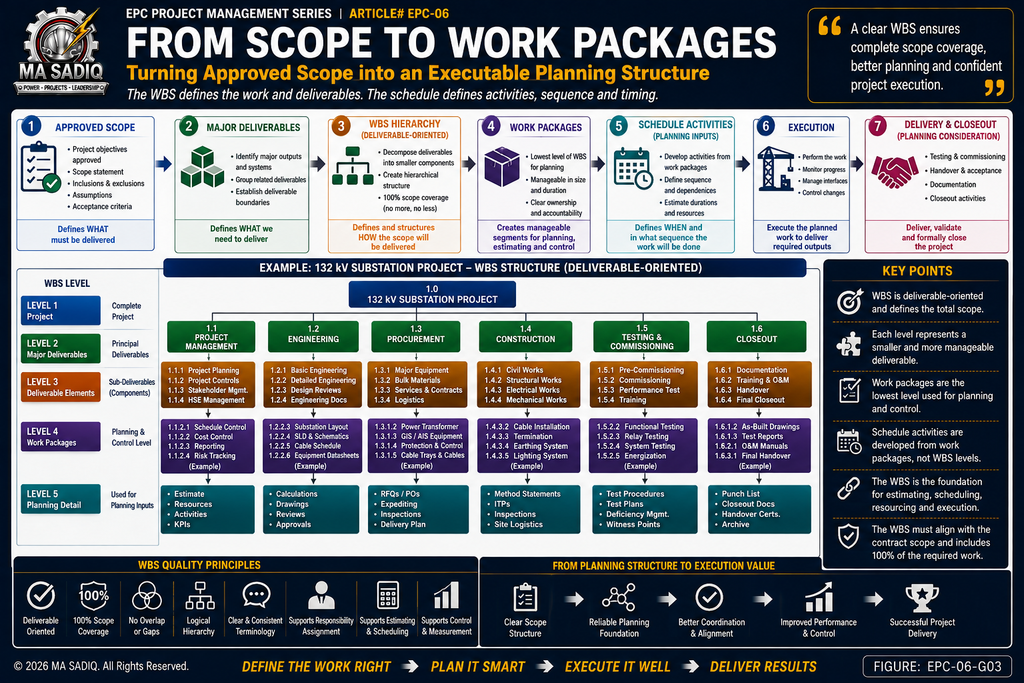
Figure EPC-06-G03 — From Scope to Work Packages
⚠️ An Important Distinction
The WBS is not the project schedule.
The WBS defines the work and deliverables.
The schedule subsequently defines the activities, relationships, sequence, durations, and timing associated with that work.
This distinction is fundamental.
A Project Manager who confuses the WBS with the schedule may create a planning structure that is difficult to manage and difficult to maintain.
9. WBS QUALITY PRINCIPLES
A useful WBS should:
- Be deliverable-oriented
- Cover the approved project scope
- Avoid unnecessary overlap
- Use clear and consistent terminology
- Establish a logical hierarchy
- Identify manageable work packages
- Support responsibility assignment
- Support estimating and scheduling
- Provide a common structure for project planning
The 100% principle is particularly important: the WBS should represent the complete approved project scope without deliberately omitting required work or introducing unrelated work.
A WBS should also remain distinct from:
- Organizational charts
- Procurement lists
- Schedules
- Activity lists
- Resource structures
Each serves a different planning purpose.
10. WORK PACKAGES — WHERE PLANNING BECOMES ACTIONABLE
The lowest-level WBS components are generally work packages.
A well-defined work package should be sufficiently understood to support:
- Responsibility assignment
- Estimation
- Scheduling
- Resource planning
- Progress measurement
- Performance tracking
The objective is not to create excessive detail.
If decomposition continues indefinitely, the planning structure can become more difficult to manage than the work itself.
The Project Manager must determine an appropriate level of detail based on the project’s:
- Size
- Complexity
- Risk
- Management needs
- Delivery strategy
Good planning achieves the right level of detail, not the maximum level of detail.
11. PLANNING THE TIME FRAMEWORK
Once the work has been sufficiently defined, the Project Manager can establish the project’s time framework.
Planning for time considers:
- Major activities
- Logical relationships
- Sequence
- Durations
- Milestones
- Constraints
- Dependencies
- Required approvals
- Major procurement lead times
- Site readiness
- Execution requirements
For example:
Engineering Requirement → Procurement Requirement → Equipment Availability → Installation Requirement → Testing Requirement → Commissioning Requirement
The detailed techniques of schedule development and schedule management will be addressed separately in:
EPC-13 — Schedule Management.
For EPC-06, the focus is on ensuring that the project’s time requirements are properly incorporated into the integrated project plan.
12. PROJECT PLANNING TOOLS
Modern EPC projects use specialized software to develop, analyze, communicate, and maintain project plans and schedules.
Commonly used tools include:
💻 Oracle Primavera P6
Primavera P6 is widely used for complex EPC and large-scale construction projects where detailed scheduling, logical relationships, resources, baselines, and project information need to be managed within a structured planning environment.
💻 Microsoft Project
Microsoft Project is commonly used for project planning and scheduling, particularly for small to medium-sized projects and less complex planning environments.
Other organizationally approved planning and scheduling tools may also be used depending on the project’s requirements, size, complexity, and established practices.
However, the Project Manager should remember:
A planning tool does not create a good project plan. It only provides a platform for representing and managing the plan.
The quality of the output depends on the quality of:
- Scope definition
- WBS
- Work packages
- Activity definition
- Logic and dependencies
- Duration estimates
- Resources
- Constraints
- Milestones
- Planning assumptions
- Project information
A sophisticated software schedule built on poor planning inputs is still a poor project plan.
The detailed use of planning and scheduling tools is beyond the scope of this article. The focus here is on the planning principles that must exist before, and alongside, the use of any software tool.
13. MILESTONE PLANNING
Milestones provide important reference points within the project plan.
Examples may include:
- Project Kick-off
- Design Basis Approval
- Major Engineering Completion
- Major Purchase Orders
- Major Equipment Delivery
- Construction Readiness
- Mechanical Completion
- Testing Readiness
- Energization
- Substantial Completion
- Handover
- Final Completion
A meaningful milestone represents an important project condition or achievement.
Milestones should therefore be linked to the actual delivery strategy rather than inserted simply to populate a schedule.
The key planning question is:
What major conditions must be achieved, and when must they be achieved to support successful project delivery?
14. PLANNING COST AND RESOURCES
The project plan must also establish the resources and financial requirements necessary to execute the defined work.
👥 Resource planning considers:
- People
- Equipment
- Materials
- Facilities
- Specialist capabilities
- Availability
- Timing
- Location
💰 Cost planning considers:
- Major project expenditures
- Engineering requirements
- Procurement requirements
- Construction requirements
- Labor
- Equipment
- Subcontracting
- Logistics
- Testing and commissioning
- Appropriate contingency considerations
The purpose at EPC-06 level is to ensure that scope, work, resources, and cost are aligned within the project plan. Detailed cost management, forecasting, and EVM will be addressed separately in: EPC-14 — Cost Management & EVM.
15. PLANNING FOR UNCERTAINTY
Every project plan contains assumptions and uncertainty. Planning should therefore identify:
- Major assumptions
- Constraints
- Dependencies
- Known uncertainties
- Planning sensitivities
- Conditions that could affect execution readiness
Uncertainty should influence planning decisions. For example, a significant uncertainty may require:
- Additional planning contingency
- Alternative sequencing
- Additional resources
- Earlier decision-making
- Additional approval time
- Alternative procurement timing
Detailed risk-management methodology shall be discussed in: EPC-16 — Risk Management.
The EPC-06 planning principle is simply: Make uncertainty visible and incorporate its implications into the project plan.
16. PLANNING QUALITY, HSE AND COMPLIANCE REQUIREMENTS
The project plan must recognize applicable:
- Quality requirements
- HSE requirements
- Regulatory requirements
- Inspection requirements
- Testing requirements
- Approval requirements
- Documentation requirements
These requirements may influence:
- Work sequence
- Resources
- Milestones
- Procurement
- Site readiness
- Acceptance requirements
EPC-06 does not attempt to teach Quality or HSE Management. Those subjects will be addressed separately in:
EPC-19 — Quality Management and EPC-20 — HSE Management.
The planning principle is straightforward:
Requirements that can affect execution must be identified during planning—not discovered accidentally during execution.
17. PLANNING ENGINEERING, PROCUREMENT AND CONSTRUCTION DEPENDENCIES
EPC projects contain major workstreams whose requirements must be reflected in the project plan.
For example:
Engineering maturity → Procurement readiness → Equipment availability → Construction readiness → Testing & Commissioning readiness
The purpose of EPC-06 is not the detailed explanation about Engineering Management, Procurement Management, or Construction Management. Those are separate subjects:
- EPC-08 — Engineering Management
- EPC-09 — Procurement Management
- EPC-10 — Construction Management
Here, EPC-06 simply establishes that their requirements and dependencies must be recognized and considered during planning.
18. PLANNING STAKEHOLDER AND COMMUNICATION REQUIREMENTS
Planning must also consider who needs to:
- Provide information
- Review documents
- Approve deliverables
- Make decisions
- Receive critical information
- Coordinate requirements
- Accept completed work
Communication and approval requirements should therefore be reflected in the project plan.
Examples include:
- Approval cycles
- Coordination requirements
- Decision points
- Reporting requirements
- Escalation requirements
Detailed Stakeholder Management and Communications Management will be covered separately in:
EPC-24 — Stakeholder Management and EPC-25 — Communications Management.
For EPC-06, the focus remains on ensuring that these requirements are recognized as planning inputs and incorporated where they affect delivery.
19. INTEGRATED PROJECT PLANNING
The central purpose of EPC project planning is to bring the planning elements together into one coherent delivery framework.
Scope cannot be planned independently of time.
Time cannot be planned independently of resources.
Resources cannot be planned independently of cost.
Procurement requirements cannot be planned independently of engineering maturity.
Execution readiness cannot be assessed independently of approvals and constraints.
The project plan therefore needs to bring these elements together. The emphasis here is planning integration—not the detailed subject of Integration Management, which will be covered in EPC-07.

Figure EPC-06-G04 — Integrated Project Planning Framework
20. PLANNING ASSUMPTIONS, CONSTRAINTS AND DEPENDENCIES
Three areas deserve particular attention.
Assumptions
An assumption is something accepted as true for planning purposes.
Examples include:
- Availability of a required facility
- Timely client approval
- Availability of a specialist resource
- Expected delivery period
- Availability of site access
Assumptions should be visible and reviewable.
Constraints
Constraints limit what the project can do.
Examples include:
- Fixed completion date
- Restricted site access
- Limited working hours
- Regulatory restrictions
- Available budget
- Resource limitations
Dependencies
Dependencies describe relationships between elements of the plan.
For example:
Design Approval → Procurement Release
or: Equipment Delivery → Installation
or: Installation Completion → Testing
Good planning makes these relationships visible before they become execution problems.
21. Execution Readiness
A project should not be considered ready for execution simply because planning documents exist.
Execution readiness should consider whether the necessary conditions are sufficiently established.
📋 Scope: Is the required scope sufficiently defined?
🧩 WBS: Has the work been appropriately decomposed?
📅 Time Framework: Is there a credible execution sequence and milestone framework?
👥 Resources: Are key resources identified and planned?
🛒 Procurement: Are critical procurement requirements understood?
⚙️ Engineering: Is the required engineering maturity available?
✅ Approvals: Are essential approvals identified?
⚠️ Uncertainty: Are major planning uncertainties visible?
🛡️ Quality & HSE: Are applicable requirements incorporated?
🔗 Dependencies: Are important relationships identified?
The question is not: “Do we have a project plan?”
The better question is: “Does the plan provide sufficient confidence that the project is ready to execute?”
22. Planning Review and Validation
Before approval, the project plan should be challenged. The review should ask:
- Is the scope complete?
- Does the WBS represent the scope?
- Are the major deliverables identified?
- Are dependencies realistic?
- Are assumptions visible?
- Are constraints understood?
- Are milestones achievable?
- Are required resources identified?
- Are planning requirements aligned?
- Are major uncertainties recognized?
- Are responsibilities clear?
- Is the execution approach realistic?
- Does the plan provide sufficient execution confidence?
This is where planning moves from document preparation to professional judgment. A plan should not be baselined simply because the planned completion date is desirable. It should be baselined when the planning team has sufficient confidence that the plan is credible, understood, aligned, and achievable within the approved project framework.
23. APPROVAL AND BASELINING
A disciplined planning sequence is:
Develop → Review → Challenge → Validate → Approve → Baseline
The approved baseline becomes the project’s reference point.
It establishes the agreed planning framework against which future performance, forecasts, and approved changes can be considered. Baselining should therefore be a management decision, not merely an administrative action.
A baseline should represent a plan that has been sufficiently reviewed and accepted by the appropriate project stakeholders.
24. PLANNING DURING EXECUTION
Planning does not disappear when execution starts. Actual project information will inevitably reveal:
- New constraints
- Better information
- Emerging dependencies
- Changed assumptions
- New uncertainties
- Resource challenges
- Design developments
- Procurement realities
Therefore, planning must remain responsive. The project team may need to:
- Refine assumptions
- Reassess execution readiness
- Re-sequence planned work
- Update forecasts
- Develop recovery options
- Reassess resource requirements
However, changes to approved baselines should follow the project’s established change-control process.
Detailed monitoring and control will be addressed later in: EPC-18 — Project Monitoring & Control.
The important EPC-06 principle is: A good plan is stable enough to provide direction, but mature enough to evolve through controlled planning and approved change.
25. COMMON PROJECT PLANNING MISTAKES
❌ 1. Planning before understanding the scope ✅A detailed plan built on an unclear scope is still an unreliable plan.
❌ 2. Confusing the WBS with the schedule ✅The WBS structures the project’s deliverables and scope; the schedule subsequently addresses activities, relationships, and timing.
❌ 3. Making assumptions invisible Unstated assumptions become difficult-to-manage surprises.
❌ 4. Ignoring constraints ✅A theoretically perfect plan may be practically impossible.
❌ 5. Developing planning elements independently ✅The project plan must bring the required planning elements together.
❌ 6. Creating unrealistic milestones ✅A milestone should represent an achievable project condition.
❌ 7. Ignoring dependencies ✅Dependencies that are not recognized during planning often emerge later as delays.
❌ 8. Treating baselining as paperwork ✅A baseline should represent a credible and reviewed plan.
❌ 9. Over-planning ✅Excessive detail can consume management effort without improving decision quality.
❌ 10. Stopping planning after approval ✅Planning must remain responsive as reliable project information develops.
26. THE PROJECT MANAGER’S PLANNING PERSPECTIVE
A functional specialist may ask: “When can I complete my deliverable?”
The Project Manager must ask: “What does this deliverable enable, what depends on it, and what happens if it is late?” For example:
Engineering Deliverable → Approval → Procurement Release → Manufacturing → Delivery → Installation → Testing
The Project Manager therefore looks beyond individual activities and considers the network of dependencies created by the plan. This systems-level perspective is one of the most important planning capabilities in EPC project management.
27. PRACTICAL EPC PLANNING LESSONS
💡 Lesson 1 — Define before you detail Do not build unnecessary planning detail around poorly defined scope.
💡 Lesson 2 — Build the WBS around deliverables The WBS should clarify what the project must deliver.
💡 Lesson 3 — Make assumptions visible Visible assumptions can be challenged and managed.
💡 Lesson 4 — Identify constraints early A constraint discovered late can invalidate an otherwise good plan.
💡 Lesson 5 — Plan dependencies explicitly A project is a network of relationships, not a collection of isolated activities.
💡 Lesson 6 — Validate before baselining An unchallenged plan may contain hidden weaknesses.
💡 Lesson 7 — Do not confuse detail with quality The best plan is not necessarily the longest plan.
💡 Lesson 8 — Keep the plan useful Planning should evolve as reliable information becomes more mature.
28. WHAT MAKES A GOOD EPC PROJECT PLAN?
A good project plan should be:
Clear The team understands what is expected.
Complete The major required planning elements are addressed.
Logical The relationships between the work are realistic.
Integrated The planning elements work together.
Measurable The plan provides meaningful reference points.
Realistic The assumptions and constraints are credible.
Executable The plan can actually be implemented.
Adaptable The plan can respond to controlled changes and improved information.
Approved The appropriate stakeholders understand and accept the baseline.
29. KEY TAKEAWAYS
Before execution begins, the Project Manager should be able to answer:
📋 Scope What exactly are we delivering?
🧩 WBS How is the total work structured into manageable deliverables and work packages?
📅 Time What major sequence and milestones are required?
👥 Resources What capabilities and resources will be needed?
💰 Cost What financial requirements must the plan accommodate?
⚠️ Uncertainty What assumptions, constraints, and dependencies could affect the plan?
🔗 Planning Integration How do the planning elements fit together?
💻 Tools Are appropriate planning and scheduling tools being used to represent and maintain the plan?
✅ Readiness Does the plan provide sufficient confidence for execution?
📌 Baseline What approved planning framework will become the project reference?
If these questions cannot be answered with reasonable confidence, the project may not yet be ready for full-scale execution.
30. CONCLUSION
A good project plan does not guarantee project success. But a poorly planned project starts execution with disadvantages that become increasingly expensive to correct.
In EPC projects, planning converts an approved project into an integrated delivery framework.
It establishes:
Scope → WBS → Work Packages → Planning Elements → Dependencies → Integrated Plan → Validation → Baseline → Execution Readiness
The most effective Project Managers understand that planning is not about creating the largest possible collection of documents. It is about creating clarity before complexity increases. A good plan:
- Establishes direction
- Defines the work
- Exposes assumptions
- Identifies constraints
- Makes dependencies visible
- Aligns planning requirements
- Establishes credible baselines
- Tests execution readiness
Most importantly, good planning creates an opportunity to influence project outcomes before problems become expensive.
The best time to influence project success is before the first dollar is spent.
Plan deliberately. Execute confidently. Deliver successfully.
31. LOOKING AHEAD
Project planning establishes the foundation.
The next article will examine the discipline that ensures the various components of the project are coordinated as one coherent system: EPC-07 — Integration Management
The series will then progressively examine Engineering, Procurement, Construction, Interfaces, Testing & Commissioning, and the other specialist management disciplines in greater depth.
👨💼 ABOUT THE AUTHOR
Engr. Muhammad Akram Sadiq is a Senior Electrical Engineer and Project Management Professional (PMP®) with over 30 years of international experience in engineering, construction, commissioning, operation & maintenance, instrumentation & control, and project management.
Throughout his career, he has contributed to major power generation, transmission, and industrial infrastructure projects with a strong focus on technical excellence, leadership, quality, safety, and continuous improvement.
Through his professional brand MA SADIQ, he is committed to transforming practical engineering experience into structured knowledge that empowers engineers, project professionals, and future leaders to achieve engineering excellence.
🏗️ ABOUT THE EPC PROJECT MANAGEMENT SERIES
The MASADIQ EPC Project Management Series is a structured educational publication developed to provide engineers, project managers, students, and industry professionals with practical knowledge covering the principles and practices of EPC project management.
Each article explores a specific EPC topic, progressing systematically from foundational concepts to advanced project-management practices while emphasizing practical experience, professional excellence, leadership, and continuous learning.
The series aims to bridge the gap between project-management principles and the realities of engineering, procurement, construction, commissioning, and project delivery.
⚠️ DISCLAIMER
This publication is intended solely for educational and professional development purposes.
Although every effort has been made to ensure the accuracy and usefulness of the information presented, project requirements, engineering codes, standards, contractual frameworks, market conditions, regulations, and management practices may vary and are periodically revised.
Readers should always consult the latest official editions of relevant publications, applicable legislation, client specifications, contractual requirements, organizational procedures, and project-specific requirements before applying any information to engineering or project-management activities.
The examples and recommendations presented in this article are intended to support professional learning and constructive discussion. They should not be considered a substitute for project-specific engineering, commercial, financial, legal, regulatory, or management judgment.
The views expressed are those of the author and are intended to promote professional learning and constructive discussion.
— THE END —