📘 𝗘𝗣𝗖 𝗣𝗿𝗼𝗷𝗲𝗰𝘁 𝗠𝗮𝗻𝗮𝗴𝗲𝗺𝗲𝗻𝘁 𝗦𝗲𝗿𝗶𝗲𝘀 | 𝗔𝗿𝘁𝗶𝗰𝗹𝗲 𝗘𝗣𝗖-𝟬𝟵
🔗 𝗣𝗿𝗼𝗰𝘂𝗿𝗲𝗺𝗲𝗻𝘁 𝗠𝗮𝗻𝗮𝗴𝗲𝗺𝗲𝗻𝘁 — 𝗥𝗶𝗴𝗵𝘁 𝗠𝗮𝘁𝗲𝗿𝗶𝗮𝗹. 𝗥𝗶𝗴𝗵𝘁 𝗤𝘂𝗮𝗹𝗶𝘁𝘆. 𝗥𝗶𝗴𝗵𝘁 𝗧𝗶𝗺𝗲. 𝗥𝗶𝗴𝗵𝘁 𝗖𝗼𝘀𝘁.
𝗗𝗲𝗮𝗿 𝗘𝗻𝗴𝗶𝗻𝗲𝗲𝗿𝘀 & 𝗣𝗿𝗼𝗷𝗲𝗰𝘁 𝗣𝗿𝗼𝗳𝗲𝘀𝘀𝗶𝗼𝗻𝗮𝗹𝘀,
In an EPC project, Procurement is much more than issuing Purchase Orders or obtaining quotations.
Procurement must transform project requirements into the equipment, materials, services, and external resources required for successful project execution.
It involves defining requirements, establishing the procurement strategy, evaluating make-or-buy alternatives, identifying suitable suppliers, conducting solicitation and source selection, negotiating agreements, managing vendor engineering, monitoring supplier performance, coordinating inspection and testing, expediting, logistics, delivery, material receipt, changes, claims, and final closeout.
That is where Procurement Management becomes essential.
EPC-09 explores how procurement can be planned, conducted, monitored, and controlled throughout the EPC project lifecycle—while maintaining alignment with Engineering, Construction, Quality, Commercial, Logistics, and overall project objectives.
The article covers:
📋 Procurement Management and the Procurement Management Plan
🔄 Purchase vs. Procurement
🎯 Procurement Objectives in EPC Projects
🧭 Procurement Strategy and Make-or-Buy Analysis
📑 Procurement Delivery Methods and Contract Types
🤝 Supplier Identification, Prequalification and Source Selection
📨 RFI, RFP, RFQ and the Bid Process
🔍 Bid Evaluation and Source Selection
🤝 Negotiation, Contract Award and Purchase Orders
🧩 Vendor Engineering and Technical Documentation
⏱️ Procurement Expediting and Supplier Follow-Up
🛡️ Inspection, Testing and Quality Assurance
🚚 Logistics, Shipping and Delivery
📦 Material Receipt, Verification and Traceability
📊 Procurement Performance and Progress Management
⚠️ Procurement Risk Management
🔄 Procurement Change Management
⚖️ Procurement Claims and Dispute Administration
🏛️ Procurement Governance, Compliance and Ethics
🔗 Engineering–Procurement–Construction Interface
✅ Procurement Closeout and Knowledge Transfer
👷 The Role of the Procurement Manager
☑️ Practical Procurement Management Checklist
The central message is simple:
“Procurement is not simply buying materials. It is the disciplined management of external acquisition that connects project requirements to reliable execution.”
For an EPC Project Manager, procurement success is not measured simply by the number or value of Purchase Orders issued.
It is measured by whether the project receives the right requirement, from an appropriate source, with the required quality and documentation, at the required time, under an appropriate commercial and contractual framework.
📘 Read full article below to explore the practical principles of EPC Procurement Management.
I welcome your experience, observations, and lessons learned.
💬 Discussion Question:
In your EPC project experience, which procurement challenge has the greatest downstream impact—unclear requirements, supplier selection, late vendor information, manufacturing delays, quality issues, logistics, or uncontrolled changes—and what practical approach helped you manage it effectively?
Learn → Share → Grow
EPC Project Management Series – Article# EPC-09
PROCUREMENT MANAGEMENT
Right Material. Right Quality. Right Time. Right Cost.

Engr. Muhammad Akram Sadiq CE (SCE), PMP® (PMI)
Sr. Electrical Engineer & Projects Manager

🔎 1. INTRODUCTION — WHY PROCUREMENT MANAGEMENT MATTERS
In an EPC project, procurement is the critical link between engineering requirements and physical project execution.
A technically sound design cannot deliver project results unless the required equipment, materials, systems, and external services are available when needed, meet the specified requirements, and are supported by the necessary technical and commercial documentation.
Procurement therefore involves much more than placing purchase orders.
It requires a structured approach to identifying requirements, developing a procurement strategy, determining whether requirements should be sourced externally, identifying suitable suppliers, soliciting and evaluating offers, establishing agreements, monitoring supplier performance, coordinating inspection and delivery, managing changes, and closing out procurement activities.
The consequences of weak procurement management can extend across the entire EPC project.
A delayed long-lead item can affect construction sequencing.
A technically non-compliant equipment item can require redesign.
Late vendor documentation can delay engineering reviews and construction activities.
Poor supplier performance can create quality, schedule, cost, and contractual problems.
Conversely, effective procurement management provides the project with greater confidence that the right requirements will be obtained from the right sources, with the required quality, at the required time and within the applicable commercial and contractual framework.
For the EPC Project Manager, procurement is therefore not an isolated functional activity. It is an integrated project-management responsibility requiring continuous coordination among Engineering, Procurement, Construction, Quality, Commercial, Planning, Logistics, suppliers, and other stakeholders.
The objective is not simply to buy something.
The objective is to ensure that the external goods, services, equipment, and other required resources are acquired and managed in a way that supports safe, compliant, timely, cost-effective, and successful project execution.
📦 2. WHAT IS PROCUREMENT MANAGEMENT?
Procurement management is the structured management of acquiring goods, services, or results from external sources to support project objectives.
In an EPC environment, this can include major equipment, bulk materials, engineered packages, specialist services, construction-related supplies, subcontracted services, and other externally sourced requirements.
Procurement management extends across the acquisition lifecycle. Depending on the project and procurement arrangement, activities may include:
- identifying procurement requirements;
- planning procurements;
- developing the procurement strategy;
- performing make-or-buy analysis;
- preparing procurement and solicitation documentation;
- identifying and qualifying potential suppliers;
- obtaining seller responses;
- evaluating offers;
- selecting appropriate sources;
- negotiating terms and conditions;
- awarding agreements;
- managing supplier relationships and performance;
- monitoring delivery and compliance;
- managing changes and claims; and
- closing procurement agreements.
This broader perspective is important because procurement performance is not determined by the moment an order is placed.
A purchase order may be issued on time, yet the project can still experience procurement failure if the supplier delivers late, the equipment does not meet the technical requirements, required vendor documents are missing, or contractual obligations are not properly managed.
Procurement in the EPC Environment
EPC procurement operates at the intersection of several project functions.
Engineering defines what is required.
Procurement establishes the external acquisition process and manages the supplier relationship.
Quality helps ensure that supplied products and services conform to specified requirements.
Logistics supports movement and delivery.
Construction requires the required materials and equipment to be available when needed.
Project Management integrates these activities with the overall project objectives, schedule, cost, risk, quality, and stakeholder requirements.
This makes procurement a major cross-functional interface, rather than a standalone purchasing activity.
Effective procurement management converts project requirements into controlled external acquisition and reliable project supply.
🔄 3. PURCHASE VS. PROCUREMENT — UNDERSTANDING THE DIFFERENCE
The terms purchase and procurement are often used interchangeably in everyday business language. In an EPC project, however, distinguishing their practical scope can help clarify responsibilities and processes.
Procurement
In PMI terminology, procurement is the broader project-management process for acquiring goods, services, or results from external sources and managing the related agreements.
It can therefore encompass activities before, during, and after a transaction, including planning, solicitation, evaluation, source selection, negotiation, agreement award, supplier performance management, changes, and closeout.
Purchase
In common EPC and commercial usage, purchase is often used more narrowly to describe the buying transaction or the action associated with acquiring an item—particularly through a Purchase Order (PO).
A purchase order is one type of agreement used within procurement management.
Therefore:
Procurement manages the broader acquisition process; purchasing represents the transaction-oriented buying activity within that process.
This distinction should be understood as a practical EPC/industry explanation, rather than as a formal PMI definition of “purchase.” PMI’s current procurement guidance explicitly addresses procurement and includes purchase orders among agreement types, but does not establish a separate formal definition contrasting “purchase” with “procurement.”
Why the Distinction Matters in EPC
Consider a major electrical equipment package.
The purchase may involve issuing a purchase order to the selected supplier.
The procurement process, however, may have already involved:
Requirement → Specification → Procurement Strategy → Supplier Identification → RFQ/RFP → Technical Evaluation → Commercial Evaluation → Negotiation → Selection → Purchase Order → Vendor Engineering → Manufacturing → Inspection → Expediting → Shipment → Delivery → Receipt → Documentation → Closeout
The purchase transaction is therefore only one part of the wider procurement lifecycle.
For an EPC Project Manager, understanding this distinction helps prevent procurement from being reduced to a simple question:
“Has the PO been placed?”
The more meaningful project-management questions are:
- Is the requirement clearly defined?
- Has the appropriate procurement strategy been established?
- Has a suitable supplier been selected?
- Are technical and commercial requirements incorporated into the agreement?
- Is vendor engineering progressing?
- Is manufacturing on schedule?
- Are inspections and quality requirements being met?
- Are required documents being submitted and approved?
- Is the item on track for delivery?
- Are changes, deviations, and claims being controlled?
- Will the material or equipment actually be available when Construction needs it?
That is the difference between managing a purchase and managing procurement.
🎯 4. PROCUREMENT OBJECTIVES IN EPC PROJECTS
Procurement objectives should be aligned with the overall project objectives. The purpose is not simply to obtain materials or services, but to establish and manage an acquisition process that supports safe, compliant, timely, cost-effective, and reliable project execution.
Although the specific priorities may vary by project, the principal procurement objectives in an EPC environment include the following.
4.1 Obtain the Right Requirement
Procurement must acquire what the project actually requires.
This starts with clear technical specifications, quantities, performance requirements, delivery requirements, applicable codes and standards, and commercial conditions.
An incorrect or incomplete requirement can create problems that cannot be solved effectively by the procurement function alone.
Good procurement begins with a well-defined requirement.
4.2 Achieve the Required Quality
Supplied equipment, materials, and services must conform to the specified technical, quality, regulatory, and contractual requirements.
Quality considerations may include:
- Approved specifications and datasheets
- Applicable codes and standards
- Supplier quality systems
- Inspection and testing requirements
- Material and equipment certificates
- Manufacturing records
- Nonconformance control
- Required approvals and documentation
Quality should therefore be considered before supplier selection, not only when an item arrives at site.
4.3 Support the Project Schedule
Procurement must support the timing requirements of the overall EPC execution plan.
This is particularly important for:
- Long-lead equipment
- Major electrical equipment
- Turbine and generator auxiliaries
- Control and instrumentation systems
- Specialized packages
- Critical bulk materials
- Construction-critical items
Procurement schedules should therefore be connected to engineering release dates, manufacturing milestones, inspection requirements, shipping dates, site requirements, and construction activities.
A procurement item is not truly successful merely because it was ordered on time.
It must be available when the project needs it.
4.4 Achieve Appropriate Cost and Value
Procurement should seek appropriate value within the project’s commercial and technical constraints.
This does not necessarily mean selecting the lowest-priced offer.
A lower initial price may be offset by:
- poorer technical compliance;
- longer delivery;
- higher lifecycle cost;
- increased inspection requirements;
- greater commercial risk;
- inadequate supplier capability; or
- additional project costs caused by late or defective delivery.
Procurement decisions should therefore consider the overall value and project consequences, rather than price in isolation.
4.5 Maintain Contractual Compliance
Procurement agreements establish obligations for both buyer and seller.
These may include requirements related to:
- Scope of supply
- Technical specifications
- Delivery dates
- Payment terms
- Inspection and testing
- Documentation
- Warranties
- Performance requirements
- Change control
- Claims
- Remedies
- Applicable laws and regulations
Effective procurement management requires these obligations to be understood, communicated, monitored, and properly documented.
4.6 Manage Supplier Performance
Supplier performance can directly affect EPC project performance.
Procurement should therefore establish appropriate mechanisms to monitor:
- Engineering/document progress
- Manufacturing progress
- Quality performance
- Delivery performance
- Responsiveness
- Commercial compliance
- Change status
- Outstanding actions
- Recovery actions where required
Supplier management should be proactive rather than waiting for a missed delivery or quality failure to occur.
4.7 Ensure Execution Readiness
The ultimate procurement objective is not merely delivery to the project site.
The supplied item should be sufficiently complete, documented, inspected, accepted, and available for its intended project use.
For example, an equipment package may physically arrive at site while critical vendor documentation, certificates, approved drawings, spare parts, or preservation requirements remain outstanding.
From an EPC project perspective, such an item may be physically delivered but not fully execution-ready.
4.8 Manage Procurement Risks
Procurement decisions and supplier performance can introduce risks involving:
- Cost
- Schedule
- Quality
- Supply availability
- Market conditions
- Logistics
- Supplier capacity
- Technical compliance
- Commercial performance
- Geopolitical or regulatory conditions, where applicable
These risks should be identified early and managed through appropriate procurement strategy, supplier selection, contractual provisions, monitoring, and contingency planning.
4.9 Maintain Transparency, Compliance and Ethical Conduct
Procurement decisions should be conducted through appropriate governance and ethical controls.
Depending on the organization and project, this may include:
- Defined approval authorities
- Segregation of duties
- Documented evaluation criteria
- Conflict-of-interest controls
- Competitive processes where appropriate
- Audit trails
- Compliance with applicable laws and policies
- Responsible supplier conduct
Procurement integrity protects both the project and the organizations involved.
The Procurement Objective in One View
The EPC Project Manager should ultimately be able to answer four fundamental questions:
What are we acquiring?
From whom are we acquiring it?
When will it be available?
Can we rely on it to meet the project’s requirements?
When these questions are addressed systematically, procurement becomes a strategic contributor to project delivery rather than simply an administrative purchasing function.
🔄 5. PROCUREMENT MANAGEMENT FRAMEWORK
Procurement in an EPC project should operate through a structured framework that connects project requirements to external acquisition and ultimately to reliable delivery.
At the project-management level, the procurement lifecycle can be understood through three broad stages:
5.1 Plan Procurements
The planning stage establishes what needs to be procured, why it is required, how it should be sourced, when it is required, and how the procurement will be managed.
Typical planning activities include:
- Identifying procurement requirements
- Reviewing the scope of supply or services
- Defining technical and commercial requirements
- Performing make-or-buy analysis
- Developing the procurement strategy
- Determining appropriate procurement and contracting approaches
- Identifying potential suppliers or markets
- Establishing procurement schedules and milestones
- Defining evaluation and selection criteria
- Preparing procurement documentation
- Establishing responsibilities, authorities, and interfaces
The quality of procurement planning has a direct influence on subsequent procurement performance.
A poorly defined requirement can lead to unclear bids, inconsistent evaluations, supplier disputes, technical changes, and delays.
5.2 Conduct Procurements
Conducting procurements is the stage in which the project engages prospective sellers and establishes the appropriate external agreements.
Depending on the procurement approach, activities may include:
Solicitation → Bid/Proposal Receipt → Technical Evaluation → Commercial Evaluation → Source Selection → Negotiation → Agreement Award
The process should be conducted in accordance with the approved procurement strategy, project requirements, organizational procedures, and applicable contractual and regulatory requirements.
Source selection should consider the criteria established for the particular procurement rather than relying automatically on the lowest price.
The selected supplier should have the capability to satisfy the project’s technical, quality, schedule, commercial, and other applicable requirements.
5.3 Monitor and Control Procurements
Procurement management does not end when an agreement or purchase order is awarded.
The project must continue to monitor and manage supplier performance throughout execution.
Depending on the procurement, this may include:
- Monitoring engineering and document progress
- Monitoring manufacturing progress
- Tracking contractual milestones
- Monitoring quality performance
- Coordinating inspections and testing
- Monitoring delivery status
- Managing technical and commercial changes
- Addressing supplier deviations
- Managing claims and disputes
- Monitoring payment and contractual obligations
- Maintaining procurement records
- Managing final delivery and closeout
The purpose is to determine whether the supplier is performing in accordance with the applicable agreement and whether corrective or preventive action is required.
5.4 The EPC Procurement Flow
In practical EPC execution, the three broad stages can be translated into a more detailed operational flow:
Requirement Definition
↓
Procurement Planning & Strategy
↓
Make-or-Buy Decision
↓
Supplier Identification / Prequalification
↓
RFI / RFP / RFQ
↓
Bid Evaluation & Source Selection
↓
Negotiation & Agreement Award
↓
Vendor Engineering & Documentation
↓
Manufacturing / Service Execution
↓
Expediting & Performance Monitoring
↓
Inspection & Testing
↓
Shipping & Logistics
↓
Delivery & Receipt
↓
Documentation & Closeout
This operational flow represents practical EPC execution, while the three broad stages provide the higher-level procurement-management structure.
5.5 Procurement Is a Lifecycle, Not a Transaction
One of the most important principles for an EPC Project Manager is that procurement should be managed as a lifecycle.
Awarding an agreement is a major milestone, but it is not the end of procurement management.
Similarly, physical delivery does not necessarily mean that procurement is completely closed.
Outstanding documentation, unresolved nonconformities, incomplete contractual obligations, warranty requirements, final accounts, or other open matters may remain.
Therefore:
Procurement success is measured across the acquisition lifecycle—not simply by the number of purchase orders issued or the value of orders placed.
This lifecycle perspective provides the foundation for the detailed procurement activities discussed in the following sections.
📋 6. PROCUREMENT MANAGEMENT PLAN
Effective procurement begins with clear requirements and a defined management approach.
Before approaching the market, the project should establish what is to be acquired, the applicable technical and commercial requirements, the required delivery dates, the procurement approach, and the controls that will govern the acquisition process.
6.1 Procurement Management Plan
The Procurement Management Plan establishes how procurement activities will be planned, conducted, monitored, and controlled within the project.
Depending on the project context and organizational procedures, it may address:
- What will be procured externally
- Procurement strategies and approaches
- Procurement packages and responsibilities
- Types of agreements to be used
- Procurement schedule and key milestones
- Solicitation and bid processes
- Source-selection approach and criteria
- Roles and approval authorities
- Supplier-performance monitoring
- Procurement documentation and records
- Change and claims administration
- Procurement interfaces with Engineering, Construction, Quality, Commercial, Planning, and other functions
- Closeout requirements
The plan should provide sufficient direction without creating unnecessary bureaucracy. Its content and level of detail should be appropriate to the project context, procurement complexity, risk, value, and organizational requirements.

Figure EPC-09-G02 — Procurement Management Framework
6.2 Procurement Requirements
The procurement requirement should clearly communicate what the project expects the seller to provide.
For equipment and material packages, requirements may include:
- Description and scope of supply
- Technical specifications
- Performance requirements
- Applicable codes and standards
- Design conditions
- Capacity and ratings
- Materials of construction
- Quality requirements
- Inspection and testing requirements
- Documentation requirements
- Delivery requirements
- Packaging and preservation
- Warranty requirements
- Spare parts and special tools
- Training or specialist services, where applicable
For services, the requirement should clearly define the scope, deliverables, responsibilities, performance expectations, interfaces, and acceptance requirements.
6.3 Statement of Work
A clear Statement of Work (SOW) or equivalent scope document is particularly important when procuring external services.
It should establish the work to be performed and the expected deliverables sufficiently clearly for prospective sellers to understand:
- What is included
- What is excluded
- Required outputs
- Applicable standards and specifications
- Interfaces
- Schedule requirements
- Acceptance criteria
- Seller responsibilities
- Buyer responsibilities
Ambiguity in the SOW can lead to inconsistent bids, assumptions, exclusions, variations, and disputes during execution.
6.4 Technical and Commercial Requirements Must Align
Procurement requirements normally contain both technical and commercial dimensions.
Engineering may establish the technical solution, specifications, performance requirements, and documentation requirements.
Procurement and Commercial functions may establish commercial conditions, contractual requirements, payment terms, delivery obligations, warranties, and other commercial provisions.
These requirements must ultimately work together.
For example, specifying a technically acceptable equipment package without clearly defining the required delivery date can create a procurement outcome that is technically compliant but unsuitable for the project schedule.
Similarly, selecting a commercially attractive offer without confirming technical compliance can create downstream engineering, quality, construction, and commissioning problems.
6.5 Procurement Packages
Large EPC projects normally divide procurement requirements into packages rather than managing every requirement as one procurement.
Packaging decisions may consider:
- Technical characteristics
- Supplier market
- Long-lead requirements
- Manufacturing capability
- Geographic considerations
- Construction sequence
- Logistics
- Commercial strategy
- Interface complexity
- Risk
- Schedule
A well-designed procurement package can improve coordination and supplier accountability.
Poor packaging can create excessive interfaces, fragmented responsibility, duplicated effort, or difficulties in managing delivery.
6.6 Procurement Schedule
The procurement schedule should be integrated with the overall EPC project schedule.
Typical milestones may include:
Requirement Ready → RFQ/RFP Issued → Bid Due → Evaluation Complete → Award → Vendor Documents → Manufacturing → Inspection → Release → Shipment → Delivery → Receipt
For critical or long-lead items, the Project Manager should also consider the relationship between procurement milestones and:
- Engineering release
- Construction requirements
- Site readiness
- Installation sequence
- Testing and commissioning
- Project completion milestones
A procurement activity that appears “on schedule” in isolation may still be late if its planned completion no longer supports the downstream execution requirement.
6.7 Procurement Requirements as a Controlled Baseline
Once procurement requirements are established and approved, changes should be managed through the project’s applicable change-control process.
Uncontrolled changes can affect:
- Supplier quotations
- Technical compliance
- Contract price
- Delivery dates
- Manufacturing
- Inspection
- Logistics
- Construction
- Commissioning
This is why Procurement should remain closely connected to Engineering and Project Controls throughout the project lifecycle.
A procurement package is only as strong as the clarity, completeness, and control of the requirement behind it.
The objective is to give the market enough reliable information to respond appropriately while maintaining the flexibility needed to manage legitimate project changes through controlled processes.
🧭 7. PROCUREMENT STRATEGY
A procurement strategy defines how the project intends to obtain the required goods, services, equipment, and other external resources in a manner consistent with project objectives and constraints.
There is no single procurement strategy that is appropriate for every EPC project. The appropriate approach depends on factors such as project scope, market conditions, technical complexity, schedule requirements, supplier availability, risk allocation, commercial objectives, and organizational requirements.
The procurement strategy should therefore be developed deliberately rather than treating procurement as a standard sequence applied identically to every project.
7.1 What the Procurement Strategy Should Address
Depending on the project and procurement context, the strategy may address:
- What should be procured externally
- How requirements will be packaged
- Potential sourcing markets
- Supplier availability and capability
- Procurement timing
- Long-lead and critical items
- Delivery requirements
- Procurement and contracting approaches
- Evaluation and source-selection methods
- Commercial considerations
- Quality requirements
- Logistics considerations
- Key procurement risks
- Supplier-performance considerations
- Applicable governance and approval requirements
The strategy should provide a clear direction for subsequent procurement planning and execution.
7.2 Procurement Packaging Strategy
A major EPC project may contain hundreds or thousands of procurement requirements.
These may be grouped into procurement packages based on technical, commercial, schedule, supplier, or execution considerations.
For example, an EPC project might separately procure:
- Major electrical equipment
- Mechanical equipment
- Control and instrumentation packages
- Bulk materials
- Specialist services
- Construction-related materials
- Spare parts and special tools
The objective is to establish packages that are manageable and commercially appropriate while avoiding unnecessary interfaces.
7.3 Sourcing Strategy
The project should determine how potential suppliers will be identified and approached.
Depending on the circumstances, sourcing may involve:
- Existing approved suppliers
- Prequalified suppliers
- Competitive bidding
- Market enquiries
- Specialized manufacturers
- Regional or international suppliers
- Single-source procurement where justified
The sourcing approach should reflect the characteristics of the requirement and the available supplier market.
A procurement strategy should not assume that competitive bidding is always practical or that a single source is always preferable.
7.4 Long-Lead and Critical Procurement
Some items can have a disproportionate effect on the project schedule.
These may include specialized equipment, custom-manufactured packages, major electrical equipment, turbines and auxiliaries, transformers, switchgear, control systems, or other items with extended manufacturing periods.
Such items should be identified early and incorporated into procurement planning.
For critical items, the Project Manager should understand the complete path:
Engineering Requirement → Procurement Release → Supplier Selection → Award → Vendor Engineering → Manufacturing → Inspection → Release → Shipment → Delivery → Site Readiness
The objective is to identify schedule threats before they become project delays.
7.5 Procurement and Risk
Procurement strategy should consider the risks associated with different sourcing and contracting approaches.
For example, risks may arise from:
- Limited supplier capacity
- Single-source dependence
- Long manufacturing periods
- Market volatility
- Complex technical requirements
- International logistics
- Regulatory requirements
- Supplier financial or operational capability
- Quality performance
- Interface complexity
The strategy should determine appropriate responses to significant procurement risks.
This does not mean eliminating all procurement risk. Rather, it means understanding, allocating, monitoring, and managing it deliberately.
7.6 Procurement Strategy and Project Context
The procurement strategy should be consistent with the broader project context.
A strategy suitable for a large international EPC project may not be appropriate for a smaller project. Likewise, procurement of a standard commercial item requires a different approach from procurement of a highly engineered, safety-critical, long-lead equipment package.
This is an application of the broader project-management principle of tailoring.
The detailed concept of tailoring is addressed separately in the PMP Series, particularly PMP-05 — Tailoring the Approach to Project Context. EPC-09 applies that principle specifically to procurement rather than repeating the broader discussion.
7.7 A Practical EPC Procurement Strategy Test
Before proceeding, the Project Manager should be able to answer:
What are we buying?
Why are we buying it externally?
How should it be packaged?
Where should we source it?
Who can reliably supply it?
When must it be available?
What risks could prevent successful delivery?
How will supplier performance be controlled?
If these questions cannot be answered clearly, the procurement strategy may require further development before procurement execution proceeds.
A good procurement strategy does not simply determine where to buy. It establishes how the project will obtain what it needs while balancing technical, schedule, commercial, quality, risk, and execution requirements.
⚖️ 8. MAKE-OR-BUY ANALYSIS
Before initiating an external procurement, the project should determine whether the required work, product, equipment, or service should be obtained externally or provided internally.
This decision is commonly referred to as make-or-buy analysis.
In an EPC environment, the decision can influence not only procurement cost but also schedule, technical control, risk, resources, quality, interfaces, and overall project delivery.
8.1 What Is Make-or-Buy Analysis?
Make-or-buy analysis compares the available alternatives for satisfying a project requirement.
The basic question is:
Should the project perform the required work or provide the required item internally, or should it obtain it from an external source?
The answer should be based on the characteristics and objectives of the specific project rather than on price alone.
For example, a project may have the technical capability to perform a particular activity internally but lack the required capacity or schedule availability. Conversely, an external supplier may offer a technically capable solution but introduce additional interface, commercial, or supply risks.
8.2 Factors to Consider
Depending on the project context, make-or-buy analysis may consider:
- Technical capability
- Internal resource availability
- Supplier capability
- Capacity and workload
- Schedule requirements
- Cost and overall value
- Quality requirements
- Required technology or specialized expertise
- Commercial considerations
- Risk
- Availability of equipment or facilities
- Intellectual property considerations
- Regulatory requirements
- Strategic considerations
- Long-term operational implications
The relative importance of these factors will vary according to the project.
8.3 Cost Is Important — But Not the Only Consideration
A common mistake is to reduce the decision to:
“Which option is cheaper?”
The relevant comparison should consider the broader project consequences.
For example, an external solution with a lower initial price could introduce longer delivery times, additional inspection requirements, greater logistics complexity, or increased interface risk.
Similarly, an internally produced solution may appear less expensive but require additional resources, facilities, engineering effort, supervision, or schedule capacity.
The Project Manager should therefore consider total project value and consequences, not merely the initial purchase price.
8.4 Make-or-Buy in EPC Projects
Make-or-buy decisions can arise at different levels of an EPC project.
Examples include:
- In-house engineering vs. external engineering services
- Internal fabrication vs. external fabrication
- In-house testing vs. specialist testing services
- Internal construction resources vs. subcontracting
- Standard equipment procurement vs. project-specific manufacture
- Internal technical support vs. specialist consultancy
The decision may also differ between project phases.
A project may perform an activity internally during engineering but use an external specialist during construction or commissioning.
8.5 Make-or-Buy Decision Process
A practical decision sequence can be:
Define Requirement
↓
Identify Internal Capability
↓
Identify External Alternatives
↓
Evaluate Cost, Schedule, Quality, Risk & Capability
↓
Compare Alternatives
↓
Select Appropriate Approach
↓
Document Decision & Rationale
↓
Implement and Monitor
The decision should be documented sufficiently to establish what was decided, why it was decided, and what assumptions supported the decision.
8.6 The EPC Project Manager’s Perspective
The Project Manager should ensure that make-or-buy decisions are aligned with the project’s overall objectives.
A decision that is optimal for one function may create problems for another.
For example:
- Procurement may identify a low-cost external supplier.
- Engineering may identify additional technical-interface requirements.
- Construction may identify installation constraints.
- Planning may identify an unacceptable delivery period.
- Quality may identify additional inspection requirements.
The final decision should therefore consider the integrated project impact.
Make-or-buy analysis is not simply a purchasing decision. It is a project decision about how best to satisfy a requirement within the project’s technical, schedule, commercial, quality, resource, and risk constraints.
📑 9. PROCUREMENT DELIVERY METHODS & CONTRACT TYPES
The way a project is delivered and the type of agreement used to obtain goods, services, or project results can significantly influence procurement responsibilities, risk allocation, commercial relationships, and project controls.
These concepts should be considered separately.
Delivery method describes the broader arrangement through which project scope is organized and delivered.
Contract type describes the commercial arrangement used to establish the obligations and payment relationship between the buyer and seller.
Neither has a universally preferred form. The appropriate approach depends on project scope, risk, market conditions, technical complexity, schedule, commercial objectives, and organizational requirements.
9.1 Procurement Delivery Methods
Depending on the project environment, delivery arrangements may include:
- Turnkey
- Design-Build
- Design-Build-Operate (DBO)
- Build-Own-Operate-Transfer (BOOT)
- Other project-specific or hybrid arrangements
In an EPC environment, the selected delivery method influences how responsibilities are distributed among the Owner, Engineer, EPC Contractor, suppliers, subcontractors, and other parties.
For example, under a turnkey arrangement, a contractor may assume responsibility for delivering an integrated facility in accordance with defined contractual requirements. Under other arrangements, design, procurement, construction, and operational responsibilities may be distributed differently.
The Project Manager therefore needs to understand where responsibility, authority, interfaces, and risks reside under the selected delivery model.
9.2 Contract Types
Contract types establish important commercial principles governing the relationship between buyer and seller.
Common categories include:
Fixed-Price Contracts
The seller agrees to provide the defined scope for an agreed price, subject to the terms and conditions of the contract.
These arrangements can provide greater price certainty when the scope is sufficiently defined, but changes, ambiguities, unforeseen conditions, and poorly defined requirements can create commercial challenges.
Cost-Reimbursable Contracts
The buyer reimburses allowable costs incurred by the seller according to the contractual terms, typically with an agreed fee or other compensation mechanism.
These arrangements can be appropriate where scope or conditions are not sufficiently defined to establish a reliable fixed price, but they generally require stronger cost monitoring and transparency.
Time & Materials Contracts
Payment is based primarily on agreed labor rates, material costs, or other defined resource-based rates.
These arrangements can be useful for certain services or work where the exact level of effort is difficult to establish in advance.
Target-Cost and Related Arrangements
Some projects use target-cost or other incentive-based commercial structures that establish target values and mechanisms for sharing or allocating cost performance.
The specific commercial mechanism must be defined in the agreement.
9.3 Selecting an Appropriate Contract Type
Contract selection should reflect the project’s circumstances rather than follow a predetermined preference.
The Project Manager and relevant commercial/procurement functions may consider:
- Scope definition and maturity
- Degree of uncertainty
- Allocation of risk
- Market conditions
- Supplier capability
- Cost predictability
- Schedule requirements
- Ability to measure performance
- Administrative requirements
- Incentives and performance mechanisms
- Change potential
- Commercial objectives
For example, transferring substantial risk to a supplier through a fixed-price arrangement does not automatically eliminate that risk from the project. If the scope is incomplete or requirements change significantly, the risk may reappear through variations, claims, delays, or disputes.
9.4 Delivery Method and Contract Type Are Different Decisions
These concepts are sometimes confused.
A delivery method addresses the broader organization of project delivery.
A contract type addresses the commercial relationship and payment/risk mechanism for a particular agreement.
A single EPC project can therefore involve multiple contracts with different contract types within its overall delivery arrangement.
For example, an EPC Contractor may have:
- a major equipment supplier under one commercial arrangement;
- a specialist engineering service provider under another;
- a construction subcontractor under another; and
- logistics or inspection service providers under yet other arrangements.
The procurement strategy should therefore consider the overall contractual ecosystem, not merely one contract in isolation.
9.5 Emerging Contracting Approaches
Current project environments may also use newer or evolving approaches, including:
- Outcome-based contracting
- Collaborative contracting
- Sustainable contracting
- Smart-contract concepts
- Agile contracting approaches where appropriate
These approaches should not be treated as universally applicable solutions. Their suitability depends on the project’s objectives, legal environment, organizational maturity, technology, market conditions, and contractual requirements.
9.6 Practical EPC Principle
The key question is not:
“Which contract type is best?”
Rather:
“Which delivery and contracting approach appropriately aligns responsibilities, risks, incentives, commercial objectives, and project requirements for this particular procurement?”
That distinction is fundamental to effective procurement management.
The procurement strategy establishes the approach; the delivery method defines the broader delivery arrangement; and the contract type establishes the commercial framework for the buyer–seller relationship.
🤝 10. VENDOR/SUPPLIER IDENTIFICATION & PREQUALIFICATION
Selecting an appropriate supplier is one of the most consequential decisions in the procurement lifecycle. A technically complete procurement package can still experience significant problems if the selected supplier lacks the capability, capacity, experience, quality performance, or resources required to deliver it successfully.
Vendor identification and prequalification should therefore focus on supplier suitability for the specific requirement, rather than simply creating a long list of potential suppliers.
10.1 Identifying Potential Suppliers
Potential suppliers may be identified through:
- Existing approved or qualified supplier databases
- Market research
- Previous project experience
- Manufacturer directories
- Industry networks
- Specialist suppliers
- Client or Owner requirements
- Prequalification exercises
- Competitive market enquiries
The appropriate sourcing approach depends on the procurement strategy and project requirements.
For specialized or safety-critical equipment, the available supplier market may be relatively limited. For standard commercial items, a much broader supplier base may be available.
10.2 Prequalification
Prequalification is the process of assessing prospective suppliers before inviting them to participate in a procurement process or before allowing them to proceed to subsequent stages, where applicable.
The purpose is to establish whether suppliers have the basic capability and suitability required for the procurement.
Depending on the requirement, prequalification may examine:
- Technical capability
- Relevant experience
- Manufacturing capability
- Production capacity
- Engineering resources
- Quality-management capability
- HSE performance
- Financial/commercial capability
- Available facilities and equipment
- Previous project performance
- Delivery capability
- Regulatory and certification requirements
- Organizational capacity
The depth of assessment should be appropriate to the value, complexity, criticality, and risk of the procurement.
10.3 Approved Vendor List
Many EPC organizations maintain an Approved Vendor List (AVL) or equivalent supplier database.
An AVL can provide an established pool of suppliers that have previously satisfied defined organizational requirements.
However, inclusion on an AVL does not necessarily mean that a supplier is automatically suitable for every procurement.
The Project Team should still consider:
- Specific technical capability
- Current production capacity
- Current workload
- Required delivery date
- Project-specific requirements
- Performance history
- Applicable approvals
- Commercial conditions
Approved does not necessarily mean appropriate for every application.
10.4 Supplier Capability Assessment
For major or critical procurements, supplier capability should be assessed against the actual project requirement.
For example, a supplier may have successfully manufactured similar equipment previously but lack sufficient capacity to meet the current project’s required delivery date.
Similarly, a supplier may offer a technically compliant product but have limited experience with the applicable codes, standards, environmental conditions, or Owner requirements.
The assessment should therefore consider both:
“Can this supplier provide the product or service?”
and
“Can this supplier provide it to the required project requirements and timeframe?”
10.5 Supplier Capacity and Workload
Supplier capacity is particularly important for long-lead and major equipment.
The Project Team should understand, where relevant:
- Current production commitments
- Available manufacturing slots
- Engineering workload
- Critical manufacturing resources
- Subsupplier dependencies
- Material availability
- Planned production milestones
A supplier with excellent historical performance can still encounter difficulties if its current workload exceeds available capacity.
10.6 Technical and Commercial Suitability
Supplier evaluation should consider both technical and commercial suitability.
Technical considerations may include:
- Compliance with specifications
- Design capability
- Manufacturing capability
- Engineering resources
- Applicable certifications
- Quality capability
- Testing capability
- Technical deviations
Commercial considerations may include:
- Pricing
- Payment terms
- Delivery commitments
- Warranty
- Commercial qualifications
- Contractual exceptions
- Financial capability
- Commercial risk
These assessments should be coordinated rather than treated as completely independent decisions.
10.7 Supplier Selection Is More Than Lowest Price
A supplier offering the lowest price does not automatically provide the best procurement outcome.
For example, a lower-priced offer may involve:
- Significant technical deviations
- Longer delivery
- Extensive exclusions
- Higher logistics costs
- Weak documentation capability
- Greater quality risk
- Unfavorable contractual conditions
Supplier selection should therefore be based on the approved evaluation criteria and the overall requirements of the procurement.
10.8 EPC Project Manager’s Role
The Project Manager does not necessarily perform every supplier assessment personally. Procurement, Engineering, Quality, Commercial, and other specialists may have defined responsibilities.
The Project Manager’s role is to ensure that the overall supplier-selection process:
- follows the approved procurement approach;
- uses appropriate evaluation criteria;
- considers critical project risks;
- maintains required interfaces between functions;
- provides sufficient visibility of significant supplier risks; and
- supports the project’s technical, schedule, commercial, quality, and execution objectives.
The objective of supplier prequalification is not to identify the largest number of suppliers. It is to establish a credible pool of suppliers capable of satisfying the project’s specific requirements.
📨 11. RFI, RFP, RFQ & BID PROCESS
Once the procurement requirement and sourcing strategy have been established, the project must communicate its requirements to prospective sellers and obtain responses in a controlled manner.
The solicitation approach should be appropriate to the procurement requirement. RFI, RFP, and RFQ are not interchangeable terms, and none should be treated as a universal procurement mechanism.
11.1 Request for Information — RFI
An RFI (Request for Information) is generally used to obtain information from the market before a formal solicitation or procurement decision.
An RFI may help the project understand:
- Available technologies or solutions
- Potential suppliers
- Supplier capabilities
- Market capacity
- Indicative delivery considerations
- Technical alternatives
- Commercial or market conditions
An RFI is primarily an information-gathering activity. It does not necessarily constitute an invitation to submit a binding commercial offer.
For complex EPC procurements, an RFI can help the project refine its understanding of the supplier market before issuing a formal request.
11.2 Request for Proposal — RFP
An RFP (Request for Proposal) is generally used where the project requires sellers to propose a solution or approach in response to defined requirements.
An RFP may request information covering:
- Technical solution
- Methodology
- Scope compliance
- Project execution approach
- Schedule
- Resources
- Commercial proposal
- Exceptions and qualifications
- Supporting documentation
RFPs are particularly useful where the project is evaluating more than simply the price of a standardized item or service.
11.3 Request for Quotation — RFQ
An RFQ (Request for Quotation) is generally used to request pricing and associated commercial information for a defined requirement.
An RFQ is more appropriate where the scope, specification, quantity, and other requirements are sufficiently established for suppliers to provide comparable quotations.
For example, a clearly specified equipment or material requirement may be suitable for an RFQ.
However, the appropriate solicitation mechanism depends on the procurement context. RFQ should not automatically be treated as the standard or universal tender mechanism for every EPC procurement.
11.4 Bid or Proposal Documents
The solicitation package should provide prospective sellers with sufficient information to understand the requirement and prepare a meaningful response.
Depending on the procurement, the package may include:
- Invitation to bid or proposal
- Scope of supply or services
- Statement of Work
- Technical specifications
- Datasheets
- Drawings
- Codes and standards
- Quality requirements
- Inspection and testing requirements
- Delivery requirements
- Commercial terms and conditions
- Pricing schedules
- Bid forms
- Required vendor documentation
- Evaluation criteria or applicable instructions
- Contract/agreement documents
The objective is to create a sufficiently clear basis for comparable and meaningful seller responses.
11.5 Bidder Conference
For complex procurements, the project may conduct a bidder conference to clarify requirements and provide common information to prospective sellers.
This can help:
- Clarify technical requirements
- Explain commercial conditions
- Identify common areas of misunderstanding
- Address bidder questions
- Improve consistency among submissions
Questions and clarifications that affect the procurement should be appropriately documented and communicated to the relevant bidders in accordance with the established procurement process.
11.6 Bid Clarifications
Seller questions may identify ambiguities or missing information in the procurement documents.
The project should manage clarifications systematically.
A clarification may relate to:
- Technical requirements
- Quantities
- Delivery requirements
- Documentation
- Commercial terms
- Contract conditions
- Scope boundaries
- Interfaces
Where a clarification changes the requirement, the change should be formally controlled and communicated through the applicable procurement process.
11.7 Bid Receipt and Administration
Once bids or proposals are requested, the project should maintain appropriate controls over their receipt and administration.
Depending on organizational procedures, these controls may address:
- Submission deadlines
- Bid validity
- Required formats
- Confidentiality
- Receipt records
- Late submissions
- Bid opening
- Clarification procedures
- Evaluation controls
The objective is to maintain an orderly and transparent process consistent with the applicable organizational and contractual requirements.
11.8 A Typical EPC Solicitation Flow
A practical sequence may be:
Requirement Finalized
↓
Solicitation Strategy Confirmed
↓
Supplier List Established
↓
RFI — Where Applicable
↓
RFP / RFQ / Bid Package Issued
↓
Bidder Questions & Clarifications
↓
Bidder Conference — Where Applicable
↓
Bid/Proposal Submission
↓
Technical & Commercial Evaluation
↓
Negotiation / Clarification
↓
Source Selection
The actual sequence will vary according to the procurement strategy, organizational procedures, project requirements, and applicable regulations.
The objective of the bid process is not simply to collect quotations. It is to create a controlled basis for obtaining, comparing, and selecting responses that can satisfy the project’s requirements.
🔍 12. SOURCE SELECTION & BID EVALUATION
Receiving bids or proposals is only the beginning of the selection process. The project must determine which seller can provide the required goods, services, or results in accordance with the established requirements and evaluation criteria.
Source selection should be based on the criteria established for the particular procurement—not automatically on the lowest price.
12.1 Establishing Selection Criteria
Selection criteria should be defined before evaluating seller responses, where appropriate, and should reflect the objectives and characteristics of the procurement.
Depending on the procurement, criteria may include:
- Technical compliance
- Quality capability
- Supplier experience
- Manufacturing capability
- Delivery schedule
- Commercial offer
- Total cost or value
- Contractual compliance
- Supplier capacity
- Financial capability
- Risk
- HSE performance
- After-sales support
- Warranty
- Documentation capability
The relative weighting or importance of these criteria should reflect the procurement strategy and project requirements.
12.2 Technical Evaluation
The technical evaluation determines whether the proposed solution satisfies the project’s technical requirements.
Engineering and other technical specialists may assess:
- Compliance with specifications
- Equipment ratings and performance
- Applicable codes and standards
- Design requirements
- Deviations and exceptions
- Proposed materials
- Manufacturing capability
- Testing requirements
- Documentation
- Interfaces with other systems
- Technical schedule
A technically compliant bid is not necessarily the final selection. It normally becomes one input into the broader source-selection process.
12.3 Commercial Evaluation
Commercial evaluation examines the financial and contractual aspects of the seller’s offer.
This may include:
- Base price
- Payment terms
- Delivery terms
- Taxes and duties
- Freight and logistics
- Warranty
- Price validity
- Commercial qualifications
- Contractual exceptions
- Optional items
- Spare parts
- Lifecycle considerations
- Other relevant commercial conditions
The objective is to establish a meaningful basis for comparing commercial offers.
12.4 Source Selection Analysis
Different procurement situations may require different source-selection approaches.
PMI identifies several source-selection methods, including:
- Least Cost
- Qualifications Only
- Quality Based
- Quality and Cost Based
- Single Source
- Fixed Budget
The appropriate method depends on the procurement context.
For example, a highly specialized technical service may place greater emphasis on qualifications and technical capability, while a well-defined standardized requirement may permit a stronger emphasis on price and commercial comparison.
The method should therefore be selected deliberately rather than assuming that every procurement should use the same evaluation model.
12.5 Lowest Price Is Not Automatically the Best Value
A low-priced offer may initially appear attractive but may contain factors that affect the project’s overall outcome.
For example:
Supplier A may offer a lower price but a longer delivery period and significant technical exceptions.
Supplier B may offer a higher price but provide stronger technical compliance, earlier delivery, and fewer contractual qualifications.
The evaluation should consider the criteria established for the procurement and the overall project implications.
Therefore:
Lowest price and best procurement outcome are not necessarily the same thing.
This does not mean that price is unimportant. Price may be the primary selection criterion for some procurement situations. The point is that the selection method should match the requirement.
12.6 Evaluation of Deviations and Exceptions
Seller deviations and exceptions should be clearly identified and evaluated.
They may relate to:
- Technical specifications
- Delivery dates
- Payment terms
- Warranty
- Contract conditions
- Inspection requirements
- Documentation
- Scope boundaries
A deviation that appears minor during bid evaluation may create significant consequences during engineering, manufacturing, construction, or commissioning.
Technical and commercial teams should therefore understand the potential downstream impact before accepting significant deviations.
12.7 Evaluation and Recommendation
The evaluation team should document the basis for its recommendation in accordance with the applicable procurement procedure.
The evaluation record may include:
- Bidders considered
- Evaluation criteria
- Technical assessment
- Commercial assessment
- Deviations and exceptions
- Clarifications
- Risk considerations
- Comparative analysis
- Recommended source
- Approval requirements
The level of documentation should be appropriate to the procurement’s value, complexity, risk, and governance requirements.
12.8 Single-Source Procurement
In some circumstances, a competitive process may not be appropriate or practical.
Single-source procurement may be considered where justified by factors such as:
- Proprietary technology
- Compatibility requirements
- Existing installed equipment
- Intellectual property
- Standardization
- Urgent project requirements
- Limited supplier market
- Continuity requirements
Such procurement should be appropriately justified and approved in accordance with applicable governance requirements.
Effective source selection is the disciplined process of matching the right supplier to the project’s actual requirements, using transparent and appropriate evaluation criteria.
🤝 13. NEGOTIATION, CONTRACT AWARD & PURCHASE ORDERS
Once the evaluation process has identified the preferred source, the procurement process moves toward commercial alignment, agreement, and award.
The objective is to establish an agreement that clearly defines the obligations of both buyer and seller and provides an appropriate framework for successful execution.
13.1 Negotiation
Negotiation may be required to establish mutually acceptable terms and conditions before award.
Depending on the procurement, negotiation may address:
- Price
- Scope
- Delivery schedule
- Payment terms
- Warranty
- Technical requirements
- Documentation
- Inspection and testing
- Performance requirements
- Contractual responsibilities
- Limitations and exclusions
- Change provisions
- Claims and dispute provisions
Negotiation should not be treated simply as an exercise to obtain the lowest possible price.
The objective is to establish an agreement that provides appropriate value, clarity, risk allocation, and executable obligations.
13.2 Clarifying the Final Scope
Before award, the buyer and seller should have a sufficiently clear understanding of what is included in the agreement.
Particular attention should be given to:
- Scope boundaries
- Deliverables
- Quantities
- Technical requirements
- Interfaces
- Schedule milestones
- Documentation
- Testing and acceptance
- Buyer-furnished information or equipment
- Exclusions and assumptions
Unresolved ambiguity at award can become a source of changes, claims, delays, and disputes during execution.
13.3 Terms and Conditions
The agreement should establish the applicable commercial and contractual framework.
Depending on the procurement, this may include:
- Contract price or pricing mechanism
- Payment terms
- Delivery requirements
- Applicable laws
- Taxes and duties
- Insurance
- Warranty
- Performance obligations
- Inspection rights
- Confidentiality
- Intellectual property
- Change control
- Termination provisions
- Claims and dispute resolution
- Applicable documentation requirements
The exact provisions depend on the organization’s contract framework and the nature of the procurement.
13.4 Contract Award
Following completion of the required evaluation, negotiation, and approvals, the buyer may award the agreement to the selected seller.
Award should be supported by the appropriate authorization and procurement records.
The award establishes the formal basis for the seller to proceed with the agreed scope under the applicable contractual conditions.
For major EPC procurements, the transition from bid evaluation to contract execution should be carefully managed because assumptions made during bidding must be converted into clear contractual obligations.
13.5 Purchase Orders
A Purchase Order (PO) is one type of agreement used within procurement management.
A PO may establish requirements such as:
- Item or equipment description
- Quantity
- Price
- Delivery date
- Delivery location
- Technical requirements
- Applicable specifications
- Inspection requirements
- Documentation
- Payment terms
- Warranty
- Commercial terms and conditions
The exact content and legal form of a PO depend on organizational procedures, applicable law, and the nature of the procurement.
A PO should therefore not be viewed simply as an administrative document.
For many EPC procurements, it becomes a key contractual instrument controlling the supplier’s obligations.
13.6 From Award to Supplier Execution
Contract award marks the transition from source selection to supplier execution.
The Project Team should ensure that relevant information is transferred from the procurement process to those responsible for managing the agreement.
This may include:
Award → Kick-Off → Technical Documentation → Manufacturing/Service Execution → Inspection → Expediting → Delivery → Acceptance → Closeout
For engineered equipment, the transition should also establish clear interfaces among:
- Procurement
- Engineering
- Supplier
- Quality
- Planning
- Logistics
- Construction
- Project Management
13.7 Negotiated Commitments Must Be Controlled
One important EPC lesson is that commitments made during negotiation should not remain only in correspondence or meeting discussions.
Agreed changes, clarifications, qualifications, commercial conditions, and technical commitments should be incorporated into the appropriate contractual documentation.
This creates a reliable reference for subsequent supplier management.
A successful procurement award converts the selected supplier’s offer and the buyer’s requirements into clear, enforceable, and executable obligations.
The work does not end with the award. It moves into the supplier-execution phase, where vendor engineering, technical documentation, manufacturing, expediting, inspection, and delivery become critical to EPC project performance.
🧩 14. VENDOR ENGINEERING & TECHNICAL DOCUMENTATION
In many EPC projects, procurement does not end with the placement of a Purchase Order. For engineered equipment and packaged systems, the supplier must develop, submit, revise, and deliver technical information required for engineering integration, manufacturing, inspection, construction, commissioning, and final handover.
This activity is commonly referred to as vendor engineering or vendor technical documentation management.
It is an important EPC execution practice because supplier-generated information can directly affect the project’s engineering deliverables, interfaces, schedule, construction activities, and commissioning readiness.
14.1 What Is Vendor Engineering?
Vendor engineering is the technical development and documentation performed by a supplier to satisfy the requirements established by the procurement package and contractual agreement.
Depending on the equipment or service, vendor engineering may include:
- Equipment drawings
- General arrangement drawings
- Datasheets
- Calculations
- Design documents
- Technical specifications
- Performance information
- Interface information
- Material information
- Inspection and testing documentation
- Operation and maintenance information
- Spare-parts information
The exact deliverables depend on the equipment, scope, contract, and project requirements.
14.2 Vendor Document Requirements
The procurement package should establish the required vendor documentation and submission requirements.
A typical Vendor Document Requirement List (VDRL) or equivalent may define:
- Document type
- Document number
- Submission requirement
- Planned submission date
- Review responsibility
- Review cycle
- Required approval status
- Final/as-built requirement
Clear requirements help prevent uncertainty after contract award.
14.3 Engineering Review of Vendor Documents
Vendor documents often require review by the EPC Engineering team and, where applicable, the Owner or Engineer.
The review may verify:
- Compliance with specifications
- Interface requirements
- Equipment dimensions
- Connections
- Loads
- Electrical characteristics
- Instrumentation and control interfaces
- Materials
- Performance requirements
- Maintainability considerations
- Installation requirements
Vendor documents should be reviewed within the agreed project process and schedule.
14.4 Vendor Data and Multidiscipline Interfaces
Vendor information rarely affects only one engineering discipline.
For example, a major equipment package may generate information required by:
Mechanical → Civil/Structural → Electrical → Instrumentation & Control → Piping → Construction → Commissioning
A late or revised vendor drawing can therefore trigger impacts across multiple disciplines.
This is why vendor engineering must be managed as an interface activity, not simply as document administration.
14.5 Vendor Deviations and Technical Clarifications
During engineering and manufacturing, suppliers may identify situations where the proposed solution differs from the original requirement.
These may involve:
- Technical deviations
- Alternative materials
- Alternative components
- Dimensional changes
- Performance variations
- Design clarifications
- Manufacturing constraints
Such matters should be formally reviewed and dispositioned through the applicable technical and commercial processes.
A supplier should not unilaterally implement a significant deviation simply because it appears technically acceptable.
14.6 Vendor Engineering and Procurement Schedule
Vendor engineering can become a critical path to procurement and construction.
For example:
PO Award
↓
Vendor Design
↓
Vendor Document Submission
↓
Engineering Review
↓
Approval / Comment Resolution
↓
Manufacturing Release
↓
Inspection
↓
Shipment
A delay at any significant stage can affect subsequent activities.
The Project Manager should therefore monitor vendor engineering milestones alongside manufacturing and delivery milestones.
14.7 Vendor Documentation at Handover
Vendor documentation also contributes to the project’s final technical records.
Depending on the project, final documentation may include:
- Approved drawings
- Final datasheets
- Test records
- Certificates
- Inspection records
- Manuals
- Spare-parts information
- Warranty documentation
- As-built or final vendor documents
Incomplete vendor documentation can therefore remain a project-closeout issue even after physical equipment has been delivered and installed.
Vendor engineering converts the supplier’s contractual commitment into technical information that can be integrated into the project’s engineering, construction, commissioning, and handover processes.
⏱️ 15. PROCUREMENT EXPEDITING & SUPPLIER FOLLOW-UP
Once an agreement has been awarded, the project must maintain visibility of supplier performance throughout execution. This is particularly important for long-lead, critical, and schedule-sensitive procurement packages.
Procurement expediting is an EPC execution practice focused on monitoring supplier progress, identifying potential delays early, and supporting timely corrective action.
15.1 What Is Procurement Expediting?
Expediting is the systematic follow-up and monitoring of supplier activities against agreed requirements, milestones, and delivery commitments.
Depending on the procurement package, expediting may monitor:
- Engineering and document submission
- Material availability
- Manufacturing progress
- Production milestones
- Inspection readiness
- Testing
- Packing and preservation
- Release for shipment
- Shipping documentation
- Delivery status
The purpose is not simply to ask the supplier, “When will you deliver?”
The objective is to establish whether the supplier’s activities are progressing sufficiently to achieve the required delivery date and to identify emerging problems early.
15.2 Expediting Starts with the Procurement Baseline
Effective expediting requires a clear baseline.
This may include:
- Contract or PO requirements
- Approved delivery schedule
- Manufacturing milestones
- Vendor-document schedule
- Inspection requirements
- Testing milestones
- Shipment requirements
- Required delivery date
Without a reliable baseline, supplier follow-up can become a series of informal status requests rather than meaningful performance management.
15.3 Supplier Progress Monitoring
Supplier progress should be monitored against planned milestones.
For a major equipment package, the sequence might include:
PO Award
↓
Engineering / Document Submission
↓
Document Approval
↓
Material Procurement
↓
Manufacturing Start
↓
Major Manufacturing Milestones
↓
Inspection & Testing
↓
Release for Shipment
↓
Shipment
↓
Site Delivery
The exact milestones vary according to the procurement package.
The Project Manager should focus particularly on milestones that could affect downstream Engineering, Construction, Testing, or Commissioning activities.
15.4 Early Identification of Delay
One of the primary benefits of expediting is early warning.
Potential warning signs may include:
- Late vendor documents
- Delayed engineering responses
- Material shortages
- Supplier manpower constraints
- Manufacturing slippage
- Subsupplier delays
- Failed inspections
- Rework
- Testing problems
- Shipping constraints
A missed final delivery date is often the result of problems that existed much earlier.
Effective expediting seeks to identify those problems while there is still time to respond.
15.5 Supplier Recovery Actions
When supplier performance falls behind the agreed baseline, the project should determine the appropriate response.
Depending on the circumstances, actions may include:
- Supplier recovery plan
- Additional supplier resources
- Revised manufacturing sequence
- Additional inspection or monitoring
- Management escalation
- Expedited transportation
- Alternative sourcing considerations
- Revised delivery strategy
- Increased reporting frequency
Any recovery action should consider its technical, commercial, quality, schedule, and contractual implications.
15.6 Expediting and Supplier Relationships
Expediting should be firm but professional.
The objective is not to create unnecessary pressure or administrative burden on suppliers. It is to maintain accurate visibility, accountability, and timely action.
Effective supplier follow-up combines:
Clear expectations + reliable information + early warning + corrective action + escalation when necessary
15.7 Expediting Is Not a Substitute for Contract Management
Expediting monitors and supports supplier progress, but it does not replace formal contract administration.
Where a supplier delay or failure has contractual consequences, the appropriate commercial and contractual processes should be followed.
Similarly, procurement expediting should not independently change contractual obligations without the required authorization.
15.8 Practical EPC Perspective
For the EPC Project Manager, the key question is not simply:
“Is the supplier reporting progress?”
It is:
“Is the supplier’s actual progress sufficient to protect the project’s required delivery and downstream execution milestones?”
That distinction is fundamental.
A supplier may report that manufacturing is progressing satisfactorily while critical engineering documents, materials, testing, or other activities remain behind schedule.
The Project Team therefore needs evidence-based visibility, not merely status statements.
Effective expediting turns supplier progress information into early visibility and timely action—before procurement delays become project delays.
🛡️ 16. INSPECTION, TESTING & QUALITY ASSURANCE
Procurement does not achieve its objective merely because an item has been manufactured or delivered. The project must have appropriate controls to establish that the supplied equipment, materials, and services conform to the specified technical, quality, contractual, and regulatory requirements.
Inspection and testing provide an important part of that assurance, particularly for critical and engineered procurement packages.
16.1 Inspection Requirements
Inspection requirements should be established according to the characteristics, criticality, and risks of the procurement.
Depending on the item, inspection activities may include:
- Review of supplier quality documentation
- Material inspection
- Manufacturing surveillance
- Dimensional inspection
- Witness or hold points
- Functional testing
- Performance testing
- Factory Acceptance Testing (FAT), where applicable
- Review of test results
- Verification of certificates and records
The applicable requirements should be defined in the procurement and quality documentation before manufacturing progresses to critical stages.
16.2 Inspection and Test Plans
An Inspection and Test Plan (ITP) may establish the inspection and testing activities required during supplier execution.
Depending on the project, an ITP can identify:
- Activity or manufacturing stage
- Inspection requirement
- Test requirement
- Acceptance criteria
- Responsible parties
- Hold points
- Witness points
- Review points
- Required records
The purpose is to establish visibility and control over important quality activities rather than relying only on final inspection after completion.
16.3 Supplier Quality Assurance
The supplier remains responsible for meeting its contractual quality obligations.
The buyer’s inspection and surveillance activities should not be interpreted as transferring that responsibility to the buyer.
Project controls may include:
- Supplier quality-plan review
- Quality-system assessment
- Inspection surveillance
- Nonconformance monitoring
- Test witnessing
- Documentation review
- Corrective-action follow-up
The extent of these activities should be proportionate to the procurement’s criticality, complexity, risk, and contractual requirements.
16.4 Factory Acceptance Testing
For certain equipment and systems, Factory Acceptance Testing (FAT) may be required before shipment.
FAT can provide an opportunity to verify specified functionality and performance under controlled conditions before the equipment reaches the project site.
Depending on the equipment, FAT may involve representatives from:
- Supplier
- Procurement
- Engineering
- Quality
- Client/Owner
- Commissioning
The exact scope and acceptance criteria should be defined in the applicable procurement and testing documentation.
16.5 Nonconformities
Inspection or testing may identify a nonconformance against specified requirements.
A nonconformance should be evaluated and managed through the applicable quality and contractual processes.
Possible dispositions may include:
- Correction
- Rework
- Replacement
- Repair
- Use-as-is, where formally justified and authorized
- Additional inspection or testing
The disposition should consider technical suitability, contractual requirements, quality implications, schedule impact, and required approvals.
16.6 Inspection Release and Shipment
For applicable procurement packages, shipment may depend on completion of required inspection and testing activities and authorization for release.
The project should confirm, as applicable:
- Required inspections completed
- Tests successfully completed
- Outstanding issues addressed
- Required documentation available
- Packing and preservation requirements satisfied
- Shipment authorization obtained
This helps prevent equipment from being physically moved while important quality or contractual requirements remain unresolved.
16.7 Quality Assurance Does Not End at Delivery
Quality control continues through receipt, installation, testing, commissioning, and final acceptance as applicable.
Procurement therefore needs an effective interface with:
Engineering → Quality → Logistics → Construction → Testing & Commissioning
Information generated during supplier inspection and testing should be retained as part of the project’s controlled records and made available to the functions that require it.
16.8 Procurement Manager and Quality Function
Procurement and Quality have complementary responsibilities.
Procurement manages the commercial and supplier relationship and ensures contractual quality requirements are incorporated and monitored.
Quality provides appropriate quality assurance and control processes, inspections, testing oversight, and quality records according to the project organization and procedures.
Neither function should operate independently of the other.
Inspection and testing provide evidence that procurement outputs conform to defined requirements; they should be planned into the procurement lifecycle rather than treated as a final checkpoint.
🚚 17. LOGISTICS, SHIPPING & DELIVERY
After equipment or materials have been manufactured, inspected, and released for shipment, the procurement process enters another critical phase: moving the required items to the project site or designated destination safely, on time, and with the required documentation.
For EPC projects, logistics can directly affect construction readiness and therefore the overall project schedule.
17.1 Logistics Planning
Logistics requirements should be considered during procurement planning rather than only after an item is ready for shipment.
Depending on the procurement, planning may consider:
- Equipment dimensions and weight
- Packaging requirements
- Transportation mode
- Shipping route
- Ports and terminals
- Customs requirements
- Special handling
- Storage requirements
- Delivery restrictions
- Site access
- Lifting and unloading requirements
- Required delivery dates
Large or specialized equipment may require significant coordination among the supplier, logistics providers, project team, authorities, and site organization.
17.2 Shipping Documentation
The shipment should be supported by the documentation required by the procurement agreement and applicable logistics processes.
Depending on the shipment, documentation may include:
- Packing list
- Commercial invoice
- Shipping documents
- Certificates
- Country-of-origin documentation
- Inspection/release documentation
- Material certificates
- Customs documentation
- Special handling instructions
Incomplete or inaccurate documentation can delay customs clearance, transportation, or site receipt.
17.3 Transportation Planning
The selected transportation method should be consistent with the characteristics and urgency of the procurement.
Possible modes include:
- Road
- Sea
- Air
- Rail
- Multimodal transportation
For oversized or heavy equipment, transportation may require route surveys, permits, escorts, specialized trailers, lifting arrangements, or other controls.
The logistics approach should therefore be coordinated with the technical and physical characteristics of the item.
17.4 Delivery Coordination
Delivery should be coordinated with the project site and downstream execution requirements.
Before shipment or delivery, the project may need to confirm:
- Site readiness
- Receiving location
- Access route
- Unloading arrangements
- Lifting equipment
- Storage area
- Preservation requirements
- Required personnel
- Required documentation
- Construction schedule
An item arriving at a site that is not ready to receive it can create additional cost, handling, storage, or damage risk.
17.5 Customs and Regulatory Requirements
For international procurement, customs and regulatory requirements may become significant schedule considerations.
The project should establish responsibility for:
- Import documentation
- Customs clearance
- Applicable duties and taxes
- Regulatory approvals
- Inspection requirements
- Restricted or controlled items, where applicable
Responsibilities should be clearly established in the applicable commercial and logistics arrangements.
17.6 Delivery Status and Tracking
Procurement and logistics teams should maintain appropriate visibility of shipment status.
For critical items, tracking may cover:
Release → Pickup → Port/Terminal → Shipment → Customs → Arrival → Site Delivery
The level of tracking should reflect the item’s importance and the potential consequences of delay.
17.7 Preservation During Transport and Storage
Some equipment and materials require specific preservation measures during transportation and storage.
These may include:
- Environmental protection
- Moisture control
- Corrosion prevention
- Packaging integrity
- Periodic inspection
- Rotation or maintenance requirements
- Controlled storage conditions
Responsibility for preservation should be clearly established between supplier, logistics provider, and site organization.
17.8 Logistics and Construction Interface
Procurement delivery must ultimately support construction requirements.
Construction should have sufficient visibility of:
- Expected delivery dates
- Material status
- Equipment dimensions and weights
- Storage requirements
- Installation sequence
- Required documentation
- Delivery constraints
A shipment that arrives earlier than required may create storage problems, while a late shipment may directly affect construction productivity and schedule.
Procurement is not complete when an item leaves the supplier’s facility. Successful logistics ensures that the right item reaches the right destination, in the right condition, with the required documentation, at the required time.
📦 18. MATERIAL RECEIPT, VERIFICATION & TRACEABILITY
Delivery to the project site does not automatically mean that a procurement item is ready for use.
Upon receipt, the project should verify that the delivered equipment, material, or package corresponds to the applicable procurement requirements and that the necessary documentation, identification, condition, and traceability are maintained.
18.1 Receiving Verification
Material or equipment receipt may include verification of:
- Item identification
- Quantity
- Purchase Order or contract reference
- Packing list
- Physical condition
- Visible damage
- Required certificates
- Required documentation
- Delivery location
- Preservation requirements
- Special handling requirements
The extent of verification should reflect the nature and criticality of the item.
18.2 Quantity and Identification
The receiving team should confirm that the delivered quantities correspond with the applicable documentation.
Identification may include:
- Equipment tag number
- Material identification
- Serial number
- Heat number
- Batch number
- Manufacturer identification
- Purchase Order reference
Correct identification is particularly important where similar items are delivered in large quantities.
18.3 Physical Condition
Items should be inspected for apparent damage or deterioration resulting from:
- Manufacturing
- Packaging
- Transportation
- Handling
- Storage
Examples may include damaged packaging, corrosion, deformation, missing components, or signs of improper preservation.
Significant discrepancies should be documented and managed through the applicable project process.
18.4 Material Certificates and Documentation
Depending on the procurement, required documentation may include:
- Material certificates
- Certificates of conformity
- Inspection reports
- Test certificates
- Calibration certificates
- Manufacturer documentation
- Approved drawings
- Packing lists
- Warranty documentation
Documentation should be checked for completeness and appropriate identification.
18.5 Traceability
Traceability allows the project to establish the relationship between the received item and its associated procurement, manufacturing, inspection, testing, and quality records.
For applicable materials and equipment, traceability may connect:
Purchase Order → Supplier → Manufacturer → Material/Equipment Identification → Inspection/Test Records → Delivery → Site Receipt → Installation
The level of traceability required should be determined by the applicable specifications, quality requirements, contractual obligations, and project procedures.
18.6 Damaged, Missing or Nonconforming Items
Where an item is damaged, incomplete, incorrect, or otherwise nonconforming, the condition should be documented and evaluated.
Possible actions may include:
- Supplier notification
- Inspection
- Replacement
- Repair
- Additional testing
- Corrective action
- Nonconformance processing
- Commercial claim, where applicable
The response should be based on the nature and significance of the issue.
18.7 Receipt Does Not Mean Acceptance
A particularly important EPC principle is:
Physical receipt and contractual or technical acceptance are not necessarily the same event.
An item may be received at site while:
- Documentation remains incomplete;
- Inspection issues remain open;
- Nonconformities require disposition;
- Technical approvals remain outstanding; or
- Other contractual requirements remain unresolved.
The project’s procedures should therefore clearly distinguish between delivery, receipt, verification, acceptance, and readiness for use, where these are separate control points.
18.8 Storage and Preservation
After receipt, responsibility for preservation and storage should be clearly established.
Requirements may include:
- Controlled storage conditions
- Weather protection
- Moisture control
- Corrosion prevention
- Identification
- Periodic inspection
- Battery or rotating-equipment preservation
- Packaging integrity
Poor storage can damage an otherwise compliant procurement item before installation.
18.9 Interface with Construction
Material receipt should provide Construction with reliable information about availability and status.
Useful status categories may include:
Ordered → Manufactured → Inspected → Shipped → Delivered → Received → Verified → Accepted/Released → Available for Installation
This provides better visibility than simply reporting that an item has been “delivered.”
Effective material receipt converts physical delivery into verified, traceable, and usable project inventory—while preserving the records needed for quality, construction, commissioning, and handover.
📊 19. PROCUREMENT PERFORMANCE & PROGRESS MANAGEMENT
Procurement performance must be measured against the requirements and milestones established for the project and the individual procurement packages.
A procurement package can be technically compliant and commercially awarded yet still create project problems if its engineering, manufacturing, inspection, or delivery performance falls behind the project requirements.
19.1 What Should Be Measured?
Depending on the procurement, performance monitoring may include:
- Procurement schedule performance
- Engineering/document progress
- Manufacturing progress
- Inspection and testing status
- Delivery performance
- Quality performance
- Supplier responsiveness
- Commercial compliance
- Open technical issues
- Change status
- Claims and disputes
- Procurement cost performance
The selected measures should be relevant to the procurement and useful for decision-making.
19.2 Procurement Milestones
Critical procurement milestones should be incorporated into the project schedule.
Typical milestones may include:
RFQ/RFP Issued → Bid Received → Evaluation Complete → Award → Vendor Documents → Manufacturing → Inspection → Release → Shipment → Delivery → Receipt
For critical equipment, additional manufacturing milestones may be established.
Milestones provide management visibility and allow emerging delays to be identified before they affect downstream activities.
19.3 Planned vs. Actual Progress
Procurement progress should distinguish between planned progress and actual progress.
For example:
| Procurement Activity | Planned | Actual | Status |
| Technical documents | 100% | 90% | Behind |
| Manufacturing | 70% | 65% | Behind |
| Inspection | 40% | 40% | On Plan |
| Delivery | 20% | 10% | At Risk |
The exact measurement method should be appropriate to the project and procurement package.
The purpose is not to produce numbers for their own sake, but to identify where management attention is required.
19.4 Procurement KPIs
Common procurement performance indicators may include:
- On-Time Delivery
- Supplier Performance
- Quality Conformance
- Purchase Order Compliance
- Procurement Cycle Time
- Engineering/Document Progress
- Inspection Performance
- Open Procurement Issues
- Supplier Recovery Status
Not every KPI is appropriate for every procurement. The measurement framework should reflect the project’s objectives and the characteristics of the procurement.
19.5 On-Time Delivery
On-time delivery is one of the most visible procurement performance measures.
However, the Project Manager should distinguish between:
Supplier contractual delivery date
and
Project-required date.
A supplier may deliver according to the contractual date but still create a project problem if the procurement strategy or project schedule has subsequently established an earlier requirement.
Changes to required dates should therefore be controlled and communicated appropriately.
19.6 Supplier Performance
Supplier performance should be evaluated using evidence rather than relying exclusively on periodic verbal updates.
Evidence may include:
- Actual manufacturing progress
- Submitted documents
- Inspection records
- Test results
- Production milestones
- Shipping records
- Delivery records
- Open actions
- Recovery plans
This creates a more reliable basis for project decision-making.
19.7 Procurement Reporting
Procurement reporting should provide management with a clear view of:
- What has been awarded
- What remains to be awarded
- Which packages are critical
- Which suppliers are performing as planned
- Which packages are delayed or at risk
- What actions are required
- What risks may affect the project
For a large EPC project, this information may be presented through a procurement dashboard or procurement status report.
19.8 Forecasting
Historical progress alone is not enough.
The Project Team should also consider the forecast completion date for critical procurement activities.
For example:
Planned delivery: 15 October
Current forecast: 28 October
Project-required date: 20 October
Such information immediately highlights a potential project issue requiring management attention.
19.9 Performance Management and Corrective Action
When performance deviates from the baseline, the response should be proportionate to the issue.
Possible actions include:
- Supplier recovery plan
- Increased monitoring
- Management escalation
- Additional resources
- Revised sequencing
- Expediting
- Corrective action
- Commercial intervention
- Risk-response activation
Where the issue has contractual consequences, the appropriate contract-management process should also be followed.
Procurement performance management converts supplier information into project intelligence—allowing the team to recognize deviations early, forecast consequences, and take corrective action before procurement problems become execution problems.
⚠️ 20. PROCUREMENT RISK MANAGEMENT
Procurement activities can introduce risks that affect cost, schedule, quality, technical compliance, delivery, and ultimately project execution.
Effective procurement risk management therefore begins before a purchase order or contract is awarded and continues throughout supplier execution.
20.1 Identifying Procurement Risks
Potential procurement risks may arise from:
- Limited supplier availability
- Single-source dependency
- Long manufacturing periods
- Incomplete or changing requirements
- Supplier capacity constraints
- Technical complexity
- Quality problems
- Material shortages
- Manufacturing delays
- Logistics constraints
- Customs or regulatory requirements
- Commercial uncertainty
- Supplier financial or operational difficulties
- Late vendor documentation
- Interface failures
- Uncontrolled changes
The risk profile will vary according to the procurement package and project context.
20.2 Long-Lead Procurement Risks
Long-lead items deserve particular attention because their delivery can directly influence downstream project activities.
A delay may affect:
Engineering → Manufacturing → Construction → Testing → Commissioning → Project Completion
The Project Team should therefore identify critical procurement items early and establish appropriate monitoring and response measures.
20.3 Supplier Capability Risk
Supplier selection itself can create risk.
Potential warning factors include:
- Limited manufacturing capacity
- High current workload
- Insufficient technical resources
- Weak quality performance
- Limited experience with similar equipment
- Dependence on critical subsuppliers
- Poor historical delivery performance
Supplier assessment and ongoing performance monitoring can help reduce these risks.
20.4 Technical Risk
Procurement requirements may involve technically complex equipment or services.
Technical risks can arise from:
- Incomplete specifications
- Ambiguous requirements
- Incorrect assumptions
- Supplier deviations
- Interface mismatches
- Unapproved alternatives
- Inadequate vendor documentation
Close coordination between Engineering and Procurement is therefore essential.
Technical issues should be identified and resolved through the appropriate technical review and change-control processes.
20.5 Quality Risk
Quality failures can result in:
- Rework
- Rejection
- Replacement
- Additional testing
- Schedule delays
- Increased cost
- Installation problems
- Commissioning difficulties
The appropriate response may include supplier qualification, inspection planning, quality surveillance, testing, documentation review, and nonconformance management.
20.6 Schedule Risk
Procurement schedule risk can originate at any stage:
Requirement → Solicitation → Evaluation → Award → Vendor Engineering → Manufacturing → Inspection → Shipment → Delivery
Monitoring only the final delivery date can therefore provide insufficient warning.
The Project Team should monitor critical intermediate milestones and forecast the likely completion date.
20.7 Logistics and Supply-Chain Risk
Procurement risks may continue after manufacturing is complete.
Potential risks include:
- Transportation delays
- Port congestion
- Customs clearance
- Damaged shipments
- Restricted routes
- Special transportation requirements
- Storage limitations
- Site access constraints
For critical items, logistics planning should begin sufficiently early to identify these risks.
20.8 Risk Responses
Depending on the risk and project context, possible responses may include:
- Early procurement
- Alternative suppliers
- Supplier prequalification
- Additional technical review
- Increased inspection
- Expediting
- Recovery planning
- Alternative transportation
- Additional schedule contingency
- Commercial or contractual controls
- Contingency planning
The response should be proportionate to the significance of the risk.
20.9 Procurement Risk and Contractual Allocation
A procurement strategy may allocate certain risks between buyer and seller through the applicable agreement.
However, allocating a risk contractually does not necessarily eliminate the project’s exposure to its consequences.
For example, a supplier may be contractually responsible for a delay, but the project may still experience:
- Construction disruption
- Idle resources
- Schedule impact
- Interface problems
- Additional management effort
The Project Manager should therefore consider both contractual responsibility and actual project consequence.
20.10 Risk Monitoring During Supplier Execution
Procurement risk management should continue after contract award.
The Project Team should periodically reassess:
- Supplier performance
- Manufacturing progress
- Technical issues
- Quality performance
- Delivery forecast
- Logistics status
- Open changes
- Claims
- Emerging market or supply conditions
A risk that was low at award may become significant during execution.
Procurement risk management is not about predicting every problem. It is about identifying significant uncertainties early, understanding their potential project consequences, and preparing appropriate responses before they become execution problems.
🔄 21. PROCUREMENT CHANGE MANAGEMENT
Procurement requirements and supplier agreements can change as an EPC project develops. Engineering may revise a technical requirement, the Owner may issue a change, site conditions may change, or a supplier may identify an issue requiring an alternative solution.
Such changes should be evaluated, authorized, documented, and incorporated into the applicable procurement records.
21.1 Sources of Procurement Changes
Procurement changes may originate from:
- Engineering design development
- Owner requirements
- Scope changes
- Regulatory requirements
- Supplier technical proposals
- Site conditions
- Material availability
- Subsupplier changes
- Schedule requirements
- Quality issues
- Commercial considerations
- Interface requirements
Not every supplier request constitutes an approved project change. Each proposed change should be evaluated through the applicable project and contractual processes.
21.2 Typical Procurement Changes
Examples may include:
- Change in quantity
- Change in technical specification
- Alternative material
- Equipment modification
- Change in delivery date
- Change in supplier
- Change in approved manufacturer
- Additional scope
- Deletion of scope
- Change in documentation requirements
- Change in inspection or testing requirements
The impact of a proposed change should be understood before approval.
21.3 Change Impact Assessment
Depending on the nature of the change, the project may assess its impact on:
- Cost
- Schedule
- Technical performance
- Quality
- Safety
- Interfaces
- Engineering
- Construction
- Testing and commissioning
- Logistics
- Contractual obligations
- Risk
A seemingly small procurement change can create significant downstream consequences.
For example, changing a component after vendor engineering has been completed may require revised drawings, additional engineering review, manufacturing changes, new testing, and an altered delivery date.
21.4 Procurement Change Control
A controlled procurement change process may involve:
Change Identification → Impact Assessment → Technical/Commercial Review → Approval → Contract/PO Amendment → Supplier Implementation → Verification → Record Update
The exact process depends on the project’s governance and contractual arrangements.
Changes should not be implemented merely through informal correspondence where formal authorization is required.
21.5 Technical Changes
Engineering changes are particularly important for engineered procurement packages.
Before accepting a supplier-proposed technical change, the relevant engineering disciplines should determine whether the alternative:
- Meets the original functional requirements
- Maintains required performance
- Remains compatible with interfaces
- Meets applicable codes and standards
- Affects other project systems
- Requires additional testing or documentation
The appropriate technical approval should be obtained before implementation.
21.6 Commercial Changes
Procurement changes can also affect the commercial agreement.
Potential consequences include:
- Price adjustment
- Payment changes
- Schedule adjustment
- Additional services
- Revised quantities
- Contract amendments
- Change orders
- Claims
Commercial changes should be evaluated and authorized according to the applicable contract and project procedures.
21.7 Change and Configuration Control
For critical equipment and systems, procurement changes should remain consistent with the project’s configuration and document-control processes.
Relevant records may include:
- Revised specifications
- Revised purchase orders
- Contract amendments
- Updated vendor drawings
- Change registers
- Approval records
- Revised datasheets
- Updated inspection requirements
- Updated delivery schedules
The objective is to ensure that the current approved requirement can always be identified.
21.8 Managing Supplier-Proposed Alternatives
Suppliers may propose alternatives for legitimate reasons, such as:
- Component obsolescence
- Material availability
- Manufacturing constraints
- Improved technology
- Supply-chain disruption
A supplier proposal should not automatically be accepted or rejected.
It should be evaluated against the project’s requirements, risks, contractual conditions, and downstream consequences.
21.9 Avoiding Uncontrolled Procurement Changes
Uncontrolled changes can create:
- Cost growth
- Delivery delays
- Technical inconsistencies
- Quality problems
- Contractual disputes
- Construction rework
- Commissioning difficulties
- Documentation gaps
The Project Manager should therefore ensure that procurement changes remain connected to the broader project change-control system.
A procurement change is not merely a revised purchase requirement. It can alter the technical, commercial, schedule, quality, and execution basis of the project—and should therefore be controlled accordingly.
⚖️ 22. PROCUREMENT CLAIMS & DISPUTE ADMINISTRATION
Procurement agreements establish obligations between the buyer and seller. During execution, differences may arise concerning scope, technical requirements, delivery, payment, changes, quality, responsibility, or contractual interpretation.
Effective procurement management therefore includes appropriate administration of claims and disputes throughout the agreement lifecycle.
22.1 What Is a Procurement Claim?
A claim generally arises when a party asserts an entitlement under the applicable agreement.
In an EPC procurement environment, claims may relate to matters such as:
- Delayed delivery
- Scope changes
- Additional work
- Changed requirements
- Technical deviations
- Unforeseen conditions
- Payment
- Extension of time
- Cost impacts
- Quality or performance issues
Whether a particular matter constitutes a contractual claim depends on the applicable agreement and governing contractual framework.
22.2 Early Identification of Potential Claims
Potential claims should be identified as early as possible.
Warning signs may include:
- Repeated supplier notices
- Disagreement over scope
- Significant technical clarifications
- Unresolved commercial qualifications
- Delayed approvals
- Supplier requests for additional payment
- Delivery-date disputes
- Repeated changes
- Disagreement over responsibility
Early identification provides an opportunity to resolve issues before they develop into larger disputes.
22.3 Contractual Records
Good records are fundamental to effective claims administration.
Relevant records may include:
- Contract or Purchase Order
- Specifications
- Drawings
- Correspondence
- Meeting minutes
- Technical queries
- Change requests
- Change approvals
- Progress reports
- Inspection records
- Delivery records
- Notices
- Schedule information
- Commercial records
The objective is to establish a reliable factual record of what was required, what occurred, when it occurred, and how the parties responded.
22.4 Notices and Contractual Requirements
Procurement agreements may establish specific requirements for submitting notices, claims, supporting information, and responses.
The responsible project and commercial teams should understand these requirements and ensure that applicable notices are managed within the contractual framework.
A failure to follow contractual procedures can complicate an otherwise legitimate entitlement.
22.5 Claims Assessment
A procurement claim may require review of:
- Contractual basis
- Scope
- Cause
- Responsibility
- Time impact
- Cost impact
- Supporting records
- Mitigation
- Applicable contractual provisions
Technical, planning, commercial, procurement, and legal resources may need to collaborate depending on the nature and significance of the matter.
22.6 Negotiation and Dispute Resolution
Many procurement disagreements can be addressed through structured communication and negotiation.
Possible approaches may include:
Issue Identification → Technical/Commercial Review → Negotiation → Agreed Resolution
Where agreement cannot be reached, the applicable contract may provide further dispute-resolution mechanisms, potentially including forms of alternative dispute resolution (ADR) or other contractual processes.
The specific mechanism depends on the agreement and governing legal framework.
22.7 Claims Are Not Always Supplier Fault
A balanced procurement-management approach should recognize that claims can arise from either party’s actions, omissions, changes, or contractual circumstances.
For example, a supplier may experience a delay because:
- Required technical information was issued late;
- An approved design was changed;
- Buyer-furnished information was incomplete; or
- An agreed approval was delayed.
Conversely, a supplier may cause delay through its own manufacturing or resource problems.
The Project Team should therefore evaluate claims based on facts, contractual provisions, and documented evidence, rather than assumptions about responsibility.
22.8 Procurement Manager and Claims Administration
The Procurement Manager may contribute significantly to claims administration by:
- Maintaining supplier records
- Monitoring contractual obligations
- Identifying potential claims
- Coordinating with Commercial and Contract Management
- Supporting negotiations
- Tracking open claims
- Ensuring required procurement records are maintained
The exact responsibilities depend on the project’s organization and contract-management structure.
Detailed treatment of claims as a dedicated EPC discipline is reserved for EPC-23 — Claims Management.
Effective claims administration is not about creating conflict. It is about protecting contractual rights, maintaining reliable records, resolving issues fairly, and preventing manageable disagreements from becoming major project disputes.
🏛️ 23. PROCUREMENT GOVERNANCE, COMPLIANCE & ETHICS
Procurement decisions involve project funds, supplier relationships, contractual commitments, technical requirements, and organizational authority. Effective governance is therefore essential to ensure that procurement activities are controlled, transparent, compliant, and properly authorized.
23.1 Procurement Governance
Procurement governance establishes the framework within which procurement decisions are made and controlled.
Depending on the organization and project, governance may include:
- Procurement policies and procedures
- Delegation of authority
- Approval thresholds
- Roles and responsibilities
- Segregation of duties
- Evaluation and selection controls
- Contract approval requirements
- Change-control requirements
- Records and audit requirements
- Supplier-management controls
The governance framework should be appropriate to the organization’s structure and the project’s characteristics.
23.2 Authorization and Delegation
Procurement commitments should be made by individuals with the appropriate authority.
Clear delegation helps establish:
- Who may approve procurement strategies
- Who may authorize solicitation
- Who may approve supplier selection
- Who may approve contracts or purchase orders
- Who may authorize changes
- Who may approve commercial settlements
The objective is to prevent unauthorized commitments and maintain accountability for procurement decisions.
23.3 Segregation of Duties
Where appropriate, procurement activities should be distributed among different roles to reduce conflicts and strengthen control.
For example, responsibilities for:
Requirement Definition → Evaluation → Approval → Award → Payment
may be assigned to different individuals or functions according to organizational procedures.
The exact arrangement depends on the organization’s governance structure.
23.4 Compliance
Procurement activities may need to comply with:
- Applicable laws and regulations
- Client/Owner requirements
- Organizational policies
- Contractual requirements
- Export/import controls, where applicable
- Industry requirements
- Applicable technical standards
- Ethical and anti-corruption requirements
Compliance should be considered throughout the procurement lifecycle rather than only during audit.
23.5 Ethical Procurement
Procurement professionals and project teams should conduct procurement activities with integrity and fairness.
Important principles may include:
- Transparency
- Fair treatment
- Confidentiality
- Avoidance of conflicts of interest
- Accurate representation of requirements
- Proper handling of supplier information
- Appropriate management of gifts and hospitality
- Compliance with applicable anti-bribery and anti-corruption requirements
Ethical procurement protects both the project and the reputation of the organizations involved.
23.6 Conflict of Interest
Potential conflicts of interest should be identified and managed according to applicable organizational procedures.
A conflict may arise when an individual’s personal, financial, family, or other interests could improperly influence—or appear to influence—a procurement decision.
The appropriate response may include disclosure, recusal, reassignment, or other controls as defined by the organization’s policies.
23.7 Supplier Confidentiality and Information
Procurement processes may involve commercially sensitive supplier information, including:
- Pricing
- Technical proposals
- Manufacturing information
- Proprietary technology
- Commercial terms
- Intellectual property
Such information should be handled according to applicable confidentiality and information-management requirements.
23.8 Auditability and Records
A well-governed procurement process should leave a reliable record of significant decisions and approvals.
Records may include:
- Procurement strategy
- Solicitation documents
- Bid submissions
- Evaluation records
- Clarifications
- Approval records
- Contracts and POs
- Changes
- Supplier performance records
- Claims
- Closeout documentation
The objective is not simply to create paperwork.
It is to maintain sufficient evidence to demonstrate what was decided, who authorized it, why it was decided, and how the procurement was managed.
23.9 Sustainable and Responsible Procurement
Where applicable to the project and organization, procurement may also consider:
- Environmental requirements
- Social considerations
- Responsible sourcing
- Supplier sustainability practices
- Local-content requirements
- Ethical supply-chain practices
These considerations should be incorporated into procurement requirements and evaluation criteria where they are relevant and formally established.
23.10 Governance as an Enabler
Governance should support effective decision-making rather than create unnecessary administrative barriers.
The objective is to establish the right level of:
Authority + Control + Transparency + Accountability
for the procurement’s value, complexity, risk, and importance to the project.
Good procurement governance does not slow procurement down; it provides the controls that allow procurement decisions to move forward with appropriate authority, transparency, accountability, and confidence.
🔗 24. ENGINEERING–PROCUREMENT–CONSTRUCTION INTERFACE
Procurement does not operate independently within an EPC project. Its effectiveness depends heavily on the quality of the interfaces between Engineering, Procurement, and Construction.
A procurement package can be technically correct and commercially awarded, yet still fail to support project execution if information does not flow effectively between these functions.
24.1 Engineering → Procurement
Engineering establishes much of the technical basis required for procurement.
Typical inputs may include:
- Technical specifications
- Datasheets
- Material requisitions
- Scope of supply
- Design requirements
- Applicable codes and standards
- Performance requirements
- Vendor-document requirements
- Inspection and testing requirements
Procurement uses these inputs to develop the solicitation and establish the technical basis for supplier responses.
Poorly defined engineering requirements can therefore become procurement problems.
24.2 Procurement → Engineering
The flow of information does not stop after award.
Suppliers generate technical information that Engineering may need to review and incorporate into the project design.
This may include:
- Vendor drawings
- Datasheets
- Equipment dimensions
- Loads
- Connection details
- Electrical characteristics
- Instrumentation information
- Performance data
- Technical deviations
- Interface information
Late vendor information can affect engineering deliverables and downstream design coordination.
24.3 Procurement → Construction
Construction needs reliable information about when and how procured equipment and materials will become available.
Important information may include:
- Expected delivery dates
- Equipment status
- Material quantities
- Storage requirements
- Equipment dimensions and weights
- Installation requirements
- Vendor documentation
- Special handling requirements
Procurement should therefore provide sufficient visibility to allow Construction to plan its activities.
24.4 Construction → Procurement
The interface also works in the opposite direction.
Construction may identify:
- Material shortages
- Damaged materials
- Incorrect deliveries
- Additional requirements
- Site constraints
- Installation issues
- Field changes
- Urgent requirements
These issues may require Procurement to coordinate with suppliers, Engineering, Logistics, Quality, or Commercial functions.
24.5 The EPC Information Flow
A simplified interface can be represented as:
Engineering
Requirements → Specifications → Datasheets → MRs
↓
Procurement
Sourcing → Evaluation → Award → Supplier Management
↓
Vendor
Engineering → Manufacturing → Inspection → Delivery
↓
Construction
Receipt → Installation → Completion
With information flowing continuously in both directions:
Engineering ↔ Procurement ↔ Vendor ↔ Construction
This is more representative of real EPC execution than treating the functions as isolated sequential departments.
24.6 Interface Management for Critical Procurement
For major equipment and critical packages, the Project Manager should establish clear interface responsibilities.
Questions should include:
- Who issues the technical requirement?
- Who communicates with the supplier?
- Who reviews vendor documents?
- Who approves technical deviations?
- Who monitors manufacturing?
- Who coordinates inspection?
- Who tracks delivery?
- Who confirms site readiness?
- Who manages outstanding documentation?
- Who owns unresolved interface issues?
Unclear ownership can cause delays even when each individual function is performing its own activities.
24.7 Procurement and Engineering Changes
Engineering development frequently continues after procurement has started.
A design change can therefore affect:
Specification → Bid → Supplier Offer → PO/Contract → Vendor Engineering → Manufacturing → Delivery
The earlier a change is identified, the greater the opportunity to manage its impact.
Late changes may create:
- Additional cost
- Re-engineering
- Manufacturing disruption
- Re-inspection
- Delivery delays
- Construction impacts
- Claims
Strong Engineering–Procurement coordination is therefore essential.
24.8 Procurement and Construction Readiness
For the EPC Project Manager, the ultimate interface question is:
Will the required equipment, material, documentation, and supplier support be available when Construction needs them?
This requires more than tracking delivery dates.
The project should also consider whether:
- Engineering information is approved;
- equipment is inspected and accepted as required;
- required documentation is available;
- site storage is ready;
- installation requirements are understood; and
- supplier support is available where required.
24.9 One Project, One Delivery Objective
Engineering, Procurement, and Construction may have different functional responsibilities, but they share the same project outcome.
Engineering seeks a technically sound solution.
Procurement seeks effective external acquisition.
Construction seeks reliable availability and installation readiness.
The Project Manager’s role is to integrate these perspectives into one coordinated project-delivery system.
The true value of procurement is realized at the point where engineering requirements become available, compliant, and usable project resources for construction and subsequent commissioning.
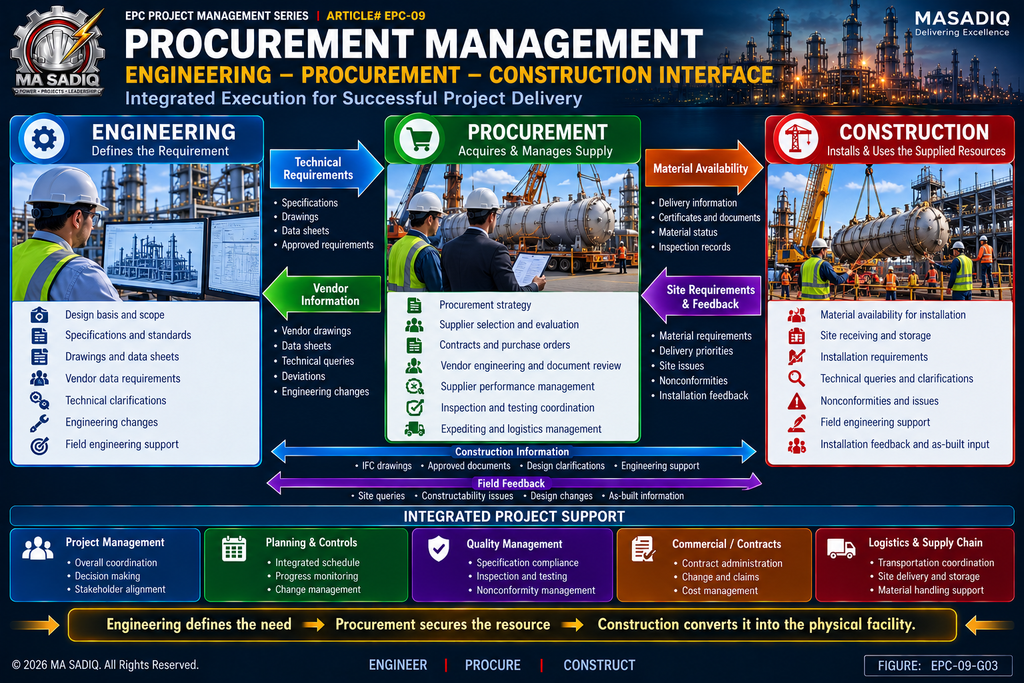
Figure EPC-09-G03 — Engineering–Procurement–Construction Interface
✅ 25. PROCUREMENT CLOSEOUT & KNOWLEDGE TRANSFER
Procurement closeout marks the transition from active supplier management to the completed and formally closed procurement record.
Physical delivery alone does not necessarily mean that procurement is complete. Outstanding documentation, commercial matters, warranty information, quality records, or other contractual obligations may still require resolution.
25.1 When Is Procurement Ready for Closeout?
Depending on the procurement, closeout may require confirmation that:
- Required goods, equipment, or services have been delivered;
- Required inspections and tests have been completed;
- Outstanding nonconformities have been resolved or formally dispositioned;
- Required technical documentation has been received;
- As-built or final vendor documents have been submitted where applicable;
- Warranty information has been received;
- Spare parts and special tools have been delivered where applicable;
- Commercial obligations have been completed;
- Outstanding claims or disputes have been resolved or appropriately transferred;
- Final payments or account reconciliation have been completed;
- Required procurement records have been retained.
The exact closeout criteria should follow the applicable agreement and project procedures.
25.2 Final Supplier Documentation
Supplier documentation can remain outstanding long after physical delivery.
Depending on the procurement package, final records may include:
- Approved drawings
- Final datasheets
- Test certificates
- Inspection records
- Material certificates
- Certificates of conformity
- Operation and maintenance manuals
- Spare-parts information
- Warranty certificates
- Calibration records
- Final vendor documentation
These records may later be required by Construction, Commissioning, Operations, Maintenance, Quality, or the Owner.
25.3 Commercial Closeout
Commercial closeout may include:
- Final account reconciliation
- Confirmation of completed scope
- Settlement of approved changes
- Resolution of outstanding claims
- Final invoices
- Release of applicable retentions or securities
- Confirmation of contractual obligations
- Closure of the Purchase Order or agreement
Commercial closeout should be coordinated with the responsible Commercial and Contract Management functions.
25.4 Supplier Performance Evaluation
Where required, the project or organization may evaluate the supplier’s overall performance.
Evaluation criteria may include:
- Technical performance
- Quality
- Delivery
- Responsiveness
- Documentation
- Commercial compliance
- Change management
- Problem resolution
- Overall supplier performance
Such information can support future supplier selection and organizational knowledge.
25.5 Lessons Learned
Procurement closeout provides an opportunity to capture lessons from the procurement lifecycle.
Useful questions include:
- Was the procurement strategy effective?
- Was the requirement sufficiently defined?
- Was the supplier appropriately selected?
- Were delivery dates realistic?
- Were vendor documents received as planned?
- Were quality requirements effective?
- What caused delays?
- Which supplier-management practices worked well?
- What should be changed on future projects?
Lessons learned should be captured while the experience remains accessible to the project team.
25.6 Knowledge Transfer
Procurement knowledge may need to be transferred to:
- Operations
- Maintenance
- Engineering
- Construction
- Commissioning
- Commercial/Contracts
- Project Controls
- Future project teams
This may include supplier contacts, warranty requirements, technical documentation, spare-parts information, unresolved obligations, and relevant lessons learned.
25.7 Procurement Records
The completed procurement record should provide an auditable history of the acquisition.
Depending on the project, the record may contain:
Requirement → Solicitation → Evaluation → Award → Supplier Execution → Inspection → Delivery → Changes → Claims → Closeout
Proper records support future audits, warranty administration, operational requirements, commercial reviews, and lessons learned.
25.8 Closeout Is a Controlled Transition
A procurement package should not simply disappear from the project team’s active tracking system after delivery.
Closeout should provide a controlled transition from:
Active Procurement → Completed Procurement → Project Records / Operations / Knowledge Base
This ensures that important information and obligations are not lost during project completion.
Procurement closeout is complete when the physical, technical, quality, commercial, contractual, and documentation obligations of the procurement have been appropriately completed, resolved, or formally transferred.
👨💼 26. ROLE OF THE PROCUREMENT MANAGER
The Procurement Manager plays a central role in translating the project’s procurement strategy into controlled and measurable procurement execution.
The exact responsibilities vary by organization, project structure, contract model, and delegation of authority. The Procurement Manager does not necessarily own every procurement-related activity, but is typically responsible for coordinating and managing procurement activities within the assigned scope.
26.1 Procurement Planning
The Procurement Manager contributes to establishing the procurement approach by coordinating:
- Procurement requirements
- Procurement packages
- Procurement schedules
- Sourcing strategies
- Supplier identification
- Procurement priorities
- Long-lead requirements
- Procurement risks
The objective is to ensure that procurement activities are planned early enough to support project execution.
26.2 Procurement Execution
During procurement execution, the Procurement Manager may coordinate:
- Solicitation activities
- Supplier communications
- Bid administration
- Technical and commercial evaluation interfaces
- Negotiation
- Agreement/PO award
- Supplier onboarding
- Procurement records
The Procurement Manager should ensure that the approved procurement process is followed and that required approvals are obtained.
26.3 Supplier Management
Following award, the Procurement Manager may coordinate supplier performance management covering:
- Vendor engineering
- Manufacturing progress
- Supplier documentation
- Expediting
- Inspection interfaces
- Delivery
- Commercial compliance
- Supplier issues
- Corrective actions
This requires continuous coordination with Engineering, Quality, Planning, Logistics, Construction, Commercial, and Project Management.
26.4 Procurement Schedule Management
The Procurement Manager should maintain visibility of procurement milestones and their relationship to the overall project schedule.
Particular attention should be given to:
- Critical procurement packages
- Long-lead items
- Engineering release
- Vendor document milestones
- Manufacturing milestones
- Inspection
- Shipment
- Site delivery
A procurement delay should be communicated early enough for the Project Team to evaluate its potential project impact.
26.5 Procurement Risk Management
The Procurement Manager contributes to identifying and managing risks associated with:
- Supplier capability
- Delivery
- Quality
- Market availability
- Long-lead items
- Logistics
- Technical requirements
- Commercial conditions
- Supplier changes
Risk information should be integrated with the project’s broader risk-management process.
26.6 Procurement Change and Claims Coordination
Procurement changes, supplier requests, and potential claims should be identified and coordinated with the appropriate functions.
Depending on the organizational structure, the Procurement Manager may work closely with:
Engineering + Commercial + Contracts + Planning + Quality + Project Management
to establish the technical, schedule, commercial, and contractual implications.
26.7 Procurement Reporting
The Procurement Manager should provide management with reliable visibility of procurement status.
Reporting may cover:
- Procurement package status
- Award status
- Supplier performance
- Vendor engineering
- Manufacturing
- Inspection
- Expediting
- Delivery
- Procurement risks
- Changes
- Claims
- Recovery actions
The emphasis should be on decision-useful information, rather than simply producing large volumes of status data.
26.8 Cross-Functional Leadership
Procurement is inherently cross-functional.
The Procurement Manager therefore needs to maintain effective interfaces with:
- Project Manager
- Engineering Manager
- Project Controls
- Quality Manager
- Construction Manager
- Logistics
- Commercial/Contracts
- Finance
- Suppliers and subcontractors
Strong coordination helps prevent functional decisions from creating unintended project-level consequences.
26.9 Procurement Governance
The Procurement Manager should also support compliance with:
- Procurement procedures
- Delegation of authority
- Approval requirements
- Evaluation processes
- Contractual controls
- Ethical requirements
- Documentation and records requirements
The Procurement Manager should ensure that procurement actions are appropriately authorized and traceable.
26.10 Procurement Leadership Mindset
An effective Procurement Manager should look beyond the immediate transaction.
Instead of asking only:
“Has the order been placed?”
the focus should extend to:
“Will this supplier deliver the required scope, quality, documentation, and equipment when the project needs it—and are emerging problems being addressed early?”
That mindset shifts procurement from transaction administration to project-delivery support.
The Procurement Manager’s role is to ensure that procurement activities remain aligned with project requirements, supplier performance is visible and controlled, and external acquisition supports the project’s overall delivery objectives.
☑️ 27. PRACTICAL PROCUREMENT MANAGEMENT CHECKLIST
The following checklist provides an EPC Project Manager with a practical high-level review of procurement readiness and performance. It is not intended to replace the project’s approved procurement procedures, contractual requirements, or detailed functional checklists.
Procurement Planning & Strategy
- ☐ Procurement requirements are clearly identified.
- ☐ Procurement packages are appropriately defined.
- ☐ Procurement strategy is established and approved.
- ☐ Make-or-buy decisions are addressed where applicable.
- ☐ Critical and long-lead items are identified.
- ☐ Procurement milestones are integrated with the project schedule.
- ☐ Procurement risks are identified and addressed.
- ☐ Responsibilities and approval authorities are clear.
Requirements & Solicitation
- ☐ Technical requirements are sufficiently defined.
- ☐ Scope boundaries and interfaces are clear.
- ☐ Applicable codes and standards are identified.
- ☐ Quality and inspection requirements are established.
- ☐ Required vendor documentation is defined.
- ☐ Delivery requirements are clear.
- ☐ Appropriate RFI/RFP/RFQ or other solicitation approach is selected.
- ☐ Bid documents provide an adequate basis for supplier responses.
Supplier Selection
- ☐ Potential suppliers are appropriately identified.
- ☐ Prequalification is completed where required.
- ☐ Supplier capability and capacity are assessed.
- ☐ Technical evaluation is completed.
- ☐ Commercial evaluation is completed.
- ☐ Selection criteria are appropriate to the procurement.
- ☐ Deviations and exceptions are identified and evaluated.
- ☐ Source-selection recommendation is properly documented and approved.
Award & Contract/PO
- ☐ Scope is clearly established before award.
- ☐ Technical and commercial requirements are aligned.
- ☐ Delivery milestones are agreed.
- ☐ Inspection and testing requirements are incorporated.
- ☐ Vendor-document requirements are incorporated.
- ☐ Terms and conditions are agreed.
- ☐ Required approvals are obtained.
- ☐ Contract/PO is formally issued.
Vendor Engineering & Execution
- ☐ Vendor document schedule is established.
- ☐ Vendor engineering progress is monitored.
- ☐ Technical queries and deviations are controlled.
- ☐ Engineering interfaces are actively managed.
- ☐ Manufacturing progress is monitored.
- ☐ Supplier performance is supported by objective evidence.
- ☐ Recovery actions are initiated when required.
Inspection & Quality
- ☐ Inspection and Test Plan is established where applicable.
- ☐ Required inspections are completed.
- ☐ Testing requirements are satisfied.
- ☐ FAT is completed where applicable.
- ☐ Nonconformities are properly managed.
- ☐ Required quality records are available.
- ☐ Release for shipment is appropriately authorized.
Expediting & Logistics
- ☐ Procurement milestones are tracked.
- ☐ Supplier delivery forecast is current.
- ☐ Expediting is focused on critical risks.
- ☐ Shipping documentation is complete.
- ☐ Transportation arrangements are coordinated.
- ☐ Customs/regulatory requirements are addressed where applicable.
- ☐ Site readiness is confirmed.
- ☐ Preservation and storage requirements are established.
Receipt & Traceability
- ☐ Delivered quantities are verified.
- ☐ Equipment/material identification is confirmed.
- ☐ Physical condition is checked.
- ☐ Required certificates and documentation are received.
- ☐ Traceability requirements are maintained.
- ☐ Damaged or nonconforming items are controlled.
- ☐ Receipt status is clearly communicated to Construction.
Performance, Risk & Change
- ☐ Procurement performance is measured against approved baselines.
- ☐ Critical procurement risks are monitored.
- ☐ Supplier performance is regularly reviewed.
- ☐ Forecast delivery dates remain aligned with project requirements.
- ☐ Procurement changes are formally assessed and approved.
- ☐ Commercial impacts are evaluated.
- ☐ Potential claims are identified early.
- ☐ Contractual notices and records are maintained where required.
Closeout
- ☐ Required deliveries are complete.
- ☐ Outstanding technical issues are resolved or formally dispositioned.
- ☐ Final vendor documentation is received.
- ☐ Warranty information is available.
- ☐ Final commercial matters are addressed.
- ☐ Claims/disputes are resolved or appropriately transferred.
- ☐ Supplier performance is recorded.
- ☐ Lessons learned are captured.
- ☐ Procurement records are complete and retained.
The EPC Project Manager’s Final Check
Before considering a critical procurement package successfully delivered, ask:
Is the required item or service technically compliant, contractually aligned, quality-assured, properly documented, physically available, and ready to support the next stage of project execution?
If the answer is yes, procurement has moved beyond buying and has fulfilled its real project-delivery purpose.
🔑 28. KEY TAKEAWAYS
Effective procurement management is much more than issuing purchase orders. In an EPC project, it is the disciplined management of external acquisition from requirement definition through supplier selection, execution, delivery, and closeout.
The key principles are:
- Start with a clear requirement.
Procurement performance depends heavily on the clarity and completeness of the technical and commercial requirement. - Treat procurement as a lifecycle.
Planning, sourcing, award, supplier execution, delivery, performance management, change, and closeout are interconnected. - Select the procurement approach to fit the project.
There is no universal procurement strategy, delivery method, or contract type suitable for every situation. - Do not equate lowest price with best value.
Technical compliance, quality, schedule, supplier capability, risk, contractual conditions, and overall project consequences also matter. - Manage suppliers after award.
Vendor engineering, manufacturing, inspection, expediting, logistics, and delivery require active monitoring. - Integrate Procurement with Engineering and Construction.
Procurement succeeds when technical requirements become compliant, documented, and usable resources for project execution. - Control changes and claims.
Changes to requirements, supplier proposals, commercial conditions, and delivery commitments should be evaluated and managed through appropriate processes. - Use governance without creating unnecessary bureaucracy.
Authority, transparency, accountability, ethics, and appropriate documentation protect the project and its stakeholders. - Measure what matters.
Procurement progress should provide meaningful visibility of supplier performance, critical milestones, risks, and forecast outcomes. - Close the loop.
Procurement is not complete simply because an item has been delivered. Technical documentation, quality records, commercial obligations, warranties, claims, and lessons learned must also be addressed.
The Central Message
Procurement is not simply buying materials. It is the disciplined management of external acquisition that connects project requirements to reliable execution.
For an EPC Project Manager, the ultimate measure of procurement effectiveness is whether the project receives the right requirement, from an appropriate source, with the required quality and documentation, at the required time, under an appropriate commercial and contractual framework.
💬 29. DISCUSSION QUESTION
In your EPC project experience, which procurement challenge has the greatest downstream impact—unclear requirements, supplier selection, late vendor information, manufacturing delays, quality issues, logistics, or uncontrolled changes—and what practical approach helped you manage it effectively?
🌱 Learn → Share → Grow
🏁 CONCLUSION
Procurement is one of the most important execution disciplines within an EPC project because it transforms project requirements into the equipment, materials, services, and external resources needed to deliver the project.
Effective procurement begins well before a Purchase Order is issued. It starts with understanding the requirement, establishing an appropriate procurement strategy, evaluating make-or-buy alternatives, identifying suitable suppliers, conducting a controlled solicitation and selection process, and establishing clear contractual obligations.
It continues through vendor engineering, supplier performance management, inspection and testing, expediting, logistics, delivery, material receipt, change management, claims administration, and final closeout.
For the EPC Project Manager, procurement must therefore be viewed as an integrated project-delivery function, not merely a purchasing activity.
The ultimate objective is simple:
Right Material. Right Quality. Right Time. Right Cost.
Achieving that objective requires disciplined planning, informed source selection, effective supplier management, strong Engineering–Procurement–Construction interfaces, appropriate governance, and continuous attention to project risk and execution requirements.
When procurement is managed as a complete lifecycle, it becomes more than a transactional function.
It becomes a strategic bridge between engineering intent and successful project execution.
GLOSSARY — KEY PROCUREMENT TERMS
Approved Vendor List (AVL)
A controlled list of suppliers that have satisfied defined organizational or project requirements for inclusion, where such a system is used.
Bid Evaluation
The structured assessment of seller responses against established technical, commercial, quality, schedule, and other applicable criteria.
Buyer
The organization or party acquiring goods, services, or results from an external source.
Contract
A mutually binding agreement establishing obligations between parties, subject to the applicable legal and contractual framework.
Expediting
The monitoring and follow-up of supplier activities to identify progress issues and support timely delivery.
FEED
Front-End Engineering Design — an engineering stage used in many projects to develop the selected concept to a level sufficient to establish and mature the technical basis for subsequent execution. Its exact scope and relationship to Basic Engineering vary by project and contract model.
Inspection & Test Plan (ITP)
A document defining applicable inspection and testing activities, requirements, responsibilities, and control points for a procurement or manufacturing scope.
Make-or-Buy Analysis
An evaluation of whether a requirement should be fulfilled internally or obtained from an external source.
Procurement
The broader project-management process for acquiring goods, services, or results from external sources and managing the related agreements.
Procurement Management Plan
A project document describing how procurement activities will be planned, conducted, monitored, and controlled.
Purchase Order (PO)
A type of agreement used to establish requirements and commercial terms for the acquisition of specified goods or services.
RFI
Request for Information — a solicitation generally used to obtain information from the market or prospective suppliers.
RFP
Request for Proposal — a solicitation requesting a seller’s proposed solution, approach, and associated commercial response to defined requirements.
RFQ
Request for Quotation — a solicitation generally used to obtain pricing and related commercial information for a sufficiently defined requirement.
Seller / Supplier / Vendor
An external party providing goods, services, equipment, or other results to the buyer. The precise terminology may vary by organization and contract.
Source Selection
The process of evaluating potential sellers and selecting an appropriate source using established criteria and the applicable procurement approach.
Vendor Engineering
Technical development and documentation performed by a supplier to satisfy the requirements of an equipment or service procurement package.
Vendor Document Requirement List (VDRL)
A controlled list identifying technical and other documents that a supplier is required to submit, together with applicable submission requirements and milestones.
📚 REFERENCES
- Project Management Institute (PMI). A Guide to the Project Management Body of Knowledge (PMBOK® Guide) — Eighth Edition. PMI, 2025. Appendix X4 — Procurement
This appendix provides the principal PMI foundation for the procurement-management concepts discussed in this article.
- EPC Practice
Additional EPC-specific concepts discussed in this article—including vendor engineering, expediting, detailed inspection and testing practices, logistics, material receipt and traceability, and Engineering–Procurement–Construction interfaces—represent practical EPC execution practices and should not be interpreted as individual PMI-defined procurement processes unless explicitly identified as such.
NEXT IN SERIES
EPC-10 — Construction Management
From Design to Execution.
After establishing how project requirements are sourced, contracted, manufactured, inspected, and delivered, the next article moves into the next major EPC execution discipline:
Construction Management.
It will explore how approved engineering information, procured resources, contractors, construction activities, site interfaces, productivity, quality, HSE, and execution controls are brought together to transform the project design into a completed physical facility.
🌱 Learn → Share → Grow
Knowledge becomes more valuable when it is shared.
This article is part of the MASADIQ EPC Project Management Series.
👨💼 ABOUT THE AUTHOR
Engr. Muhammad Akram Sadiq is a Senior Electrical Engineer and Project Management Professional (PMP®) with over 30 years of international experience in engineering, construction, commissioning, operation & maintenance, instrumentation & control, and project management.
Throughout his career, he has contributed to major power generation, transmission substations, and industrial infrastructure projects with a strong focus on technical excellence, leadership, quality, safety, and continuous improvement.
Through his professional brand MA SADIQ, he is committed to transforming practical engineering experience into structured knowledge that empowers engineers, project professionals, and future leaders to achieve engineering excellence.
🏗️ ABOUT THE EPC PROJECT MANAGEMENT SERIES
The MASADIQ EPC Project Management Series is a structured educational publication developed to provide engineers, project managers, students, and industry professionals with practical knowledge covering the principles and practices of EPC project management.
Each article explores a specific EPC topic, progressing systematically from foundational concepts to advanced project-management practices while emphasizing practical experience, professional excellence, leadership, and continuous learning.
The series aims to bridge the gap between project-management principles and the realities of engineering, procurement, construction, commissioning, and project delivery.
⚠️ DISCLAIMER
This publication is intended solely for educational and professional development purposes.
Although every effort has been made to ensure the accuracy and usefulness of the information presented, project requirements, engineering codes, standards, contractual frameworks, market conditions, regulations, and management practices may vary and are periodically revised.
Readers should always consult the latest official editions of relevant publications, applicable legislation, client specifications, contractual requirements, organizational procedures, and project-specific requirements before applying any information to engineering or project-management activities.
The examples and recommendations presented in this article are intended to support professional learning and constructive discussion. They should not be considered a substitute for project-specific engineering, commercial, financial, legal, regulatory, or management judgment.
The views expressed are those of the author and are intended to promote professional learning and constructive discussion.
— THE END —